

By Nelson Ayivor
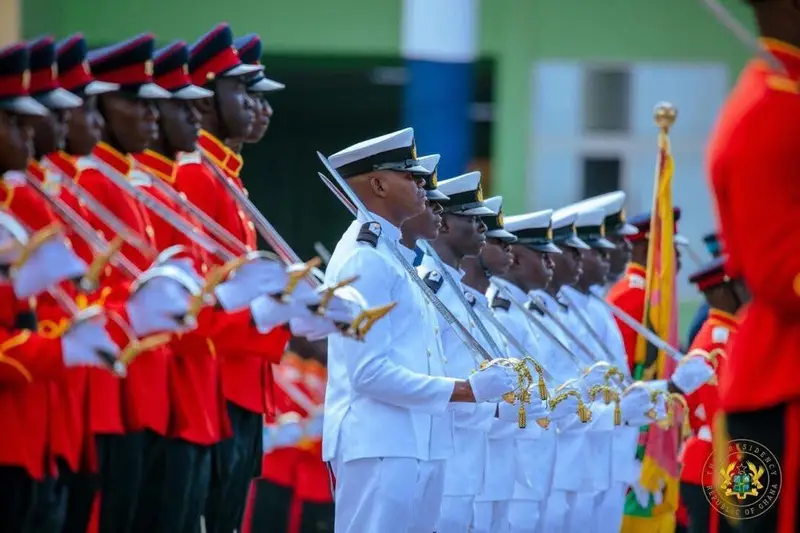
The President of Ghana and Command-in-chief, John Dramani Mahama, has commissioned 263 officer cadets into the Ghana Armed Forces, reaffirming the state’s commitment to national security, professionalism, and democratic governance amid evolving regional and global threats.
The commissioning ceremony took place at the Ghana Military Academy and marked the successful completion of rigorous military training by cadets drawn from the Regular Career Course 64, Short Service and Special Duties Intake 62.
President Mahama recalled that the previous graduation parade had been attended by several senior officers, including a former Minister of Defence, who later lost their lives in the August 6, 2025, tragic helicopter crash.
He led the gathering in prayers for their peaceful repose, describing their loss as a reminder of the sacrifices associated with military service while expressing gratitude to God for the opportunity to once again join the Academy community at such a significant milestone.
Addressing the parade, the President praised the discipline and professionalism displayed by the graduating cadets, noting that their precision and confidence reflected months of demanding training and personal sacrifice.
“The precision, confidence, and bearing of the 263 Officer Cadets on parade today reflect months of rigorous training and personal sacrifice. The crisp drills, coordinated movements, and prompt execution of commands testify to the high standards of leadership and instruction offered at this academy.”
He commended the military high command, the Commandant of the Academy, and the entire instructional staff for their dedication in transforming civilians into officers prepared to serve the Republic.
According to him, the drills and coordinated movements witnessed at the parade were clear evidence of the high standards of leadership and instruction that define the Academy’s ethos of service, devotion, and sacrifice.
President Mahama acknowledged the challenges of commissioning officers during a period of limited resources, but emphasized that government remained determined to maintain a capable and resilient Armed Forces.
He said such resolve was necessary to confront the complex security challenges confronting Ghana and the wider sub-region. He described the current security environment as volatile, citing violent extremism, terrorism, and transnational crime as persistent threats, particularly along Ghana’s northern borders.
Rise of Non-State Actors and Asymmetric Warfare
Beyond national borders, the President noted that the rise of non state actors and asymmetric warfare had altered the nature of global security threats. These realities, he said, demand a comprehensive and coordinated national response.
He stressed that security should not be seen as the sole responsibility of the Armed Forces and security agencies, but as a shared national duty requiring the active participation of citizens, communities, traditional authorities, civil society, and government institutions.
He urged all Ghanaians to remain vigilant and security-conscious in safeguarding the peace and stability of the nation. The President also highlighted Ghana’s long standing contribution to international peace support operations.
He recalled that Ghana first participated in a United Nations mission in the Republic of Congo in 1960 and has since maintained a consistent presence in global peacekeeping.
“Today, Ghana is among the leading troop-contributing countries to the United Nations’ peacekeeping missions. Our men and women serve with distinction in 15 missions worldwide under the United Nations, the African Union, and the ECOWAS.”
Ghanaian personnel, he said, continue to earn international respect for their professionalism, discipline, and respect for human dignity in missions ranging from Lebanon and South Sudan to Libya and Somalia.
President Mahama assured that transparency, fairness, and merit would continue to guide the selection of personnel for peace support operations, ensuring that only the most qualified officers represent Ghana abroad.
He further noted Ghana’s leadership in gender inclusion in peacekeeping, pointing out that female participation in formed units and staff positions exceeds United Nations targets. This, he said, demonstrates Ghana’s commitment to equity and operational excellence.
GAF’s Respect for Constitutional Rule
Turning to domestic governance, the President underscored the Ghana Armed Forces’ respect for constitutional rule and democratic authority. In a region that has experienced unconstitutional changes of government, he said Ghana’s military has remained firm in defending democracy, civilian oversight, and the rule of law.
The graduating cadets, he told them, were inheriting this proud tradition and must uphold it with honour, courage, and integrity in service to the country and its cherished citizens.
In a symbolic gesture, President Mahama noted that over the years he had addressed the Academy in ceremonial uniforms representing the Army, Navy, and now the Air Force, as a mark of respect to all branches of the Armed Forces. He paid tribute to the men and women of the Air Force for their tireless efforts in keeping the country safe.
Addressing the cadets directly, the President reminded them that leadership is not about rank or privilege, but about responsibility, service, and sacrifice. He urged them to lead with integrity, show courage in adversity, demonstrate compassion in command, and inspire loyalty among those they lead.
“The path ahead of you will test you, but your training has prepared you very well to serve with pride and unwavering loyalty to Ghana. I congratulate all award winners and commend your excellence in leadership, academics, and military skills.”
President Mahama extended the gratitude of the government and people of Ghana to all graduating officers, saying “Long live the Ghana Armed Forces, long live our democracy, long live Ghana, and may God bless us all.”
By the authority vested in him as President of the Republic and Commander in Chief of the Ghana Armed Forces, President Mahama formally granted the President’s Commission to the graduating cadets, marking their transition from training to active service in defence of the nation.