

Love, Lies, and the Battle for NPP’s Soul
-Factionalism deepens in NPP as former minister launches personal and political broadside against leading flagbearer contender
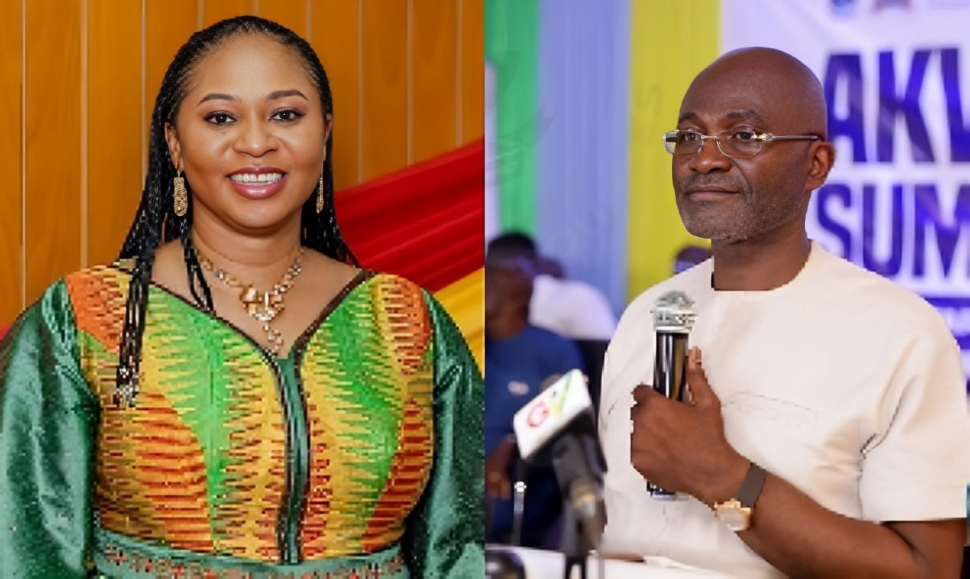
Former Gender Minister and Dome-Kwabenya MP Sarah Adwoa Safo has launched a scathing attack on New Patriotic Party (NPP) presidential hopeful Kennedy Agyapong, warning delegates particularly women against endorsing his candidacy ahead of the party’s January 2026 flagbearer elections.
In a series of public statements and viral video clips, Safo accused Agyapong her former partner and father of her two children of harbouring deep-seated contempt for women, citing personal experiences of verbal abuse and public humiliation.
Her intervention, while couched in personal grievance, signals a broader realignment within the NPP’s fractured post-2024 opposition landscape.
Safo’s remarks, delivered during a campaign event for Vice-President Mahamudu Bawumia, whom she now backs, were unusually direct. She recounted past episodes in which Agyapong allegedly insulted her character, questioned her loyalty to the party, and derided her family background.
“If he can speak this way about the mother of his children,” she told delegates, “imagine how he would treat women he has no ties to.”
The former minister warned that Agyapong’s record of inflammatory rhetoric would be weaponised by the opposition National Democratic Congress (NDC) should he secure the NPP nomination. “They will replay every insult, including those against me,” she said, “and it will cost us dearly.”
Safo’s endorsement of Bawumia is not without calculation. Once seen as a rising star in the party’s inner circle, her political fortunes waned following her controversial absenteeism from Parliament and Cabinet in 2022–2023.
Her re-emergence as a vocal Bawumia surrogate suggests a bid to rehabilitate her image and position herself for a future role possibly as a vice-presidential contender.
She dismissed speculation that her decision to back Bawumia was driven by personal animus, insisting that her choice was based on political pragmatism. “This is not about family and friends,” she said. “It is about the future of the party and the country.”
Safo’s intervention underscores the NPP’s ongoing identity crisis following its 2024 electoral defeat. She criticized the Akufo-Addo administration’s reliance on familial networks and blamed former Finance Minister Ken Ofori-Atta for the economic mismanagement that alienated voters. “Bawumia was not the Finance Minister,” she argued. “He was the driver’s mate, not the driver.”
Her comments reflect a growing narrative within the party that seeks to absolve Bawumia of responsibility for the economic downturn, while shifting blame to the President and his inner circle.
This narrative is central to Bawumia’s campaign, which positions him as a reformist outsider despite his central role in the previous administration.
Safo’s public rebuke of Agyapong one of the party’s most combative and populist figures risks deepening internal divisions. While her criticisms may resonate with segments of the party’s base, particularly women and urban professionals, they also expose the fragility of the NPP’s post-Akufo-Addo coalition.
Agyapong’s camp has yet to respond formally, but insiders suggest that Safo’s remarks are unlikely to go unanswered. With the flagbearer contest set for January 31, 2026, the NPP faces a bruising internal battle that could shape its viability as a national force in the 2028 general elections.