

By Nelson Ayivor
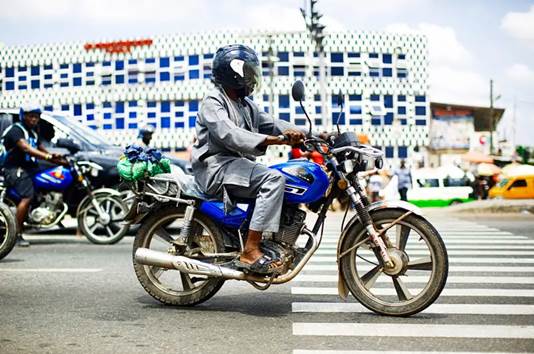
The recent passage of the Road Traffic Amendment Bill 2025, which legalizes commercial motorcycle operations (Okada), has opened a sharp and fundamental debate over Ghana’s developmental vision.
While Ibrahim Adjei, former Secretary to the Office of the former President, has strongly endorsed the bill as a pragmatic move that will “create jobs and bring order,” Political Commentator, Elvis Darko, has vehemently opposed the legislation, calling it an “admission of a systemic failure,” in national public transport policy.
Ibrahim Adjei urged the public to support the new law, arguing that its passage is a critical step toward regulating commercial motorcycle operations.
“The bill has been passed, and it is good. I think all of us need to support it because it will encourage Okada riders to work within the law. Until it was passed, riders were a law unto themselves, but now they can operate legally and create employment”
He offered context for the initial opposition from the New Patriotic Party (NPP), clarifying that the resistance was never against the concept of Okada but was rooted in genuine safety concerns over the “high rate of deaths involving Okada riders.”
Adjei stressed that the initial hold on legalization was motivated by the need to first address the regulatory framework and ensure that the necessary safety measures were in place. With the law now passed, Mr. Adjei asserted, the benefits of formalized accountability will become evident, particularly in a sector notorious for indiscipline and accident rates.
He emphasized that regulation instills discipline, makes riders identifiable, and accountable for their actions, which are crucial steps toward saving lives on Ghana’s roads.
Adjei stressed the importance of proactive government implementation and encouraged authorities to study the regulatory frameworks of other countries as reference points to ensure effective enforcement.
Systemic Failure and Backward Policy:
Despite Adjei’s stance, Elvis Darko based his opposition not solely on safety but on a comprehensive national development critique.
He described the legalization of commercial motorcycles as a policy that is inconsistent with Ghana’s stated aspirations to emulate the rapid development of the “Asian Tigers” like Malaysia, Singapore, and China.
Darko argued that while these successful economies focus on advanced public transport solutions – such as high-speed trains, trams, and buses – Ghana has resorted to legalizing a method of transport that signals a surrender to systemic failure.
“Legalizing okada is just an admission of a systemic failure that we failed to put in place good train systems, put in place good public transport systems through buses, trams – we are admitting that we are unable to do it and we don’t have a solution.”
He stressed that developed nations prioritize infrastructural advancement, while Ghana has chosen a policy that suggests the dream of advanced public transport is “only a dream – it won’t happen,” thereby lowering the national standard for transport infrastructure.
Darko further expanded his critique by attacking what he termed the national mentality of discarding fundamentally sound policies due to implementation challenges and mismanagement by officials. He used two prominent examples to illustrate this pattern of policy self-sabotage, citing the failed Sky Train project and the Savannah Accelerated Development Authority (SADA) project, both of which he argues are still viable projects that could transform the country, warning that the nation should not “throw away whole projects,” simply because the people in charge mess up executions or face implementation challenges.
Darko believes that by legalizing Okada, the government has admitted that it is unable and unwilling to find a solution to the systemic lack of efficient public transport, thereby regressing development goals instead of resolving the execution problems that have plagued past projects.
The debate, therefore, is ultimately about whether Ghana is reaching for the future or settling for the present.
The Road Traffic Amendment Bill 2025, which Parliament passed under a certificate of urgency, is expected to provide comprehensive regulation for the industry, including motorcycles, tricycles, and quadricycles used for commercial purposes.
The legislation also sets a new limit for the determination of alcohol concentration in drivers, aiming to reduce incidents of drunk driving and improve overall road safety.
However, the opposing views from Adjei and Darko reflect a deeper disagreement over whether the legalization represents progress through the formalization of a necessary informal economy, or regression through the surrender of national developmental goals.