

As Jihadist Threat Closes In
By Nelson Ayivor
John Dramani Mahama is betting heavily that traditional authority, not the security forces or the courts, will finally unlock Bawku’s intractable Kusasi-Mamprusi conflict.
By putting Otumfuo Osei Tutu II at the centre of the peace push, the presidency is signalling both its limits and its strategy: outsource the toughest political questions to the King of Ashanti while Accra grapples with rising jihadist threats on its northern flank.
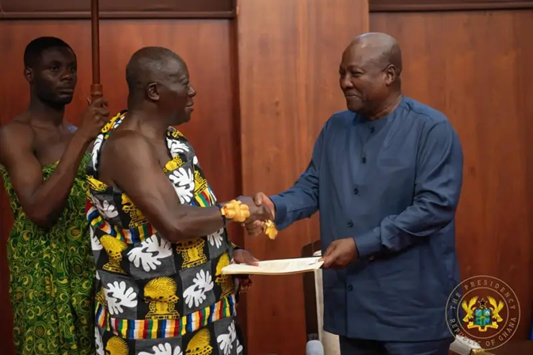
At Jubilee House, Mahama received the Asantehene’s long-awaited report on the dispute, describing it as a “turning point” in a conflict that has outlasted multiple administrations, security operations and government white papers.
The process, initiated under Nana Addo Dankwa Akufo-Addo, was deliberately insulated from partisan interference, insiders say, after years of mutual suspicion among Kusasi and Mamprusi leaders about the political leanings of successive governments.
Shortly after taking office, Mahama quietly travelled to Manhyia to secure Otumfuo’s continued engagement. Palace sources say the King insisted on broad discretion and time to “talk to everyone who matters” from royal courts and youth commanders to security chiefs before accepting to continue.
That insistence partly explains the length of the mediation but also its relative credibility on the ground.
Mediation, Not Verdict
Mahama went out of his way to underline that this was mediation, not arbitration no formal winners, no legal losers. That framing is crucial. Any state-backed “award” on who holds legitimate authority in Bawku would risk inflaming both chieftaincy and partisan tensions: Kusasi and Mamprusi elites are embedded in rival party networks, with each side long convinced that the other has friends in high places in Accra.
By emphasising reconciliation rather than adjudication, Mahama is trying to sidestep a zero-sum fight the security services admit they cannot police indefinitely.
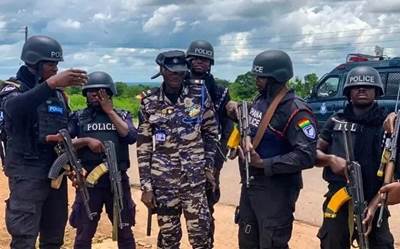
Senior officers privately concede that repeated troop deployments have only produced fragile lulls, with both factions re-arming and reorganising between curfews.
“This conflict cannot be won militarily,” Mahama said, echoing what the intelligence community has been telling the presidency for years.
Border Security Calculus
Bawku’s strategic position at Ghana’s northeastern tip, close to Burkina Faso and Togo, now looms larger in Accra’s calculations than at any point since the conflict escalated. National security briefings, officials admit, increasingly link a durable settlement in Bawku to Ghana’s wider counter-terrorism posture.
With jihadist groups consolidating in Burkina Faso and probing southern corridors, Bawku’s instability offers cover for illicit arms flows, recruitment and intelligence-gathering. Security sources say there is growing concern that local grievances land, chieftaincy and access to state resources could be exploited by regional militants if left to fester.
By wrapping the Bawku file more tightly into national security strategy, Mahama is also trying to build cross-party consensus: no government wants to be blamed for allowing a local chieftaincy dispute to open Ghana’s northern gateway to extremist networks.
Economic And Political Costs
The President’s lament about Bawku’s economic decline—teachers and doctors refusing postings, civil servants pulling out, national service halted—is not just social commentary. It is also a warning about the state’s shrinking footprint in a sensitive frontier zone.
Civil servants quietly complain that the area is becoming “ungoverned space” in all but name, with basic services interrupted and informal actors controlling key routes and markets.
Business leaders who once used Bawku as a staging post for trade into Burkina Faso and beyond now divert through safer corridors, adding to local resentment that the state has abandoned the town.
Mahama’s allies worry that continued instability could erode his government’s credibility in the Upper East Region, where expectations are high that a northern-born President and a more consultative approach would deliver where previous administrations failed.
### Outsourcing The Heavy Lifting
Although Mahama pledged to study the report and announce a government position within 24 hours, insiders say the real work is being deliberately pushed onto a broader coalition: the National Peace Council, the National House of Chiefs, religious leaders and, crucially, Otumfuo himself.
The presidency is keen that the Nayiri and the Bawku Naaba own any settlement, rather than appear to be cajoled by Accra. That means slow, painstaking follow-up with factional youth groups, business elites and diaspora financiers who have long bankrolled rival militias and court actions.
Mahama’s public praise for the Asantehene’s decision to read the report openly calling it an “honourable job” and an act of transparency also has a political edge.
By casting Otumfuo as a national asset “who does not belong to Ashanti alone,” he is reinforcing the King’s role as a supra-partisan fixer whose prestige can shield the government from direct blame if implementation proves bumpy.
High Stakes For All Sides
Failure would be costly. For Mahama, a stalled peace process would undercut his image as consensus-builder-in-chief and feed opposition claims that the government is weak on security.
For Otumfuo, it would dent the aura of infallibility that has made him the go-to mediator in some of Ghana’s thorniest disputes.
For Bawku’s residents, already paying the price in lost lives, livelihoods and services, another aborted peace push would deepen cynicism about both chiefs and politicians.
Mahama ended on an optimistic note, arguing that Ghana stands at a “critical juncture” where lasting peace in Bawku is finally within reach.
That optimism rests on a fragile equation: firm political will in Accra, sustained royal engagement in Kumasi and the north, disciplined security management along the border and buy-in from local actors who have profited from war far longer than they have tasted peace.