

By Nelson Ayivor
As part of efforts to sustain Ghana’s economic recovery, President John Dramani Mahama has reaffirmed his administration’s commitment to strict fiscal discipline, declaring that the ban on first-class travel by ministers and public officials remains firmly in force.
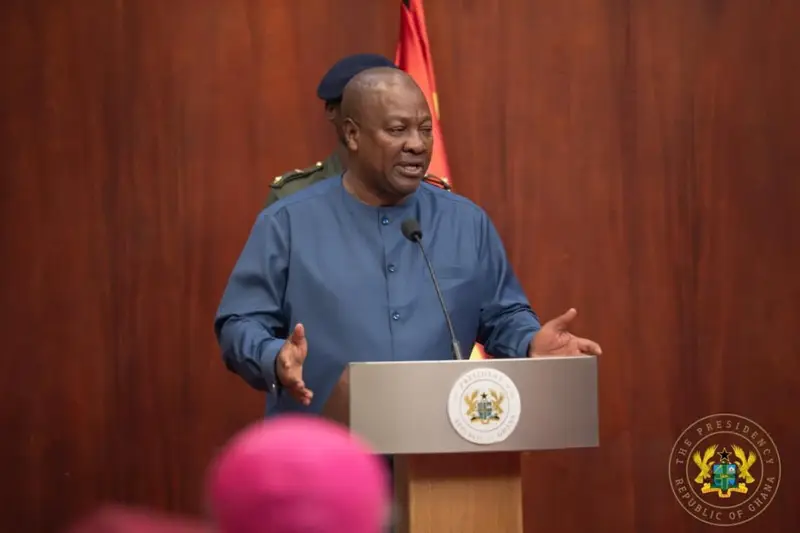
The President made this clear while addressing participants at the opening ceremony of the University of Ghana’s 77th Annual New Year School and Conference on Tuesday, January 6.
Speaking to an audience of policymakers, academics and development partners, President Mahama linked cost consciousness at the highest levels of government to the credibility of Ghana’s economic reform programme.
He said restoring confidence in the economy requires not only sound policies but also visible restraint in public sector conduct. According to him, leadership must demonstrate prudence if citizens are to trust that sacrifices are being shared fairly.
The President outlined key pillars of his administration’s economic strategy, including strengthening domestic revenue mobilisation, restoring fiscal discipline, rebuilding confidence in the financial sector and supporting indigenous enterprises to expand and create jobs.
He stressed that resilience cannot be achieved through austerity alone, arguing that production, inclusion and shared prosperity are essential to building a durable recovery.
President Mahama noted that Ghana is nearing the completion of its extended credit facility programme with the International Monetary Fund (IMF), a milestone he described as important but not an endpoint, emphasizing that commitment to fiscal discipline will continue even after the IMF programme concludes, as a means of safeguarding the gains achieved so far and preventing a relapse into instability.
To illustrate the seriousness of his government’s stance, the President recounted an incident involving air travel to Dubai that he said underscored the effectiveness of the first-class travel ban.
He explained that an acquaintance who had boarded a flight noticed he was the sole passenger seated in the first class cabin. Curious about the empty seats, the individual asked airline staff, who reportedly explained that the President of Ghana had prohibited ministers and public officers from travelling first class.
According to President Mahama, the explanation offered by the flight attendant confirmed that government officials were seated in business class in compliance with the directive. An anecdote which was a practical demonstration that the policy is being enforced across the public sector. The President added that the restriction applies regardless of whether an official believes they can personally afford the higher fare.
The President was unequivocal in his warning, stating that any public official who violates the directive will face sanctions, adding that discipline in public spending must be visible and consistent if government is to maintain moral authority while asking citizens to endure reforms and adjustments.
He framed the ban not as a symbolic gesture but as part of a broader effort to entrench a culture of accountability and modesty in public service.
President Mahama argued that such measures send an important signal to both domestic and international observers about Ghana’s seriousness in managing public resources.
For him, fiscal discipline at the top helps reinforce confidence among investors, development partners and financial institutions, all of whom closely monitor governance practices alongside economic indicators.
Beyond the travel policy, the President reiterated his administration’s focus on supporting indigenous businesses as a pathway to inclusive growth, observing that local enterprises play a critical role in job creation and value addition, and that rebuilding confidence in the financial sector is essential to ensuring they have access to affordable credit. According to him, economic recovery must translate into tangible opportunities for Ghanaians if it is to be sustainable.
The President also underscored the importance of domestic revenue mobilisation, describing it as a cornerstone of fiscal sovereignty, adding that reliance on borrowing alone exposes the economy to external shocks, while a strong domestic revenue base provides the flexibility needed to invest in social services and infrastructure without compromising stability.
The Annual New Year School and Conference, hosted by the University of Ghana, serves as a platform for reflection on national development challenges and policy direction.
President Mahama said such forums are vital for fostering informed debate and aligning national priorities with evidence based research. He praised the university for sustaining the tradition and contributing to policy discourse.
As Ghana continues its recovery from recent economic turbulence, the President said consistency in policy implementation and conduct will be crucial.
He maintained that fiscal discipline must be a shared ethic across government, not a temporary response to crisis. The continuation of the first-class travel ban, he said, is one of several measures intended to institutionalize restraint and signal a break from practices that undermine public confidence.
President Mahama concluded by urging public officials to embrace the spirit behind the directive and to see personal sacrifice as part of the responsibility of leadership.
He said the success of Ghana’s economic reset depends as much on attitudes and behaviour as it does on technical reforms, adding that discipline today lays the foundation for shared prosperity tomorrow.