

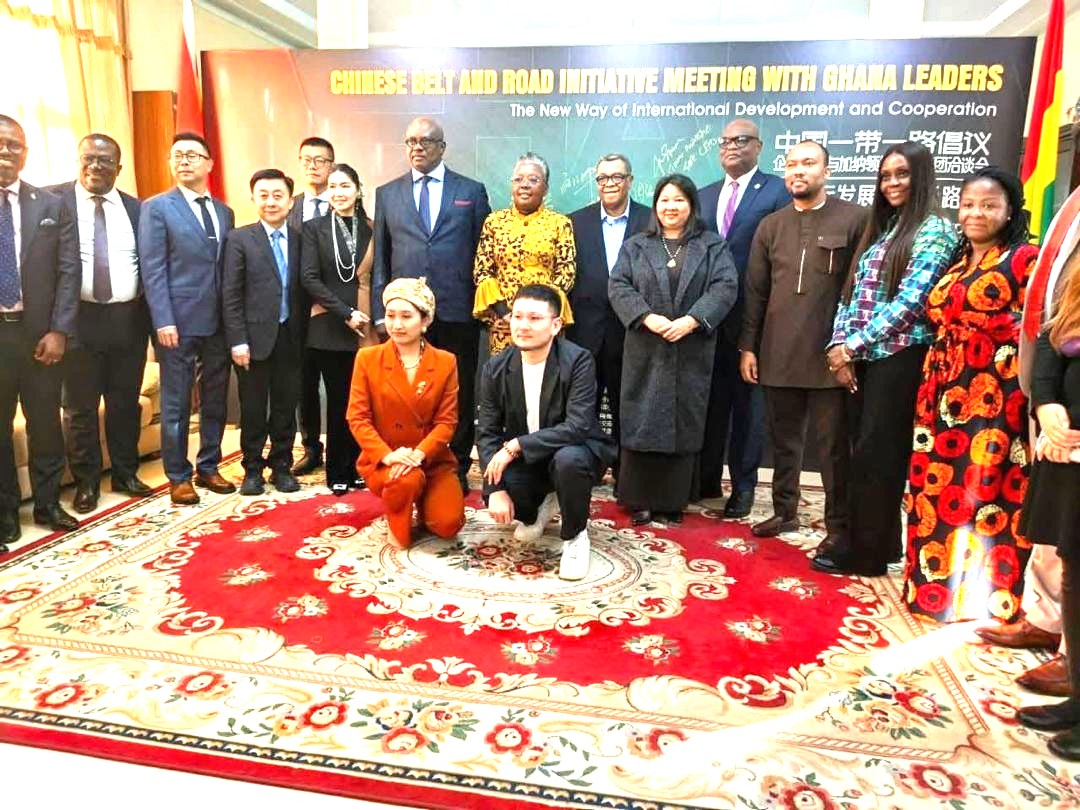
In a calculated move blending economic diplomacy with technological ambition, a high-powered Ghanaian delegation led by Mr. Simon Madjie (Esq.), the sharp-elbowed CEO of the Ghana Investment Promotion Centre (GIPC), is currently navigating the corridors of power and innovation in China.
Dubbed the ’24H+ mission’, this is no mere courtesy call. Insiders describe it as a targeted offensive to recalibrate Ghana’s relationship with its largest trading partner, shifting from raw material exports to a complex partnership in the defining technology of this century: Artificial Intelligence.
The mission, sanctioned at the highest levels of government, has a multi-pronged agenda that reads as a blueprint for President John Mahama’s renewed “Ghana Is Open For Business” doctrine.
The delegation is engaging with top Chinese political, financial, and technological institutions. The goal is not just to attract capital, but to decode the Chinese model itself. A source close to the delegation told Africa Confidential, “It’s about understanding the engine room how Chinese governance, policy discipline, and cultural drivers align to produce their economic miracles. We are not copying; we are learning to contextualise.”
While securing investment for traditional sectors like infrastructure, energy, and agribusiness remains a key objective, the mission’s signature pursuit is the hunt for AI partnerships. Madjie, a lawyer known for his strategic mind, is pushing a bold vision: applying Chinese AI research and computational power to guide Ghana’s economic planning.
This involves potential collaborations in smart agriculture, predictive infrastructure maintenance, and public sector digitisation. The aim is to leapfrog developmental stages, using data as the new strategic resource.
“This is a Simon Madjie special,” a finance ministry official commented. “He’s selling Ghana not just as a destination for factories, but as a laboratory for AI-driven solutions tailored to African contexts. The Chinese have the tech and the scale; we have the real-world challenges and the strategic intent.”
The trip underscores a strategic pivot in Ghana’s foreign economic policy under the Mahama administration. It seeks to deepen the Ghana-China relationship beyond its current asymmetry, advocating for a “knowledge-led, mutually beneficial” framework. However, analysts warn of inherent tensions.
“The gamble is significant,” said Dr. Ama Serwah, an economist at the University of Ghana. “Can Ghana negotiate the transfer of genuine technical expertise and ownership, or will we merely become data providers and consumers of Chinese technology? The ‘mutually beneficial’ part is what Madjie’s team must nail in those closed-door meetings.”
The delegation’s success will be measured not in signed MOUs alone, but in the quality of the partnerships secured. Can they secure commitments for local AI capacity-building and research centres, or will the gains be confined to hardware and software imports? The mission also arrives amidst a global scramble for AI influence, with China keen to expand its digital Silk Road footprint.
The government’s active promotion of the mission on social media, flagged with the President’s hashtag, signals its political importance. It is a clear statement that the administration is proactively seeking non-traditional tools for economic management. For Mr.
Simon Madjie, the stakes are personal and professional. Returning with a portfolio of vague understandings will not suffice. He needs deals that demonstrate tangible progress towards an AI-augmented economy, proving that Ghana can indeed play in the premier league of the Fourth Industrial Revolution.
The outcomes of this 24H+ mission will provide the first concrete evidence of whether this high-tech vision can move beyond political sloganism into the realm of transformative policy.