

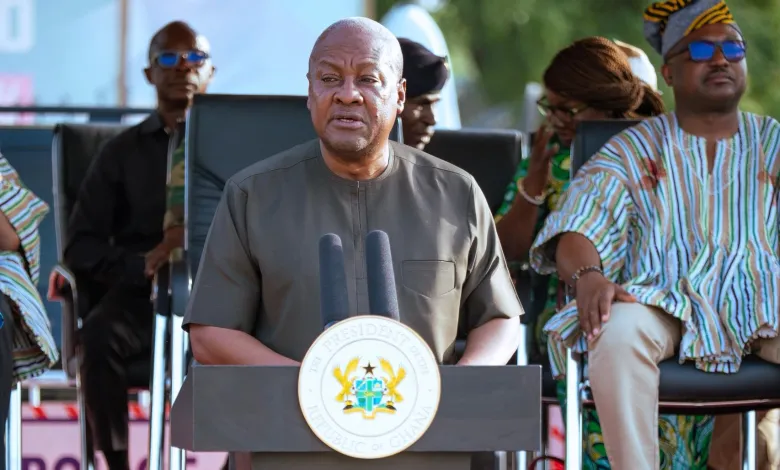
President John Dramani Mahama has announced a novel, if contentious, funding mechanism to bankroll a new airport for Wa, the capital of the Upper West Region, seeking to leverage a proposed national tax on air travel to fulfill a long-standing regional infrastructure promise.
During the launch of the SheaPark Resource Hub in Wa, Mahama confirmed that a new airport for the city would proceed, financed by the Airport Infrastructure Levy Bill soon to be presented to Parliament.
The levy, which would apply to all domestic, international, African, and ECOWAS regional flight tickets, is designed to create a ring-fenced fund for airport development nationwide, with Wa positioned as the immediate priority.
“Now that money is going to go into a fund, and that fund is going to be used to develop the airports around the country,” Mahama stated, directly linking the new tax to the Wa project.
A Shift in Site and Strategy
The announcement signals a strategic shift. The President cited severe limitations at the existing Wa airport, where logistical compromises such as a public road diverted around the runway make expansion impossible.
He revealed that the Ghana Airports Company Limited (GACL) has already identified and assessed an alternative site allocated years ago, with officials having recently visited for planning purposes.
This move suggests the government is abandoning attempts to upgrade the current facility in favor of a greenfield project, a more expensive but potentially more transformative approach.
The new airport is framed as a catalyst for improved connectivity, economic growth, and tourism in one of Ghana’s most remote regions.
The proposed Airport Infrastructure Levy represents a significant policy innovation, creating a dedicated revenue stream for aviation capital projects. Proponents argue it provides a sustainable, transparent model for funding critical infrastructure without overburdening the central treasury, which is strained by debt and other fiscal demands.
However, the plan is fraught with political and economic risk. The levy will effectively increase the cost of all air travel in Ghana.
This could provoke opposition from airlines, tourism operators, and passengers, particularly if the economic benefits are perceived as distant or unequally distributed.
The success of the fund hinges on robust collection mechanisms and strict parliamentary oversight to prevent diversion for other purposes.
Furthermore, the decision to champion Wa’s airport through this mechanism is politically symbolic. It reinforces Mahama’s commitment to northern development a core constituency and offers a tangible, high-profile project ahead of the 2028 election cycle.
Yet, it also raises expectations in other regions that will now demand their share of the airport fund, setting the stage for complex inter-regional competition.
The Wa airport project, backed by the new levy, underscores the government’s focus on using infrastructure to integrate peripheral regions into the national economy. A functional airport in the Upper West could enhance the region’s shea, agricultural, and tourism value chains, potentially justifying the investment.
However, analysts caution that airports alone are not economic panaceas. Their viability depends on concurrent investments in feeder roads, hospitality services, and local economic activity to generate sustainable passenger and cargo traffic.
The government will need to ensure the Wa project is part of a cohesive regional development plan, not an isolated white elephant.
The passage of the Airport Infrastructure Levy Bill will be the first major test. It will reveal parliamentary appetite for sector-specific taxes and the strength of the government’s coalition.
If successful, it could establish a new template for funding national infrastructure. If it fails or faces severe public backlash, the future of the Wa airport and perhaps the government’s broader infrastructure-led development strategy will be thrown into doubt.