

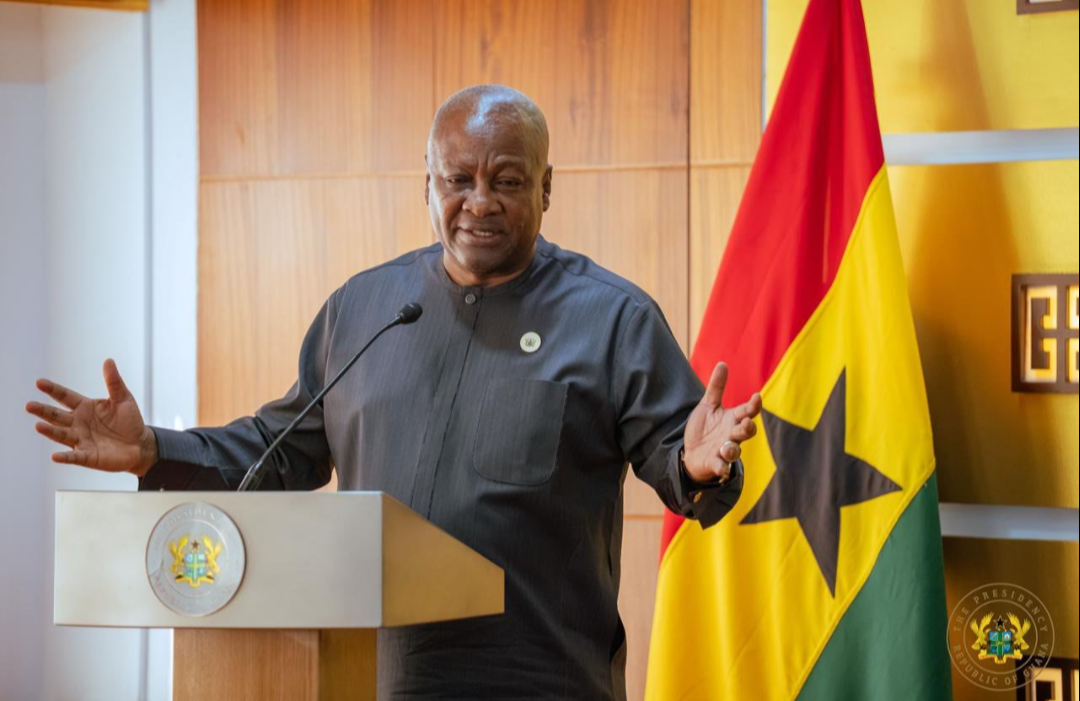
President John Dramani Mahama has reaffirmed his government’s commitment to restoring lasting peace and accelerating development in Bawku, stressing that the rule of law remains the only sustainable path to resolving protracted conflicts.
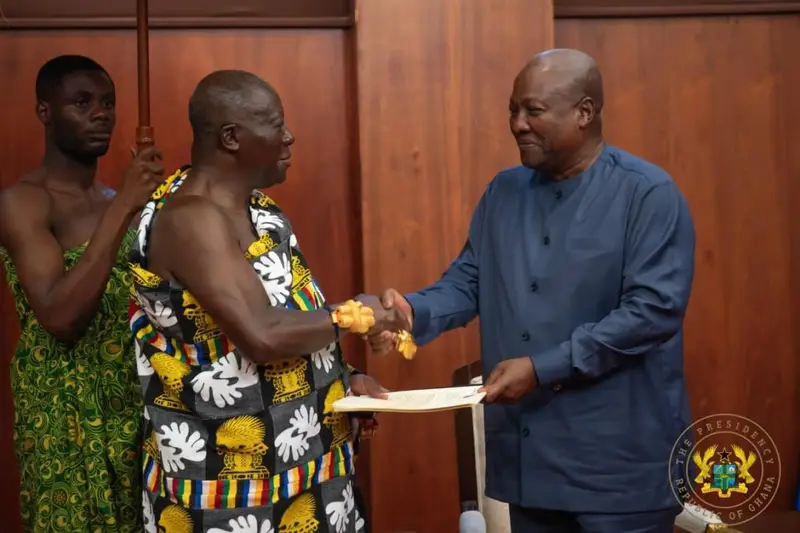
He made the remarks during a courtesy visit by the Upper East Regional House of Chiefs at the seat of government, where discussions focused on security, reconciliation, and development in conflict-affected areas of the region.
The President acknowledged that although relative calm is gradually returning to Bawku, the situation remains fragile. He recalled that mediation efforts led by the Otumfuo Committee were initiated under his predecessor, former President Nana Addo Dankwa Akufo Addo, and formally handed over to him during the transition.
“And so as his successor, I was duty-bound to allow that mediation to go on, and I want to thank Otumfuo again for the role that he played in mediating the conflict.”
He noted with concern that violence persisted during the mediation period, with an estimated 119 lives lost, underscoring the depth and complexity of the conflict. According to him, the mediation sought a traditional resolution that would allow the conflicting parties to accommodate each other, as had been done in the past.
However, when that approach failed to produce a consensus, the mediator had no choice but to fall back on the law. The President emphasized that the final report of the mediation clearly outlined the lawful position on the Bawku chieftaincy.
No Parallel Claims to the same Stool
He stated that as President, having sworn an oath to uphold the Constitution and laws of Ghana, he could not act on sentiment or political pressure. He reiterated that the legally gazetted Bawku Naba is Naba Asigri Abugrago Azoka II and that the law does not permit parallel claims to the same stool.
“The law is the law,” President Mahama said, stressing that peace cannot be built on ambiguity or selective enforcement of legal decisions. He warned that allowing rival claims outside the law would plunge not only Bawku but the entire country into chaos.
Drawing parallels with other chieftaincy disputes, the President referenced the Bolgatanga chieftaincy matter, which has been adjudicated by the Judicial Committee. He maintained that once such bodies deliver decisions, they must be implemented without resistance.
According to him, no individual has the authority to reject lawful rulings and impose themselves as rival chiefs, as such actions undermine the foundations of order and governance.
President Mahama noted that similar conflicts have emerged in other parts of the country, including Sampa and Sunyani, where succession disputes followed the death of long reigning chiefs.
He added that beyond chieftaincy, land and boundary disputes continue to fuel tensions in many communities. In all cases, he stressed, violence only deepens divisions and delays solutions.
“But in all this, we must recognise that violence does not solve the problem. Because we no longer live in the jungle where it’s survival of the fittest, and that the strongest is the one who rules.
“You can fight as long as you want. It will not solve the issue, and so we must always go by the law or go by arbitration or go by mediation. Those are the only options left to us.”
He cautioned that armed conflict between ethnic groups cannot eliminate any community and only leads to unnecessary loss of life. He further reminded the gathering that modern international law prohibits genocide and that perpetrators of such crimes would face justice.
The President stressed that peace is a prerequisite for development and that without stability, government investments cannot yield meaningful benefits for the people. In a major development initiative, the President announced the establishment of a one billion Ghana cedi Bawku Restoration Fund aimed at accelerating development in the area.
The fund, to be disbursed over three years, will target the six districts that make up the Bawku area. Planned investments include roads, health facilities, educational infrastructure, irrigation dams, and income-generating projects.
President Mahama explained that the Minister of Finance Dr Cassiel Ato Forson has been appointed chair of the fund’s governing committee to ensure the timely release of resources. Other members include the Majority Leader in Parliament and MP for Bawku Central, Hon. Mahama Ayariga, who represents the area, among key stakeholders.
“The one billion is to be disbursed over a three-year period. And so they will identify what the projects are, where the projects should be. And the funds will be allocated. It will go through procurement. Contracts will be awarded. And people will start working on the projects for the Bawku Restoration Fund.”
Welcoming the Upper East Regional House of Chiefs, the President described the visit as deeply symbolic, likening it to parents checking on a son who has moved into a new home.
He expressed gratitude for the support, prayers, and blessings he received from traditional leaders during the election campaign, noting that their role in mobilizing communities remains invaluable. President Mahama reaffirmed his government’s recognition of chiefs as critical partners in governance, conflict resolution, and local development.
He commended them for their efforts in maintaining peace and assured them of continued collaboration and support to improve their working conditions. According to him, only through sustained peace and mutual respect can development and prosperity reach the people of Bawku and the wider Upper East Region.