

By Leo Nelson
Asharami Ghana, a subsidiary of Nigeria-based Sahara Group, has vowed to position Ghana as the primary gateway for liquefied petroleum gas (LPG) distribution in West Africa.
Through aggressive infrastructure development and strategic maritime investments, Asharami Ghana intends to leverage Ghana’s coastal advantage to catalyze a regional green transition.
This initiative aligns with broader efforts to decarbonize the sub-region while establishing a robust logistical corridor that ensures clean energy is both accessible and affordable for millions of households and industries across the continent.
The strategy centers on a multi-modal approach that integrates shipping, high-capacity storage, and downstream coordination to mitigate the supply volatility often found in the West African energy market.
“By improving shipping reliability and storage depth, Ghana can support cleaner energy access beyond its borders. With our sustained investments in the sector, we are enabling more reliable supply beyond Ghana’s borders and supporting intra-African energy trade. This integrated capacity reduces supply volatility in inland markets and supports the expansion of clean cooking adoption across West Africa.”
A cornerstone of this vision is the deployment of the MT Asharami Ghana gas vessel, a dedicated asset designed to improve shipping reliability and streamline the movement of fuel from international markets to local shores.
By expanding its storage depth most notably through a 12,000-metric-tonne LPG terminal currently under development in Tema the company is building a “logistics anchor” that will serve as a buffer against global price shocks.
This infrastructure does not only serve domestic needs; it is explicitly engineered to support landlocked neighbors, including Burkina Faso, Mali, and Niger, which traditionally struggle with consistent energy access due to geographical and logistical constraints.
The development of the Tema LPG terminal represents a significant leap in Ghana’s industrial capacity. With a 6,000-metric-tonne first phase scheduled for commissioning later this year, the facility will dramatically increase the nation’s “storage depth,” allowing for larger bulk imports and more efficient distribution cycles.
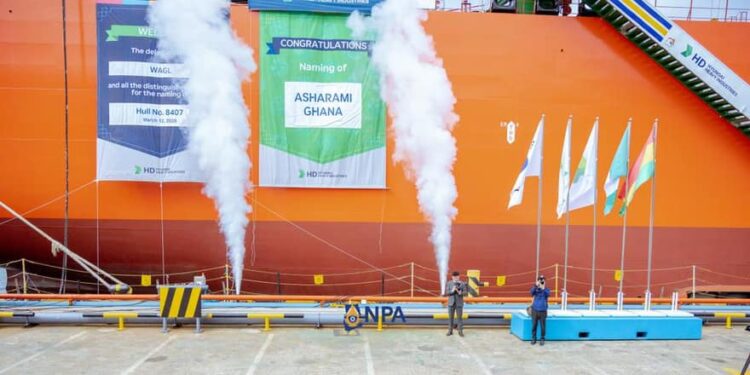
Managing Director of Ashrami Ghana, Yaa Serwaa Alifo, emphasized that the company is “building integrated LPG infrastructure” to ensure that the transition to cleaner fuels is not hindered by technical bottlenecks.
This move is a practical application of the African Continental Free Trade Area (AfCFTA) objectives, using energy system integration as a tool to deepen intra-African trade.
By serving as a transit point for the sub-region, Ghana effectively reduces the carbon footprint of its neighbors, who might otherwise rely on more pollutive fuels like charcoal or kerosene due to the lack of LPG availability.
The project also places a heavy emphasis on human capital. Beyond the physical steel and concrete of the terminals, Asharami Ghana is focusing on “capacity building and skills transfer” across vessel operations and safety systems.
By committing to hire Ghanaians for the operations of both the vessels and the terminal, the company is embedding global best practices within the local energy sector.
This ensures that the green transition is inclusive, providing high-skilled employment opportunities and fostering a domestic workforce capable of managing complex energy ecosystems.
If fully realized, this regional energy hub agenda will offer Ghana significant macroeconomic advantages. By becoming the primary distribution point for West Africa, the country stands to see an increase in service-related revenue through port charges, transit fees, and terminal handling costs.
Furthermore, a consistent and voluminous supply of LPG can lead to economies of scale that lower the unit cost of fuel for Ghanaian consumers and industries. This promotes “industrialisation and inclusive growth,” as affordable energy is a prerequisite for manufacturing and small-scale enterprise development.
As the country becomes a net exporter of energy services to its neighbors, it strengthens its trade balance and increases its influence over regional energy policy.
The move toward LPG also carries profound public health benefits; the expansion of “clean cooking adoption” reduces respiratory illnesses associated with traditional biomass fuels, which currently place a heavy burden on Ghana’s healthcare system and economic productivity.
The shift toward an LPG-led energy model is a critical component of the “green transition” in the West African context.
While the global north focuses on electrification, for many African nations, the immediate priority is transitioning away from wood-fuel and charcoal, which drive rapid deforestation.
By facilitating a “resilient regional LPG ecosystem,” Asharami Ghana is actively protecting the region’s carbon sinks. The MD noted that their broader ambition is to support “clean cooking” on a scale that can meaningfully impact the environment and social well-being.
As the terminal in Tema nears its phase-one completion, the eyes of the region are on Ghana.
The successful execution of this project will demonstrate that private sector investment, when aligned with national strategic goals and regional trade frameworks like AfCFTA, can provide the necessary momentum for a sustainable energy future.
Ghana’s trajectory as a “regional gateway” is no longer just a policy ambition; it is becoming a tangible reality through the integration of maritime logistics and massive onshore storage capabilities.