

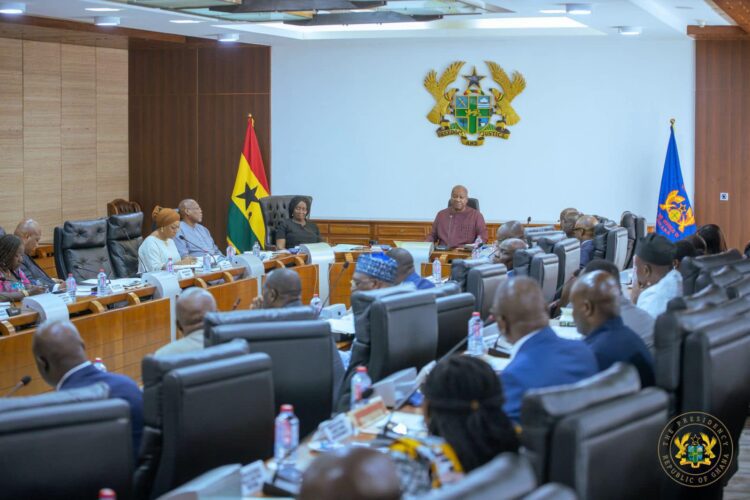
The government has announced a set of emergency measures aimed at reducing the burden of rising fuel prices on Ghanaians, following a high level Cabinet meeting chaired by President John Dramani Mahama.
The decision comes at a time when global oil market disruptions have pushed domestic fuel prices to record levels, intensifying pressure on households and businesses.
Speaking after the meeting, Felix Kwakye Ofosu, Presidential Spokesperson and Minister of Government Communications, confirmed that Cabinet has directed the Ministers of Finance and Energy to ensure a reduction in fuel prices in the next pricing window.
This will be achieved through the suspension of selected taxes and margins, with details expected to be announced in the upcoming pricing review. According to the government, the suspension will be implemented for an initial period of four weeks.
According to Kwakye Ofosu, the decision will be subject to review depending on developments in global crude oil prices and the evolving geopolitical situation in the Middle East.
Officials say the intervention is designed to provide immediate relief while maintaining flexibility to respond to changing conditions.
The emergency meeting was convened in response to recent tensions involving the United States, Israel, and Iran, which disrupted global oil supply chains and drove crude oil prices above 100 dollars per barrel.
This surge translated into sharp increases at the pumps in Ghana, where new price floors took effect on April 1, 2026. Petrol rose by about 15 percent to a minimum of GH¢13.30 per litre, while diesel increased by approximately 19 percent to GH¢17.10 per litre.
Although a conditional ceasefire announced on April 8 has led to a decline in global oil prices, the impact on domestic fuel prices remains gradual. Brent crude has fallen to around 94.80 dollars per barrel, offering some indication that the upward pressure on local prices may begin to ease.
Government officials note, however, that the situation remains uncertain and requires continuous monitoring. Beyond tax adjustments, Cabinet has also introduced measures targeting the transport sector, which has been significantly affected by rising fuel costs.
Deployment of 100 Newly Acquired Metro Mass Transit Buses
The Minister for Transport has been directed to accelerate the deployment of 100 newly acquired Metro Mass Transit buses across major routes. These buses are expected to complement existing fleets and provide more affordable travel options for commuters.
Authorities have further been instructed to ensure that fares on these buses remain lower than those charged by private operators. The move is intended to prevent excessive fare increases and to offer some level of stability for passengers who have faced rising transportation costs in recent weeks.
Enforcement of No Fuel Allowance to Appointees
Officials describe the intervention as part of a broader effort to manage the ripple effects of fuel price increases across the economy. In addition to these measures, Cabinet has reinforced a directive requiring all ministers and senior government appointees to strictly comply with the cancellation of fuel allocations and allowances.
The decision, introduced by President Mahama, is aimed at reducing government expenditure and demonstrating shared sacrifice during a period of economic pressure.
Government sources have also sought to reassure the public about fuel availability. Ghana currently holds strategic reserves of more than 200 million litres of petrol and 150 million litres of diesel, which are expected to sustain the country for approximately two months.
This assurance is intended to ease concerns about potential shortages while the government implements its response measures. The latest actions build on earlier steps taken to stabilise the fuel market, including the suspension of a proposed increase in the energy sector levy.
Officials say the combined effect of these interventions is to protect consumers while ensuring that the energy sector remains functional.
Economic analysts suggest that the government’s approach reflects a balance between short term relief and long term sustainability. While the suspension of taxes and margins is expected to reduce fuel prices in the immediate term, analysts note that the durability of the relief will depend on global oil market trends and domestic fiscal capacity.
For many Ghanaians, the coming weeks will be critical in determining whether these measures translate into tangible reductions in fuel and transport costs. The government has indicated that it will continue to assess the situation and adjust its policies as necessary to support economic stability.
The emergency Cabinet session highlights the extent to which global events can quickly influence domestic economic conditions. As Ghana responds to the current challenges, the focus remains on ensuring affordability, maintaining supply security, and safeguarding the broader economy against external shocks.