

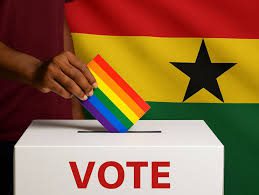
The current debate around the Human Sexual Rights and Family Values Bill is a political strategy. Both parties have weaponized the situations surrounding it to drive attention toward it.
In 2024, the ruling party, NPP, after numerous failed attempts, did not sign the bill, while the NDC, spearheaded by Sam George, pushed it forward for its campaigns. Though the NDC’s victory cannot be reduced to a single issue, the bill formed part of their electoral advantage. After the election, the bill remains unsigned, and the public attention around it has intensified continuously.
Earlier in the week, the Minority accused the Mahama administration of reversing course. Addressing journalists, Rev. Fordjour alleged that the President and his administration had secured electoral victory on the back of strong public advocacy for the bill, only to retreat from that position after assuming office.
The accusation reconstructed the climate of the 2024 campaign, where the bill operated as a signal of national commitment. He described it as “grand deception,” a disconnect between campaign rhetoric and governance decisions. If political messaging during the campaign relied on moral urgency, then the shift after the election invites scrutiny of intent and consistency across both sides.
In another interview, Rev. Ntim Fordjour argued that failure to sign the bill contributed to NPP’s electoral defeat. He said, “If the President had signed the bill, we would have served the nation better and it would have even enhanced the image of my party.” “I dare say that the outcome of the 2024 elections would have been different,” he added.
This claim redirects attention to a counterfactual outcome and places electoral loss within a single decision point. A different reading suggests a different political context on the basis of multiple economic, and political factors rather than a single legislative issue.
The bill operated within an electoral calculated move where parties sought understanding across diverse groups, where one side was allowed to consolidate sentiment while placing the other within a narrowing field of response.
The NDC, now in government, has adjusted its posture as the bill continues to draw attention beyond Parliament. The withdrawal of an honorary award to John Dramani Mahama by Lincoln University over his stated position on LGBTQ issues brings the debate into an international and institutional setting.
The LGBTQI issue transcends the domestic politics of Ghana to international body. The significance of the withdrawal lies in its implications rather than the award itself as political decisions can produce external consequences for partnerships, and credibility. Reactions to the decision also reveal a divide in interpretation.
For some, it reinforces the need to defend local values without external pressure. For others, it raises concerns about how Ghana’s political direction is viewed globally. Though the President has affirmed his stance, the issue still draws much from the international bodies.
The Minority has also raised concerns about educational content, accusing the government of introducing LGBTQ-related material into the curriculum. The claim centers on definitions of gender identity as a person’s internal experience, which may not correspond with assigned sex at birth, and the suggestion that gender includes male, female, or a combination of both.
This position invites debate on whether such definitions are significant to evolving academic perspectives or represent a departure from established norms within Ghanaian society.
The argument poses questions of authority, interpretation, and the role of education in shaping social understanding. A closer examination of political conduct complicates these accusations.
While in office, the handling of the bill followed a pattern of extended procedure without conclusion. Deliberation continued within institutional channels, accompanied by legal and administrative justification, nonetheless, no decisive action followed.
The absence of resolution did not prevent the issue from remaining active in public discourse. In opposition, the same delay is presented as failure, recast as evidence of retreat rather than caution. The direction in interpretation is based on the influence of political positioning on public judgment as opposition sharpens critique.
From Campaign Rhetoric to Governance Reality and Policy Choices
In 2024, Sam George framed opposition to LGBTQ recognition as a central campaign concern, presenting it with urgency and clarity. In government, there could be a difference in dissemination of communication. Felix Ofosu Kwakye stated, “this is not an issue, it is a waste of time,” redirecting attention toward socioeconomic priorities. This has raised concerns though in practice, he has a valid point as the fuel pricing and others have drawn attention.
At the same time, Sam George has maintained its significance and emphasized how it remains a national priority.
“To those who say we have other priorities, this is a priority for us. This is a priority for us. Any country worth its salt can deal with multiple priorities at the same time.”
The divergence in emphasis within the same administration create tension in public communication and raise questions about coherence and agenda direction.
Senegal and Burkina Faso have taken firmer legislative positions within these stakes of debates. Ghana occupies a different space, shaped by deeper engagement with international partners whose positions on LGBTQ issues diverge from prevailing local attitudes. This contrast places the decision over the bill within a broader calculation that extends beyond parliament.
Signing the bill would project decisiveness and respond to segments of domestic opinion that have demanded action, strengthening claims of representation and political legitimacy. It could also introduce new pressures, particularly in diplomatic and economic relations. Refusal or continued delay preserves room for negotiation and protects external interests, yet risks reinforcing public perceptions of inconsistency and weakening trust in political commitments.
The future of the bill therefore rests less on stated conviction and more on how far either side is willing to convert political advantage into binding action.