

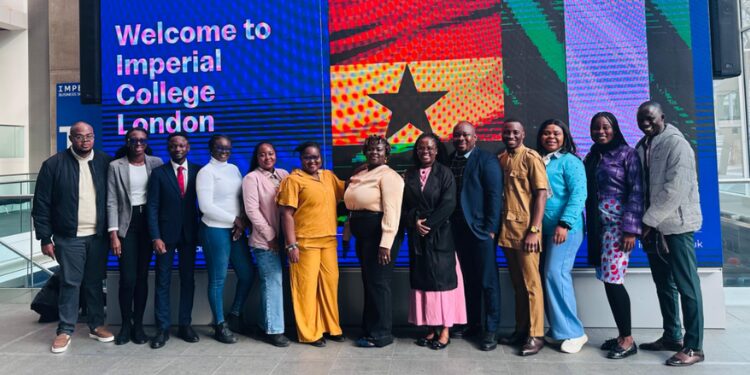
Journalists from Ghana and Nigeria have been equipped with advanced tools, practical exposure, and specialist training to strengthen their ability to communicate complex scientific developments to the public following an intensive programme hosted at Imperial College London.
The training programme, funded by the UK government through the Science Granting Councils Initiative, forms part of broader Science, Technology and Innovation collaboration strategies between the UK and West African partners.
Participants were selected through a competitive story-pitch process, ensuring that only journalists with demonstrated interest and potential in science reporting were chosen. Those selected travelled to London for four days of structured engagement that combined laboratory visits, expert-led workshops, and professional media training sessions focused on strengthening both technical understanding and storytelling skills.
Earlier preparatory workshops held in Abuja and Accra provided foundational instruction to a wider group of journalists, introducing key principles of science communication, research literacy, and evidence-based reporting.
The London-based segment of the programme built upon that foundation, offering participants direct exposure to cutting-edge scientific environments and encouraging them to develop story ideas rooted in local relevance and impact within their home countries.
The experience was structured not only as an academic exercise but as a professional development opportunity aimed at strengthening the capacity of media practitioners to interpret and communicate emerging scientific advancements. By embedding journalists within research environments, the programme sought to bridge the gap between scientific communities and the public, ensuring that complex developments are conveyed with clarity, accuracy, and contextual relevance.
Jamie Proctor, Head of the West Africa Research and Innovation Hub at the Foreign, Commonwealth & Development Office indicated that strong science journalism can translate complex research and innovation into real world impact. He added that“by investing in the skills of journalists in Ghana and Nigeria, we are supporting more informed public debate, stronger evidence‑based policymaking, and deeper public trust in science.”
“This programme reflects the UK’s commitment to long term partnerships that strengthen local capacity while fostering closer scientific collaboration between the UK and West Africa. It also demonstrates how UK institutions and expertise can play a catalytic role in supporting high‑quality science communication that benefits both the region and the UK.”
Beyond capacity building, the program is positioned as a mutual benefit mechanism, facilitating information sharing, collaborative storytelling, and the amplification of research outcomes with regional and global implications.
Strengthening Partnerships, Communication, and Public Trust in Science
Manager at Imperial College London, explained that for a global research university like Imperial, “working closely with journalists is vital to telling our story and bringing cutting-edge science and research to the public from medical breakthroughs to the realities of climate change and the promise of emerging technologies.”
“This programme helps strengthen science journalism in Ghana and Nigeria, while also shining a spotlight on the significant contributions of our African researchers and students, and the growing partnerships we have formed across the continent. Through this initiative, we want to build lasting connections that deliver impactful, globally relevant science storytelling to audiences across Ghana and Nigeria.”
Moreover, Aseosa Uwagboe-Anuna, Head of Communications at the British High Commission in Abuja, highlighted the importance of building journalistic capacity to ensure that scientific information is conveyed accurately and responsibly.
She noted that strengthening the knowledge and skills of journalists across Nigeria and Ghana plays a critical role in ensuring that scientific advances are communicated in ways that serve the public interest. This includes improving the clarity, reliability, and contextual relevance of reporting, particularly when dealing with complex or rapidly evolving scientific developments.
She also pointed to the wider achievements of the initiative in empowering journalists to produce high-quality science stories, enhancing collaboration across the region, and amplifying African perspectives within global discussions on research and innovation.
This reflects a growing recognition of the importance of ensuring that African voices and experiences are represented in science communication, particularly as research increasingly addresses challenges that directly affect local communities.
The project is also in line with the UK government’s Plan for Change, which places a high priority on international collaborations meant to bolster evidence-based policymaking and increase public confidence in science.
This initiative helps create a more informed public realm where scientific knowledge may be better understood, critically assessed, and implemented in decision-making processes by investing in the professional development of journalists and encouraging cooperation across institutions.