

By Leo Nelson
More than half of Ghana’s district assemblies have failed a government-administered performance evaluation covering the 2024 fiscal year, Local Government Minister Ahmed Ibrahim has revealed, exposing deep weaknesses in local governance and service delivery across the country.
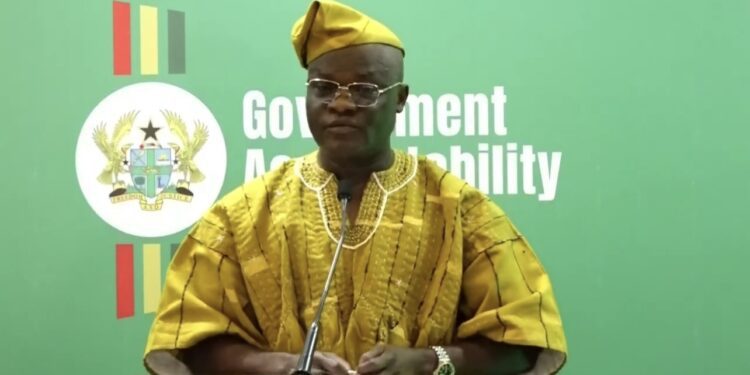
The Minister made the disclosure on Monday, April 20, while addressing the Government Accountability Series in Accra .According to the minister, the government assessed all 261 Metropolitan, Municipal and District Assemblies, commonly known as MMDAs, as part of a broader effort to measure how effectively local bodies are fulfilling their mandates. Of the 261 assemblies evaluated, 143 failed to meet the required standard while 118 passed. The pass mark for the exercise was set at 36 percent and still, more than half of Ghana’s local assemblies could not reach it.
The figures represent a significant governance challenge at the district level, where assemblies are expected to drive local development, manage public resources, and deliver essential services to communities.
A Lapse That Cost Ghana Its Donor
Ibrahim used the occasion to shed light on the circumstances that made the 2024 assessment particularly urgent. He revealed that the previous administration led by the New Patriotic Party conducted district assembly evaluations consistently up to 2022 but failed to carry out any such assessment for the year 2023 leaving a critical gap in Ghana’s decentralisation accountability framework.
That failure, the minister said, did not go unnoticed by Ghana’s international development partners, who had been providing financial and technical backing to support the country’s decentralisation agenda.
“Because of that, all the donor partners who were supporting Ghana’s decentralisation said if you can’t help yourself, we will not help you,” Ibrahim stated, describing how the missed evaluation directly triggered a withdrawal of donor confidence and support.
The consequences of that lapse, according to the minister, extended beyond funding. It damaged Ghana’s credibility with partners who viewed consistent self-assessment as a prerequisite for continued cooperation and investment in local governance reform.
Reset of Decentralisation Framework
Upon assuming office, President John Dramani Mahama moved quickly to address the gap. According to Minister Ibrahim, the president directed his ministry to conduct a full performance assessment covering the 2024 period, describing it as a foundational step toward restoring the integrity of Ghana’s decentralisation system.
The evaluation was completed in 2025 and was designed specifically to determine how well each assembly delivered on its core responsibilities and upheld accountability standards within its jurisdiction.Presenting the outcome of that exercise at the Government Accountability Series he mentioned that progress and achievemnt has been made.
“I am happy to announce to you that in 2025, we were able to reset the decentralisation concept of the district assemblies in 2024, and in the assessment, out of the 261 Metropolitan, Municipal and District assemblies, 143 of them failed and 118 of them passed. The passed mark was 36/100.”
The Minister described the results as a wake-up call for assemblies that fell short, stressing the urgent need for improvements in governance quality, administrative efficiency, and the direct delivery of services to citizens at the community level.
He added that the Mahama government would not allow evaluation lapses to recur, announcing that the administration is committed to strengthening monitoring and evaluation systems to ensure that the principles of decentralisation produce real, measurable development outcomes for Ghanaians in every district across the country.
The Government Accountability Series, where the minister made these disclosures, is an initiative aimed at holding public institutions and office holders to account on their performance at various sectors,the platform is dedicated to promoting transparency and accountability in the management of public institutions.
This 2024 performance audit serves as a baseline for the government’s new operational standards. Moving forward, the Ministry intends to use this data to identify specific areas of weakness and provide targeted support failing assemblies.