

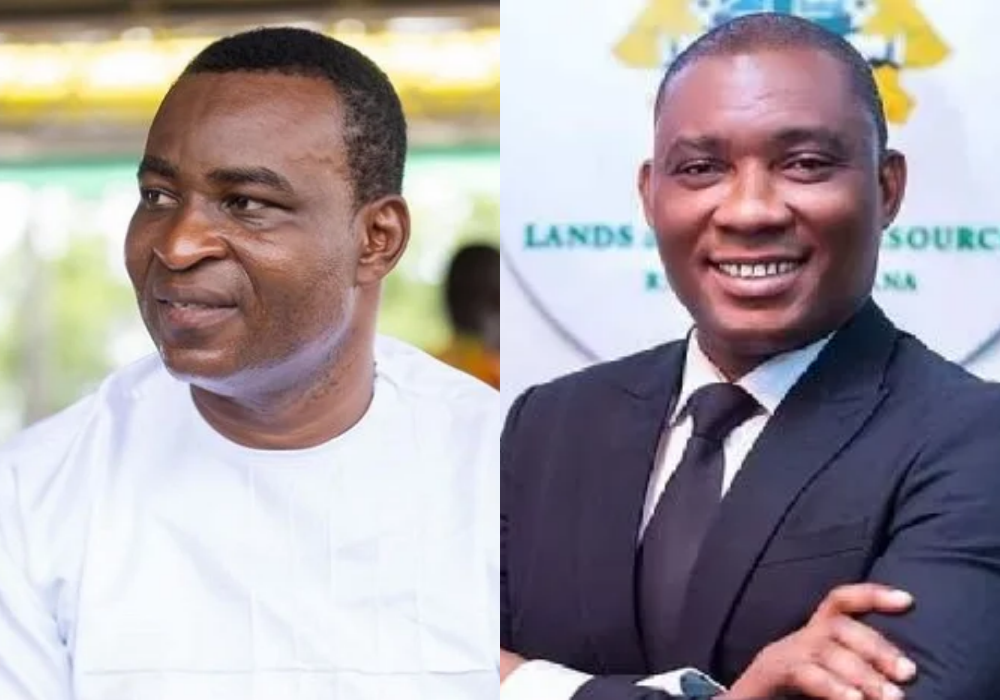
…as twin scandals close in on NPP kingpin
By Prince Ahenkorah
A former deputy minister has gone into the witness box to salvage the Ashanti NPP chairman from one criminal trial even as a second, far more damaging fraud case threatens to engulf the party’s richest grassroots operator. But his defence may already be holed below the waterline.
George Mireku Duker, who served as Deputy Minister for Lands and Natural Resources until 2024, appeared before the High Court this week as the second defence witness for Bernard Antwi‑Boasiako better known as Chairman Wontumi and his company, Akonta Mining.
The charge: illegally permitting two men to conduct mining operations on Akonta’s Samreboi concession without the required approvals.
Duker’s argument is lawyerly and narrow. Reclamation, he told the court, is not mining. Under Section 14 of the Minerals and Mining Act (Act 703), the transfer or assignment of mineral rights requires the minister’s written approval.
But filling holes and planting coconut trees “mine support services” do not. “If there is no written document to meet the dictates of Section 14,” Duker testified, “it becomes clear that there is no action at all.”
The prosecution, led by Deputy Attorney‑General Justice Srem‑Sai, was unsparing. The charge sheet does not mention “assignment.”
It says Wontumi permitted illegal mining. Duker admitted he had never met the prosecution witness Henry Okoom, nor witnessed any interaction between him and the accused. He conceded that no written approval for any reclamation activity on the concession had ever crossed his desk.
When pressed on whether Wontumi had personally told him that Okoom was engaged only for reclamation, Duker referred to a conversation at a Ministry awards event where the NPP chairman allegedly spoke of coconut plantations. The court’s temperature rose.
But the former deputy minister’s intervention comes as Wontumi fights a far more existential legal battle, one that insiders say has already shaken the NPP’s Ashanti stronghold.
Separate proceedings before the High Court’s Criminal Division (Accra) arise from a confidential prosecutorial dossier filed on 15 May 2026.
The 19‑page charge sheet and brief of facts, obtained by The New Republic, allege that Wontumi through his company Wontumi Farms Ltd defrauded the Ghana Export‑Import Bank (EXIM Bank) of over GHC 30 million.
The scheme, according to the Attorney‑General’s filing, began in January 2018. Wontumi approached EXIM Bank seeking GHC 19 million for a 100,000‑acre commercial farm.
He submitted a board resolution dated 9 December 2017 authorising the loan. One problem: the company was incorporated on 13 December 2017. “Four clear days before A3 was incorporated,” the dossier notes dryly.
The proposal claimed the farm would employ 38,000 people on just 2,500 hectares. EXIM Bank approved GHC 18.7 million and disbursed GHC 14.3 million. Then investigators dug deeper.
The most explosive detail: a forged receipt. In March 2018, Wontumi presented a document showing the purchase of agricultural machinery.
It was originally a pro‑forma invoice from KAS‑SAMA Enterprise issued after Wontumi made price enquiries but never followed through. The words “Pro‑forma Invoice” had been altered to read “Receipt”. The supplier never heard from him again.
No land was acquired. No machinery was bought. No workers were hired. No farm existed. Instead, the Attorney‑General alleges, Wontumi withdrew huge sums for personal use and invested them in unrelated business ventures. The charge of money laundering (under Act 1044) widens the net, carrying far heavier penalties than simple fraud.
The second accused, Thomas Antwi‑Boasiako, remains “at large”. The company itself is the third accused.
Wontumi is not an ordinary defendant.
As Ashanti Regional NPP chairman, he is a party financier, a kingmaker, and a man with deep networks in the party’s electoral heartland. His arrest and arraignment on the EXIM Bank charges following a referral by the bank to EOCO in March 2025 have triggered quiet panic among loyalists.
Senior government insiders say the Attorney‑General’s office, stung by accusations of selective prosecution, is using the Wontumi case to signal independence. A conviction would be one of the highest‑profile scalps of a politically‑connected figure in recent memory.
An acquittal would reinforce public cynicism about elite impunity. Meanwhile, in the Samreboi trial, Duker’s defence may be too clever by half. Under cross‑examination, he admitted that certain parliamentary ratifications and operational approvals for Akonta’s concession had not been secured during his tenure.
The prosecution suggested he was defending the legitimacy of mining operations that lacked legal foundation. Duker insisted he was speaking only about the lease acquisition process, not about any alleged mining.
For now, Wontumi faces two separate criminal proceedings: one for environmental crimes in Samreboi, where Duker is fighting on his behalf; another for financial crimes involving EXIM Bank, where no such political cavalry has yet appeared.
Whether the former deputy minister’s testimony will rescue the NPP chairman from the first case is uncertain. What is clear is that the second case the phantom farm, the forged receipt, the GHC 30 million has already blown open a far more damaging narrative.
As one court insider put it: “You can argue about whether reclamation is mining. You cannot argue about a board resolution signed before the company existed.”