

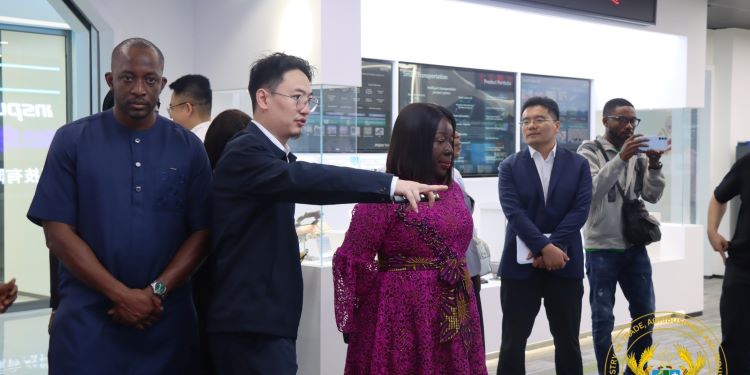
The Government of Ghana has launched an aggressive economic offensive in China’s industrial heartland, pitching the West African nation as a highly secure, deregulated, and profitable manufacturing hub for East Asian capital.
Speaking before a high-level assembly of manufacturing executives, technology pioneers, and state-backed investors at the Ghana-China Investment Forum in Jinan, Shandong Province, the Minister for Trade, Agribusiness and Industry, Elizabeth Ofosu-Adjare, presented an urgent case for long-term industrial partnerships.
The high-level diplomatic deployment was a coordinated effort by the newly realigned Ministry of Trade, Agribusiness and Industry (MoTAI) to position Ghana as the primary gateway for foreign direct investment (FDI) into the continent’s rapidly integrating markets.
“Addressing business leaders in Jinan, the capital of Shandong Province – a region recognized globally for its heavy industrial output, machinery manufacturing, and advanced chemical processing sectors – Hon. Ofosu-Adjare extended an open invitation to Chinese conglomerates.
“The Minister emphasized that Ghana’s unique market proposition relies on a rare combination of absolute democratic stability, a highly favorable geographic location at the center of global shipping lanes, and an aggressive package of market-friendly regulatory reforms.”
The delegation’s strategy focused on removing the perceived risks of sub-Saharan investment by presenting verifiable commercial data and strong legal guarantees.
State officials noted that as global supply chains restructure, Ghana offers a highly stable alternative for manufacturing entities seeking to diversify their production bases while maintaining access to international export corridors.
To validate Ghana’s capacity to host complex industrial operations, Ofosu-Adajre highlighted several thriving Chinese-led conglomerates currently operating inside the country.
Rather than relying on theoretical business plans, the state leveraged these existing success stories as a live proof of concept for the Shandong corporate assembly.
Special prominence was given to the multi-sector footprints of “Sentuo Group, Zonda Tec, and the collaborative ventures of KEDA and Sunda.”
These industrial entities have successfully integrated into the local economic landscape, scaling up from simple distribution networks into massive localized production complexes that feed goods directly into regional trade channels.
“Sentuo Group has become one of the most remarkable Chinese investment success stories on the African continent, employing thousands of Ghanaians across multiple sectors including steel, ceramics, recycling and oil refining.”
Similarly, the Minister praised KEDA and Sunda for their joint investment in the Twyford Ceramics factory, noting that the manufacturing plant has successfully transformed Ghana from a net importer of ceramic goods into a regional export powerhouse, supplying building materials to West African, European, and American markets while sourcing the vast majority of its raw chemical inputs locally.
Within the automotive sector, Zonda Tec was highly commended for its progressive industrial expansion, moving swiftly from heavy-duty vehicle assembly into high-tech investments in domestic electric vehicle (EV) production.
The cornerstone of Ghana’s updated investment pitch is a sweeping legislative reform package designed to eliminate historical bureaucratic bottlenecks.
Ofosu-Adjare detailed the operational impacts of the newly enacted Ghana Investment Promotion Authority (GIPA) Act 2026, a milestone law passed under the administration of H.E. President John Dramani Mahama to accelerate the country’s transition toward an export-driven economy.
“The recently passed Ghana Investment Promotion Authority Act 2026 has significantly improved the ease of doing business by removing minimum capital requirements for foreign investors and shortening investment approval timelines.”
Furthermore, the new act introduces automated fast-track mechanisms that substantially compress investment approval timelines.
Foreign entities can now secure necessary operational permits, land-use clearances, and tax registration certifications within a fraction of the time previously required, providing a highly predictable and secure legal environment for project planning and capital deployment.
The macro-policy driving this diplomatic push is centered entirely on diversification, shifting the country away from its historical dependence on raw commodity exports toward an economy anchored by value-added manufacturing.
To achieve this, the MoTAI mapped out a series of high-priority economic sectors where Chinese expertise can match directly with Ghana’s resource endowments and industrial parks.
In the agricultural sphere, the state is targeting heavy capital injection into large-scale agro-processing and agri-technology. This involves establishing modern processing hubs to refine local crops into high-value exports, reducing post-harvest losses while securing domestic food reserves.
Parallel to agriculture, the Ministry is aggressively positioning Ghana’s textiles and garments sector for a massive revival, seeking to draw in Chinese technical partnerships to expand local milling, apparel design, and large-scale manufacturing for western and continental export markets.
The state’s industrial framework also marks a major push into specialized manufacturing. The Ministry of Finance and MoTAI are courting Chinese pharmaceutical giants to establish localized formulation plants, aiming to transform Accra into the primary hub for medical consumables across West Africa.
According to the Ministry, this strategy extends directly into the construction materials sector, where the state seeks to duplicate the success of the Twyford ceramics model by expanding the local production of steel, glass, and cement utilizing domestic mineral reserves.
Furthermore, Ghana is positioning itself at the cutting edge of global industrial trends by prioritizing green manufacturing, industrial recycling, and digital technology. The government is actively inviting investments into clean-tech operations and electronic waste recycling plants, alongside digital infrastructure projects that can anchor advanced supply chain logistics.
These high-tech sectors are designed to integrate seamlessly with the country’s expanding automotive footprint, providing a ready supply chain for localized commercial truck manufacturing and next-generation electric vehicle assembly.
“Ghana is ready. Ghana is safe. Ghana is profitable,” Ofosu-Adjare stated, assuring investors of government support throughout the investment process. The delegation concluded its presentation by reassuring investors that the state would provide continuous institutional support throughout the entire life cycle of their investments.