

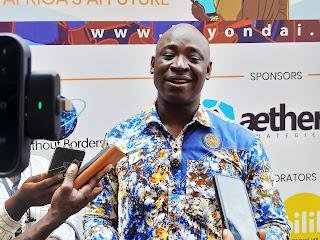
The final day of the Nyansa Futures 2026 forum in Accra has delivered a clear dual mandate for Ghana urgently calling for the modernization of the country’s digital legal framework and empower the youth to transition from being mere consumers to actual owners of artificial intelligence.
Organized by the Beyond AI Movement under the theme “From Adoption to Ownership: Shaping Africa’s AI Future,” the two-day event brought policymakers and tech enthusiasts together to chart a realistic path for the continent’s AI integration.
Leading the call for legal reforms, Dr. Abed L. Bandim, Chairman of Parliament’s Information and Communications Committee and MP for Bunkpurugu, warned that Ghana’s current ICT laws are severely outdated and risk leaving the country behind.
Drawing on his extensive background in ICT and Law, Dr. Bandim pointed out that key legislation, such as the National Communications Authority Act (passed in 2008) and the Data Protection Act (passed over 15 years ago), does not account for modern realities.
“Today we are talking about AI. We are talking about emerging technologies. All of these are driven by data. If you don’t have a robust data protection law, you are bound to fail,” he cautioned.
To address this, Dr. Bandim revealed that approximately 15 ICT-related bills—including critical reviews of the Data Protection law and the 2017 Cyber Security Act—are currently awaiting Cabinet approval. He gave his firm assurance that once these bills reach the floor of Parliament, his committee will prioritize steering them into law to ensure Ghana has a “fit for purpose” regulatory framework.
While Parliament focuses on the macro level, Michael Owusu-Asare, Executive Director of No Limit Consult and Foundation, zoomed in on the micro level, challenging Ghanaian youth to seize “agency over AI.”
Owusu-Asare stressed that the critical issue is not just adopting AI but having the ability to influence and own it. He noted that young people do not need technical backgrounds to leverage AI for graphic design, video editing, and social media management.
“If you are unemployed, why don’t you teach yourself AI and start teaching people and making money out of it? Whenever anything is new, the ones who take advantage early are the ones who make the most money,” he advised.
A Political Science and Sociology graduate who taught himself digital marketing for free, Owusu-Asare urged the youth to utilize platforms like YouTube to acquire AI skills without spending money.
He also highlighted AI as a powerful equalizer, particularly for persons with disabilities. Speaking from personal experience as a wheelchair user, he noted that remote AI and IT jobs eliminate physical barriers, offering an unprecedented level playing field for marginalized groups.
The Nyansa Futures 2026 workshop ultimately served as a catalyst for action, bridging the gap between legislative preparedness and grassroots digital empowerment to ensure Africa truly owns its technological future.