

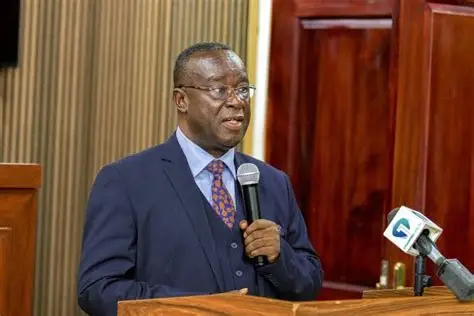
The Chief Justice (CJ) Justice Paul Baffoe-Bonnie, has come under intense attacks after his visit to some State-Owned Enterprises (SOEs) and passed some comments deem to be political.
This is not the first time he is attracting this heavy criticisms from members of the public as well as politicians and social commentators for mingling with political actors.
In the past months, the CJ was seen in the midst of the Vice President Prof. Jane Naana Opoku-Agyemang in Canada for the World Cup. He was also at the funeral of the father in-law of the Chief Executive Officer of the GoldBod, Sammy Adu-Gyamfi and a few others.
A while back, he visited places such as the Ministry of Finance where he had an interaction with the Minister, Dr Ato Forson.
The about 70-year old who is due for retirement by close of this year, yesterday, Wednesday, September 2, paid a familiarization visit to state-owned institutions including the Social Security and National Insurance Trust (SSNIT) and Minerals Income Investment Fund (MIIF), praising them for their current performances barely two months into the administration.
He expressed his admiration for some of the successes they have recorded saying he has been left wondering what Ghana was doing over the past eight years.
“I must congratulate you. I mean, you have done marvelously well. See, because sometimes when we hear the things that you have done, the things that some organisations are doing now, we wonder; some of us keep wondering what really we have been doing in the past eight years,” he said at MIIF.
The Chief Justice said the information he received during his visit to SSNIT was particularly striking, especially against the backdrop of previous plans involving some of the institution’s assets.
“We’ve just come back from SSNIT, we went to SSNIT this morning, and the kind of things that we heard, and we hear, we even heard before we went there, what we were told, if you compare that to the fact that not too long ago, SSNIT was preparing to sell its prized assets like Labadi Beach Hotel, you wonder how Ghana could have sunk so low,” he added.
According to the Chief Justice, the improved performance of the institutions demonstrates the importance of proper management, prudent use of public resources and a commitment to serving the public interest.
“I think maybe you have achieved all this through proper management and the use of resources and the recognition of the fact that we are not here for ourselves,” he said.
He urged managers of state institutions to focus on the legacy they would leave behind, stressing that public office comes with a responsibility to serve the people.
“Whatever we should aim at is how we want to be remembered for the stewardship that we were given,” he said.
Baffoe-Bonnie also encouraged public officials to put citizens at the centre of their work, drawing on the judiciary’s approach to public service.
“We at the judiciary always say that power is for the people. The judicial power emanates from the people. We only exercise that power on their behalf. So whatever we do, we should have them in mind,” he said.
He said the quality of public service delivery begins from a citizen’s first interaction with an institution.
“Justice actually starts from when the processes are filed,” he said.
But this appears not to have gone down well with some concerned Ghanaians who have urged him to desist from going beyond his boundaries as a sitting CJ and respecting the ethics of the judiciary.
Publicly, Member of Parliament (MP) for the Ofoase-Ayirebi, Kojo Oppong Nkrumah, described the visit as “unprecedented”.
The onetime radio host demanded to know the motive behind the visits, describing the development as unprecedented and bewildering.
According to the former Information Minister, he was surprised by the CJ’s decision, arguing that such engagements were unusual for the Judiciary.
The immediate past Works and Housing Minister, touching on the issue on Asempa FM’s Ekosii Sen programme, could not recall any instance in recent political history where a Chief Justice had embarked on official tours of state-owned enterprises.
“For all the years that I have followed politics and governance, I haven’t heard of such that the Chief Justice will be touring state-owned enterprises. I haven’t heard of that before,” he said.
He argued that the Judiciary, as an independent arm of government, traditionally maintains a certain distance from the activities of the Executive and Legislature.
“The Judiciary is supposed to be more or less independent. It’s an arm of government on its own; they don’t mingle with whether it’s the Legislature or the Executive,” he stated.
Another commentator and civil society activist, Dr Steve Manteaw, urged him to desist from his public commentary on the government’s performance.
“I sincerely think the Chief Justice should desist from his public commentary on government’s performance,” Dr Manteaw wrote on Facebook.
He added, “An arbiter must always keep people guessing. His views and preferences are better kept to him/herself.”
Another concerned Ghanaian and legal scholar Prof Kwaku Asare cautioned Chief Justice against making public comments that could be interpreted as partisan political assessments, following his remarks about the performance of state institutions under the current administration.
Prof Asare said although he understood the sentiment behind the Chief Justice’s comments, the reference to “the past eight years” carried an unmistakable political meaning in Ghana’s political discourse.
He argued that such language, coming from the head of the Judiciary, could be interpreted as an assessment of one political administration against another and therefore risk undermining public confidence in judicial independence.
Reacting in a Facebook post on Wednesday, September 2, Prof Asare said he was concerned less about whether the Chief Justice’s observation was right or wrong than about the implications of the language used.
“I understand the sentiment. But I worry about the language,” he wrote.
He said the phrase “the past eight years” had a clear partisan connotation in Ghana’s political environment.
“The past eight years’ carries an unmistakable partisan meaning in our political discourse. Coming from the Chief Justice, it can therefore easily be understood, fairly or unfairly, as an assessment of one administration relative to another,” Prof Asare said.
“That is territory the head of the Judiciary should avoid,” he added.
According to him, judges remain citizens with personal views when they assume office, but the judicial robe places a greater obligation on them to exercise restraint in their public pronouncements.
“Judges do not cease to be citizens when they assume office. But the robe necessarily constrains their public speech. This is especially so for the Chief Justice, whose words inevitably carry the institutional weight of the Judiciary,” he said.
Prof Asare said the expectation of judicial restraint should complement demands on politicians to respect the independence of the Judiciary.
“We rightly insist that politicians respect judicial independence and stay out of the judicial arena. The obligation is reciprocal,” he said.
“Judges, particularly the Chief Justice, must also exercise the restraint necessary to stay out of the partisan political arena.”
He stressed that his criticism was not based on an assumption about the Chief Justice’s motives or whether his assessment of government performance was accurate.
“The point is not whether the observation is right or wrong. Nor is it about the motives of the speaker. It is about protecting an institution,” he said.
Manasseh Azuri Awuni was not left out in the criticism cautioning judges to sacrifice their freedom of association and speech sometimes as public servants.
The investigative journalist in a post on social media said |”Public service is also a sacrifice. Sometimes you must sacrifice your freedom of association and of speech. Judges know this.”
By Gifty Boateng