


I used to feel genuinely excited whenever a new professor was appointed, another group of doctors graduated or newly trained engineers entered the profession. Each announcement gave me hope. I saw every new academic title as evidence that Ghana was building a larger army of knowledgeable minds—people equipped to solve our problems and move the country forward.
I particularly enjoyed listening to inaugural lectures delivered by professors. These lectures often represented decades of disciplined study, research and intellectual achievement. I listened with admiration, believing that such knowledge would eventually leave the lecture halls, laboratories and academic journals and find practical expression in the life of our nation.
Not anymore.
Galamsey has profoundly changed the way I view academic achievement. It has forced me to ask an uncomfortable question: What is the purpose of producing thousands of professors, doctors, engineers, lawyers and scientists if our collective knowledge cannot protect the elementary foundations of human survival?
What is the value of our degrees when the rivers from which we drink are being poisoned before our eyes? What is the meaning of our professorships when forests are being destroyed, farmlands devastated and entire communities exposed to serious environmental and health dangers? Of what practical use are our universities if their graduates can build impressive careers but cannot defend the country that made their education possible?
The purpose of education is not to decorate individuals with titles. A country is not educated simply because it has many universities, professors and certificate holders. Education must be measured by the intelligent application of knowledge to solve problems, improve society, protect the environment and advance humanity.
Education Made Visible
Across the world, nations are showing that education becomes meaningful when knowledge is translated into long-term policy and practical action.
Singapore has embarked on a national programme to plant one million more trees as part of its transformation into a “City in Nature.” Its National Parks Board says urban greenery can cool surrounding areas, improve air quality and strengthen environmental resilience. By the 2024–2025 reporting year, more than 760,000 trees had already been planted under the programme. That is knowledge leaving the lecture hall and entering the streets. It is science translated into public policy – and public policy translated into a living inheritance for future generations. Singapore National Parks Board
China has spent decades confronting desertification through its vast Three-North Shelterbelt Forest Programme. In 2024, the country announced that the Taklimakan Desert—its largest desert—had been completely encircled by a 3,046-kilometre sand-blocking green belt after more than four decades of sustained work. China is attempting to push vegetation into areas where nature itself is hostile to plant life. Government of China
Ethiopia, despite its economic difficulties, has also recognized that environmental restoration is fundamental to national survival. Through its Green Legacy Initiative, it launched an ambitious programme to plant billions of trees and pledged to restore 15 million hectares of degraded forests and landscapes by 2030. These efforts are not perfect, and planting seedlings must always be followed by protection and long-term care. Nevertheless, the scale of the ambition reveals a country attempting to confront environmental degradation rather than surrender to it. United Nations Environment Programme
Costa Rica offers another powerful example. After suffering severe deforestation, it used environmental policies and incentives to reverse the decline. The World Bank reported in 2022 that forests covered close to 60 per cent of the country, compared with about 40 per cent in 1987. Costa Rica demonstrated that ecological destruction is not necessarily permanent when knowledge, political will and sustained national action are brought together. World Bank
Even across Africa’s Sahel region – one of the harshest environments on Earth – countries participating in the Great Green Wall initiative are trying to restore degraded landscapes, improve food and water security and resist desertification. They are attempting to make barren land productive again. United Nations Environment Programme
These countries face different conditions, and none is environmentally perfect. But they share an important understanding: the environment is not an obstacle to development. It is the foundation of development.
My Bedfordshire Testimony
Since 1998, I have repeatedly visited a small village in Bedfordshire in the United Kingdom. Over nearly three decades, I have noticed something remarkable: the entire area appears to be getting greener and greener.
The trees planted years ago have matured. I planted a few trees myself including conifers and helped nurture them until they gained roots. Woodlands and hedgerows have been protected and expanded. The landscape looks increasingly alive, cared for and deliberately preserved. My observation is also consistent with the wider national direction: official UK statistics show that woodland habitat increased from about 10 per cent of the country’s land area in 1990 to 13 per cent in 2024. UK Office for National Statistics
Within Bedfordshire itself, the long-term Forest of Marston Vale strategy seeks to increase tree cover from approximately 3 per cent to 30 per cent. This is what purposeful planning looks like: identifying environmental damage, setting a generational target and working consistently towards it. Bedford Borough Council
Each time I return to that little village of Bromham and see it becoming greener, I am reminded of what is possible when a society thinks beyond the present generation.
Sadly, the same cannot be said of Ghana.
Since 1998, Ghana should also have become progressively greener. Our towns should have acquired mature tree canopies. Our degraded forests should have been restored. Our rivers should have become cleaner. Our cities should have been cooler, healthier and more beautiful.
Instead, in many places, we have moved in the opposite direction. Trees are removed and replaced with concrete. Forests are invaded. Farmlands are excavated. Rivers that sustained communities for generations are turned into channels of muddy, contaminated water. While other countries struggle to push forests into deserts, we are turning naturally fertile and forested land into wasteland.
China is fighting to make deserts green. Ghana is allowing green land to become desert-like.
Ethiopia is mobilizing citizens to plant billions of trees. Ghana struggles to protect the mature trees and natural forests it already possesses.
Costa Rica reversed deforestation through deliberate national policy. Ghana continues to permit ecological destruction despite possessing the scientific knowledge, professional expertise and legal institutions required to stop it.
The contrast is not merely environmental. It is educational.
Schooled, But Are We Educated?
Ghana has universities, professors, doctors, engineers, lawyers, environmental scientists and highly qualified public officials. We understand hydrology, toxicology, forestry, agriculture, mining, economics and public health. We know what mercury and other pollutants can do. We know that forests protect watersheds, regulate temperature and preserve biodiversity. We know that contaminated rivers threaten human health, agriculture and national security.
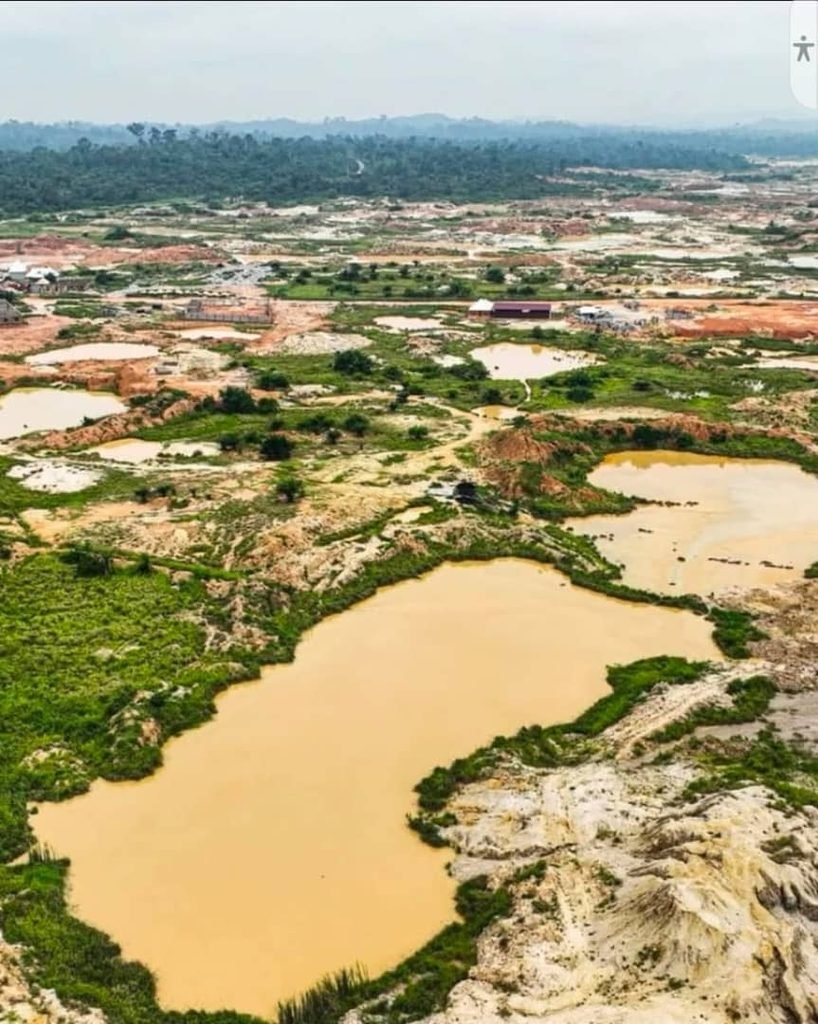
Yet galamsey continues.
This is not ignorance resulting from a lack of information. It is something more disturbing: the possession of knowledge without the conscience, courage and discipline to apply it.
Knowledge that remains trapped in certificates, offices, conference halls and inaugural lectures has failed society. Education must be visible in the quality of our institutions, the conduct of our leaders, the condition of our communities and the protection of our natural inheritance.
It must help us think beyond immediate profit and consider the lives of people who will inhabit this country 20, 50, 100 or even 1,000 years from now.
Galamsey has therefore stripped our impressive academic titles of much of their moral and practical significance. It has exposed the enormous distance between being schooled and being educated.
We know that polluted water threatens life, yet we continue to poison our rivers. We understand that environmental toxins can harm present and future generations, yet meaningful action remains inadequate. We know that forests regulate climate, protect water systems and support life, yet we permit their destruction.
We understand the science. We understand the medicine. We understand the engineering, economics and law. But our national behaviour contradicts our knowledge.
Why the Titles No Longer Impress Me
That is why the appointment of another professor or the graduation of another cohort of professionals no longer excites me as it once did.
The ceremonies continue. The gowns remain colourful. The speeches are eloquent, the inaugural lectures sophisticated and the titles increasingly impressive. But outside the auditoriums, the rivers continue to turn brown.
This is not an attack on professors, doctors, engineers or universities. It is a challenge to all educated Ghanaians – including myself. Education brings responsibility. The greater our knowledge, influence and privilege, the greater our obligation to speak, think, organize and act in defence of society.
Ghana does not merely need more title holders. We need educated citizens whose learning develops a conscience. We need professors whose research shapes national action, doctors who defend the environmental foundations of public health, engineers who design sustainable solutions, lawyers who insist that environmental laws be enforced and leaders capable of thinking beyond the next election.
An inaugural lecture should not merely demonstrate what a professor knows. It should help transform the society in which that knowledge was acquired.
A medical degree should not only provide a career. It should compel its holder to confront the environmental conditions that will fill our hospitals tomorrow.
An engineering qualification should not merely permit its holder to construct buildings and roads. It should help build a country capable of surviving and flourishing for generations.
Until our knowledge can protect the water we drink, the soil that feeds us and the forests that sustain us, we should be cautious about celebrating ourselves as an educated nation.
Our degrees may prove that we attended school.
Our titles may prove that we passed examinations.
But galamsey is the great national examination of our education, conscience and capacity to apply knowledge.
So far, we are failing it.
Wasn’tMe | Steward of the Environment