

Public water. Public questions. A better way must protect both investment and the citizen.
CITIZEN QWESI
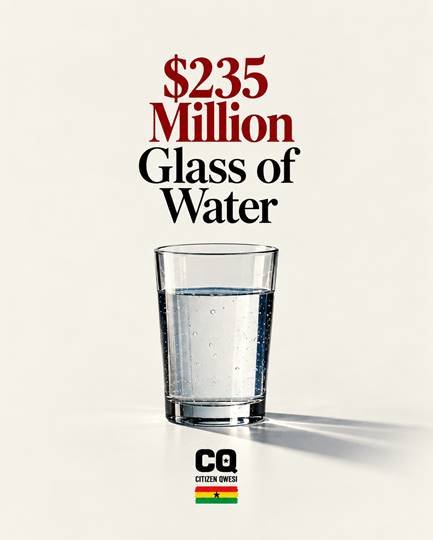
If a glass of water ends with a US$235 million question, the country must pause before it argues. Not because public water should be cheap by slogan, or infrastructure should be built by hope, but because essential services carry a special public duty. When water is involved, every contract is more than paperwork. It is a promise made in the name of households, hospitals, schools, markets and communities.
That is why the reported arbitral award linked to the Accra desalination plant deserves sober attention. According to market disclosures by Cox Infrastructure Group, Befesa Desalination Developments Ghana Limited received notice of two final arbitral awards connected to proceedings against Ghana Water Company Limited and the Republic of Ghana over the Accra desalination plant and the related sovereign guarantee. The filing says Ghana Water is required to pay US$235 million, net of taxes, in termination payments under the Water Purchase Agreement, with accrued interest from 1 April 2026 until actual payment, and that the Republic is obliged under the sovereign guarantee to satisfy the amounts awarded, subject to no double recovery.
That is the legal headline. The public headline is simpler: a project presented around water now stands before the country as a bill. The citizen may not know every clause of the agreement, every operational dispute, every technical argument or every claim and counterclaim. But the citizen understands the moral shape of the matter. If public infrastructure is badly conceived, badly supervised, badly exited or badly explained, the ordinary person pays twice. First through weak service. Then through the public purse.
This is not an argument against private investment. Ghana needs serious capital and technical competence. But when a private arrangement touches a public necessity, the terms cannot remain private mystery until the bill becomes public pain.
Water is too basic for casual governance. A desalination plant is not a campaign prop. It is not a ribbon-cutting photograph. It is not a line item that can be praised in one administration and abandoned in another without consequence. It is an infrastructure commitment with engineering risks, revenue assumptions, performance obligations, termination clauses, dispute procedures and possible sovereign exposure. If those risks are not properly understood before signature, they do not disappear. They wait.
The uncomfortable question is not only who won the arbitration. It is who protected the public interest before the arbitration became necessary. Who tested the cost of termination before the contract was signed? Who monitored whether the project was delivering value? Who reported early signs of trouble? Who advised on the sovereign guarantee? Who explained to citizens what Ghana was taking on in their name? Who carried the institutional memory when officials changed, politics shifted and the project entered difficulty?
Too often, Ghana debates these matters only when the damage has matured. By then, the story has moved from policy to lawyers, from service delivery to claims, from public need to financial exposure. The public hears of awards, guarantees and accrued interest after the important decisions have already passed through offices, boardrooms and ministries.
A better way is possible, and it does not require Ghana to fear big infrastructure. It requires Ghana to respect big obligations. Before essential-service contracts are signed, there should be clearer public-interest review, stronger publication of non-sensitive contract risks, independent assessment of termination exposure, and regular reporting on whether the project is delivering the service for which the public ultimately carries the burden. Sovereign guarantees should not be treated as ceremonial comfort letters. They are potential public liabilities and should be handled with that seriousness.
The better way is also not to turn every failed project into a partisan trophy. That may satisfy the loudest voices, but it rarely fixes the institutional habit. If Ghana wants to learn, the question must move beyond which political season produced the problem. It must ask what public systems allowed the risk to grow.
This is where CQ stands: not against investment, not against infrastructure, not against difficult decisions, but against a public culture where ordinary people inherit the cost of decisions they were never allowed to understand. Water is a right. Competence is a duty. Accountability is the bridge between the two.
The US$235 million glass of water should not become just another number in Ghana’s long memory of expensive public lessons. It should become a turning point in how we sign, supervise, disclose, exit and learn.
Because when the bill is public, the questions must also be public.