

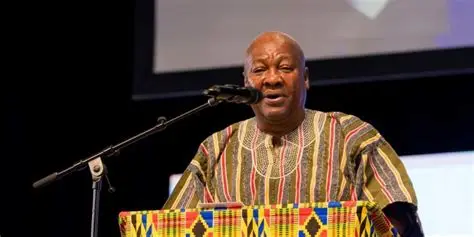
President John Dramani Mahama has lamented the state of Ghana’s new media landscape, saying that while he remains unmoved by insults directed at him, some of the reasons for which citizens have been arrested over their utterances are far too trivial to justify police action.
The President made the remarks when he addressed the Ghanaian community in the United States, where he is attending the 81st United Nations General Assembly (UNGA).
Changing Media Landscape
Reflecting on his background as a trained media professional, Mahama said the concept of “information integrity” has become necessary because the media environment has transformed dramatically.
“Before, if you saw a story in Graphic, it had been well researched. The journalist whose byline is there has put his reputation behind it,” he said, citing state media houses such as the Daily Graphic, Channel One, and Daily Guide as institutions that once stood behind their publications.
“Today, we don’t have that traditional media that we knew. The media has become democratized. Anybody with a mobile phone can disseminate information,” he noted.
TikTok and the Challenge of Regulation
The President singled out TikTok as a platform posing fresh regulatory challenges not only for Ghana but for countries across the world, explaining that its algorithm amplifies and spreads content indiscriminately.
“Anybody who has a phone just puts it in front of him and says whatever he likes. And once they put it out, the algorithm shares it,” he said, adding that users are repeatedly fed similar content whether they seek it or not.
He expressed concern about anonymity, noting that while he does not mind criticism from people who own their views openly, some individuals hide behind their devices to post “the vilest things.”
‘This Skin Is Crocodile Skin’
Despite the provocations, the President said personal attacks do not trouble him.
“As a leader, I don’t mind being insulted. I’ve been insulted, I was vilified, I was voted out of office. So me, this skin is a crocodile skin,” he stated, adding that his focus remains on doing what is right for Ghana and Africa.
Stakeholders Forum on New Media
President Mahama said his government could easily direct the Inspector General of Police (IGP) to stop all arrests related to speech, but questioned whether that would serve the country’s interests.
Rather than act unilaterally, he said he has tasked the Ghana Journalists Association (GJA) and the Media Foundation for West Africa (MFWA) to convene a stakeholders’ forum to collectively decide how the new media should be handled — including whether the police should be involved at all.
“We’ll get the results from the stakeholders’ forum, put it before cabinet, and give a guideline on how these things should be handled,” he said.
He also drew a comparison with the United States, host of the UNGA, questioning whether a person could openly threaten to assassinate a sitting American president and walk free.
“But in Ghana, you can say it. And when you arrest somebody, they say, no, no, you are trampling on free expression,” he observed.
Arrests Made Without His Knowledge
The President distanced himself from several arrests over speech-related offences, saying many of them never reach his desk.
“A lot of these arrests, I don’t even know about them. I also hear them in the media,” he said.
He admitted the situation sometimes worries him, arguing that some of the alleged insults cited as grounds for arrest are far too minor to warrant detention.
“Sometimes the reason for which the person has been arrested — they say he’s insulted me. And you look at the insult, and it can’t even touch my coat for the person to be arrested,” he said.
The President assured that government would ultimately be guided by the outcome of the stakeholders’ forum in shaping national policy on information integrity.
By Gifty Boateng