

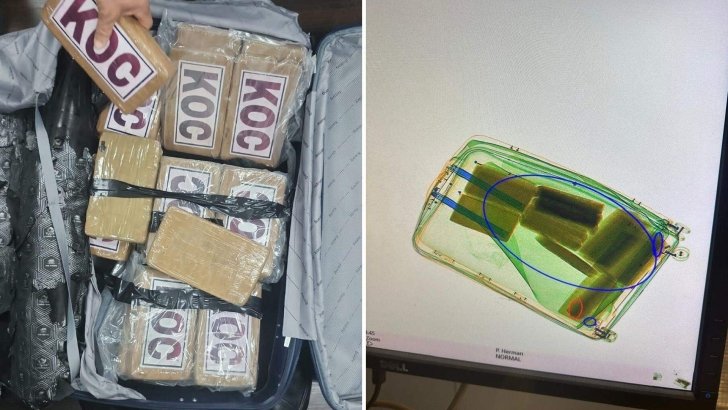
Lebanese security authorities have arrested a Syrian passenger arriving from Accra, Ghana, after discovering 46.7 kilogrammes of cocaine concealed in his luggage at Beirut’s Rafic Hariri International Airport.
The seizure, described by Lebanese Customs as the largest drug haul in the airport’s history, was made on Saturday, October 31, 2026, during a joint operation involving the General Directorate of Customs and the General Security.
In a statement issued on Sunday, November 1, Customs identified the suspect only by his initials, B.H., and said he had arrived in Beirut aboard Middle East Airlines flight MEA 576 from Accra.
A search of his luggage uncovered 40 packages containing cocaine, which had been concealed using sophisticated methods and layers of packaging and insulation materials designed to evade detection by airport scanning equipment.
Electronic tracking devices were also discovered inside the packages.
“The passenger’s luggage was searched, revealing 40 packages of cocaine concealed using sophisticated methods and complex packaging and insulation materials designed to evade detection by scanning equipment. Electronic tracking devices were also found inside the packages,” the Customs statement said.
Preliminary investigations indicate that the suspect had entered Lebanon through the Masnaa border crossing several weeks earlier before travelling to Accra and subsequently returning with the consignment.
According to Customs, initial findings suggest that he was assigned to transport and deliver the drugs as part of an organised international smuggling operation.
Investigators are now working to establish the identity of the intended recipient and locate the individual who was expected to take delivery of the consignment at a designated location.
Lebanese Prime Minister, Nawaf Salam, has congratulated the General Security and Customs authorities for intercepting the shipment, praising the cooperation and intelligence-sharing between the two agencies.
In a statement posted on X by the Grand Serail, he stressed that Lebanon’s land, sea and air border crossings “would not serve as conduits for drug smuggling, money laundering or any other illegal activities.”
He further pledged that the government would continue to tighten border controls, improve coordination among security agencies and intensify operations against smuggling networks and organised crime.
The latest seizure comes amid a series of major drug interceptions by Lebanese security authorities at the country’s airports and seaports.
In August, the Internal Security Forces announced the arrest of a Lebanese man who arrived from Brazil at the same airport with 4.9 kilogrammes of cocaine concealed in the bottoms of two suitcases and mixed with adhesive substances.
A month earlier, Lebanese Customs intercepted 3.5 tonnes of narcotics at the Port of Beirut in a shipment reportedly destined for an unnamed African country.
Lebanese authorities have since reiterated their commitment to preventing the country’s airports and seaports from being exploited as transit routes for narcotics, while strengthening intelligence cooperation with other countries to detect and intercept international drug shipments.