

By Prince Ahenkorah
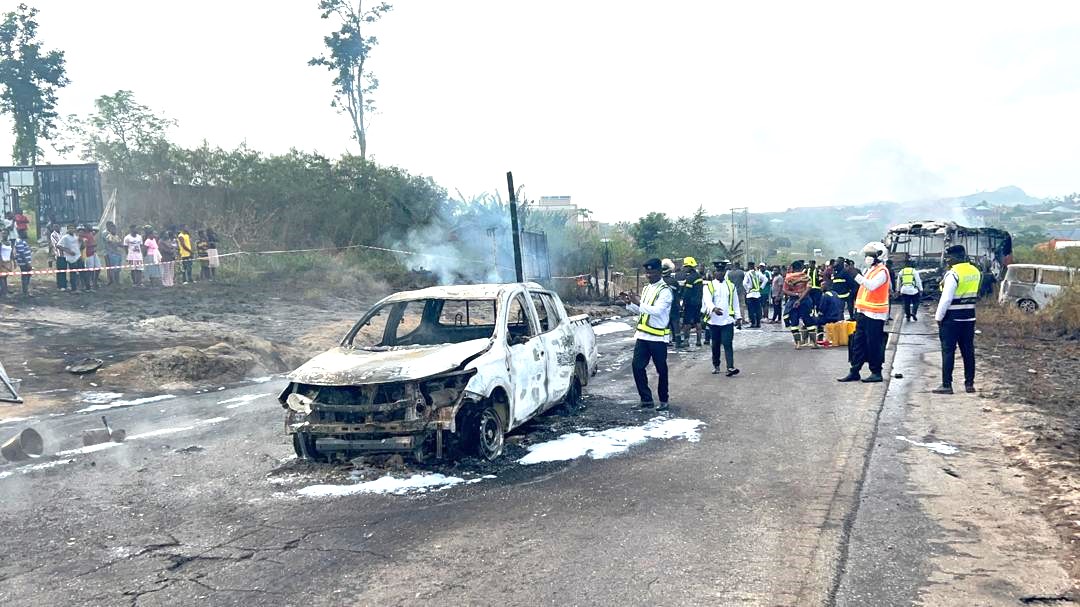
A catastrophic fire on the Accra-Nsawam Highway has left six people dead and seven fighting for their lives after a petrol tanker became the epicentre of a deadly explosion early on Saturday morning. The incident, which occurred near Okanta, has laid bare the extreme risks posed by the informal economy of fuel scavenging that festers around major road accidents.
The Ghana National Fire Service (GNFS) received the distress call at 4:45 a.m. By the time crews arrived, the scene was one of total conflagration. A tanker carrying a staggering 54,000 litres of fuel had become a molten core, igniting a VIP bus, three saloon cars, and four motorcycles that were trapped in the inferno.
Divisional Officer Ignatius K. Baidoo, the Eastern Regional PRO, confirmed that the blaze’s intensity necessitated reinforcement from as far as Bunso. Firefighters, employing foam compound, battled for over six hours to finally extinguish the flames at 11:08 a.m. The scene they uncovered was one of utter devastation.
Of the 15 casualties recorded 11 males and 4 females three were found dead at the scene, their bodies handed over to the police. The remaining twelve, engulfed in flames, were rushed to Nsawam Hospital.
Two were treated and released, but the ten most critical cases were transferred to the Koforidua Regional Hospital. It was there that three more succumbed to their injuries.
The survivors two male children, four male adults, and one female adult remain in critical condition, a grim testament to the ferocity of the flash fire.
While the tanker’s overturning was the catalyst, the GNFS’s preliminary findings point to a far more sinister cause for the death toll: human intervention. Investigators believe that the fire was sparked during a bungled, illegal attempt to siphon fuel.
“Sparks generated while attempting to breach the petrol tanker with cutting tools may have ignited petrol vapours, causing the intense fire,” the Service stated.
The implication is clear. As the tanker lay on its side, a group of individuals likely local residents or passers-by saw not a disaster, but an opportunity. Armed with cutting tools, they attempted to tap the vessel, a highly dangerous practice that ignites thousands of such fires across West Africa annually. The resulting explosion did not discriminate, incinerating the scavengers alongside innocent motorists who happened to be at the wrong place at the wrong time.
The Eastern Regional Command has issued a stark warning to the public, appealing for citizens to avoid accident scenes and report emergencies immediately. For the families of the six dead, and the seven fighting for survival in Koforidua, the warning comes too late. The tragedy on the Nsawam highway serves as a brutal epitaph to the deadly lure of free fuel.