

Says Faction fighters will kill 2028 Dream as ‘slow poison” spreads in NPP
By Prince Ahenkorah
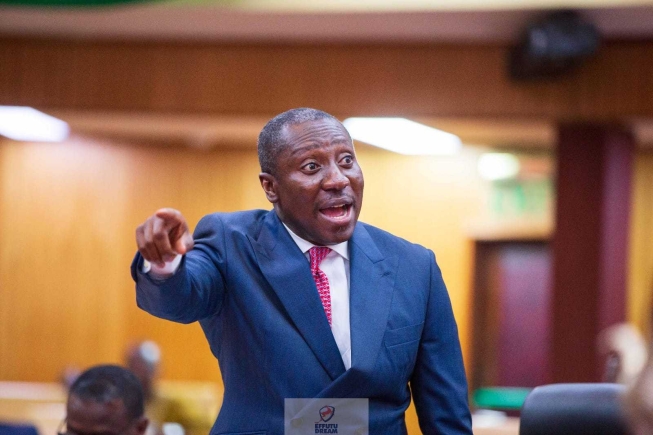
The New Patriotic Party’s Minority Leader, Alexander Afenyo-Markin, has issued a stark internal warning, describing factionalism and disunity as a “slow poison” that could destroy the party’s chances of reclaiming power in 2028. His comments, delivered to party stalwarts in his Effutu constituency, expose the depth of internal anxiety following the party’s bruising 2024 defeat and the contentious flagbearer contest that solidified Former Vice-President Mahamudu Bawumia’s leadership.
Speaking after Bawumia’s coronation as presidential candidate, Afenyo-Markin’s appeal for unity underscores the significant internal repair job facing the NPP.
The party’s history, he argued, provides a grimly consistent lesson: internal fractures directly lead to electoral failure. His speech was a blunt admission that the NPP’s greatest threat currently lies within its own ranks.
“Disunity remains our slow poison,” Afenyo-Markin told the gathering. “History has taught us, repeatedly, that when we are divided, we lose, no matter how strong our candidate or how noble our message.”
A Litany of Self-Inflicted Defeats
The Minority Leader presented a detailed historical indictment, tracing the party’s electoral misfortunes directly to periods of internal schism.
He pointed to the 1979 split within the Danquah-Busia tradition which birthed the United National Convention and the Popular Front Party as the original sin that allowed Hilla Limann’s People’s National Party to seize power.
He cited the same pattern for defeats in 1992, 1996, 2008, and 2012, explicitly linking each loss to moments “whenever factions spoke louder than unity, whenever personal ambition outweighed collective interest.” Conversely, he framed the party’s victories in 2000, 2004, 2016, and 2020 as direct products of cohesion.
The subtext of his history lesson was a clear warning to factions still resentful of Bawumia’s victory and to those positioning themselves for the post-Bawumia era, particularly the camp of rising figure Bryan Acheampong.
The message was that any continuation of internal sabotage would guarantee another term for the governing National Democratic Congress.
Afenyo-Markin identified a specific tactical failure from the 2024 campaign: the prevalence of “skirt and blouse” voting, where supporters chose the NPP’s presidential candidate but rejected its parliamentary candidates. This phenomenon, often a protest against unpopular local MPs or a symptom of poor grassroots mobilisation, critically weakened the party’s overall structure.
“When our supporters vote for a presidential candidate but abandon the party in parliamentary or local contests, it weakens our collective strength,” he cautioned. “We must not allow 2024 to happen again.”
This analysis suggests that unifying behind Bawumia alone is insufficient. The party must also address deep-seated grievances at the constituency level to ensure a cohesive national ticket.
A Call to Rally – With a Veiled Ultimatum
The core of Afenyo-Markin’s address was a direct, almost contractual, appeal to the party machinery. He framed the coming years as a collective test, where the fate of the flagbearer and the party are inseparable. “If Dr. Bawumia fails, it is because we failed him,” he stated, elevating support for Bawumia from choice to obligation.
The speech reveals the central dilemma of the NPP’s post-2024 era. While publicly presenting a unified front behind Bawumia, senior figures are acutely aware that the “slow poison” of disunity fed by recriminations over the last defeat and jostling for future position is still circulating.
Afenyo-Markin’s intervention is an attempt at political chemotherapy, a high-stakes effort to purify the party’s culture before the 2028 campaign begins in earnest. The party’s ability to heed this warning will determine whether it is a viable contender or a house divided against itself.