

TNR News Desk
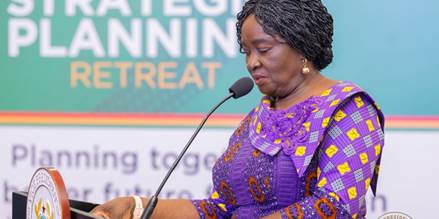
The Vice President, Professor Naana Jane Opoku-Agyemang, has expressed her concerns over the lack of limited participation of African small and medium-sized enterprises (SMEs) in cross-border trade.
She emphasized that the continent’s economic transformation agenda cannot be realized without enhanced support for SMEs, as well as for women and young entrepreneurs.
During her address at the 2026 Africa Prosperity Dialogues held in Accra, Veep highlighted that while the African Continental Free Trade Area (AfCFTA) presents a significant opportunity for deeper economic integration, many businesses are still unable to take advantage of the expanded market.
“Fewer than 20% of SMEs engage in export trade,” she noted, identifying this as a major obstacle to Africa’s goal of establishing a cohesive economic environment.
Prof. Opoku-Agyemang pointed out that the AfCFTA is the largest free trade area globally in terms of the number of participating countries, encompassing a market of 1.3 billion individuals, and offers Africa a pathway from reliance to self-sufficiency.
Nevertheless, she stressed the necessity for an inclusive future, cautioning that neglecting young people, women, and small enterprises could threaten long-term prosperity.
“A future that excludes young people, women, and small businesses is one we cannot afford,” she asserted.
The Vice President underscored the significance of SMEs, which account for approximately 80% of employment across Africa and are essential for economic growth and job creation.
She also highlighted the critical role of women, who make up nearly half of Africa’s workforce and are pivotal in micro and small enterprises, yet continue to face substantial challenges related to access to finance, mobility, and market opportunities.
The Veep said African governments must generate coherent long- and medium-term policies and grow strong development finance institutions and regional projects that reflect the scale of our collective ambition.
“We must continue to interrogate our borders. This is not about erasing sovereignty. It is about organising our sovereignty in service of our shared market and prosperity. It is about enabling an entrepreneur or manufacturer, whether in Accra, Kigali, or Luanda, to see Africa not as a fragmented abstraction, but as one connected market with opportunities.