

By Leo Nelson
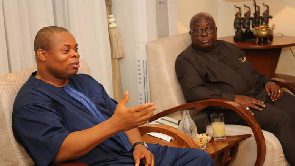
The Founding President and Chief Executive Officer of IMANI Center for Policy and Education, Franklin Cudjoe, has offered a candid reflection on his relationship with former President Nana Addo Dankwa Akufo-Addo, revealing what he describes as a gradual breakdown in policy engagement during the latter’s time in office.
Speaking in a media interview, Cudjoe suggested that despite early collaboration and open dialogue, the former president became increasingly unresponsive to critical policy advice, particularly as his administration progressed.
His remarks shed light on the internal dynamics between civil society organisations and political leadership during one of Ghana’s most consequential governance periods.
Cudjoe recalled that his relationship with Akufo-Addo predated his presidency, describing him as a friend with whom he had engaged extensively on policy matters.
One of the most notable engagements, he said, took place before the 2016 elections, when IMANI and other policy experts held discussions with the then presidential candidate on the proposed Free Senior High School policy.
Early Policy Debates on Free SHS
According to Cudjoe, the Free SHS policy was the subject of intense debate during those early interactions. He explained that IMANI, which identifies with market oriented principles, had reservations about the sustainability of a fully free model without means testing or cost-sharing mechanisms.
“We told him clearly that if you are going to undertake something of that scale, you have to be careful about how it will be funded,” Cudjoe recounted. He noted that Akufo-Addo remained confident in his position, insisting that tackling corruption would free up sufficient resources to support the policy.
In response, the IMANI team conducted detailed research, assembling a group that included policy analysts such as Bright Simmons and Kofi Bentil. The group spent weeks analysing projections and cost implications before presenting their findings to the then candidate.
Cudjoe said the team made it clear that their support for policy development would not prevent them from criticising implementation if necessary. “We told him that even if you win, we will still hold our position and critique what we believe does not work,” he explained.
Shift in Engagement After Assumption of Office
Following Akufo-Addo’s electoral victory, Cudjoe indicated that IMANI maintained its critical stance, engaging the administration on several policy issues. However, he observed that over time, the nature of that engagement changed.
“At some point, I realised that if you advised him, he did not seem to be listening,” Cudjoe said, suggesting that this shift became more apparent around 2020 and 2021.
He noted that civil society actors raised concerns about governance issues, including controversial contracts and decisions that were perceived to be affecting public confidence in the administration.
He explained that these concerns were not raised privately alone but also in public discourse, reflecting what he described as a commitment to transparency and accountability.
According to him, some of these criticisms were met with dismissive responses, including public remarks that appeared to downplay the concerns raised by civil society organisations.
Cudjoe referenced a moment when the former president commented on complaints brought to him by some civil society actors, suggesting that upon review, such concerns were unfounded.
While he did not directly respond at the time, Cudjoe indicated that such reactions contributed to a sense that meaningful engagement was diminishing.
Concerns Over Governance and Public Spending
Beyond communication challenges, Cudjoe raised broader concerns about governance and fiscal management under the Akufo-Addo administration. He pointed to initiatives such as infrastructure and development projects, including the One Village One Dam programme, which he suggested were poorly executed in some cases,
alleging that certain contracts were awarded to individuals without sufficient experience, leading to questionable outcomes on the ground. According to him, these developments contributed to a growing perception of inefficiency and weakened confidence in public spending.
Cudjoe also highlighted concerns about the cost of elections, arguing that significant financial resources were committed at a time when Ghana’s fiscal position was becoming increasingly constrained.
He noted that earlier warnings about excessive spending and borrowing were not adequately addressed. “We cautioned that these decisions would affect the country’s financial stability, but the signals were not taken seriously,” he said.
Economic Pressures and Structural Weaknesses
Reflecting on Ghana’s economic trajectory during the period, Cudjoe suggested that structural weaknesses were already evident before external shocks such as the COVID 19 pandemic.
He argued that while the pandemic accelerated economic challenges, underlying issues related to fiscal discipline and financial management had been building over time.
He pointed to inefficiencies in public financial management systems, noting that a significant portion of government transactions did not pass through established oversight mechanisms. This, he argued, limited transparency and accountability in public expenditure.
Cudjoe further suggested that Ghana’s classification as a middle income country influenced borrowing patterns, with the government accessing international markets more aggressively. However, he noted that this approach became unsustainable as investor confidence declined.
Withdrawal from Engagement and Political Reflections
As concerns mounted, Cudjoe indicated that some policy advocates chose to step back from direct engagement with the administration. He described this decision as a response to what they perceived as a lack of receptiveness to constructive criticism.
“At a point, some of us felt that continuing to engage would not yield results,” he said, adding that this marked a turning point in relations between certain civil society groups and the government.
He also reflected on the broader political landscape, suggesting that the challenges faced by the Akufo-Addo administration would have posed difficulties for any government in office during that period. In his view, policy decisions made between 2018 and 2019 had long-term implications that became more visible in subsequent years.
Lessons for Governance and Policy Dialogue
Franklin Cudjoe’s remarks underscore the complexities of policy engagement between governments and civil society organisations. While early collaboration may create opportunities for input and influence, sustaining that engagement requires openness to criticism and a willingness to adapt.
His reflections also highlight the importance of balancing ambitious policy goals with fiscal sustainability and institutional accountability.
As Ghana continues to navigate economic and governance challenges, the experiences shared by policy actors such as Mr Cudjoe offer insight into the dynamics that shape decision making at the highest levels.
The interview adds to ongoing discussions about leadership, accountability, and the role of independent policy institutions in strengthening democratic governance. It also raises questions about how governments can better integrate expert advice into policy implementation while maintaining public trust.