

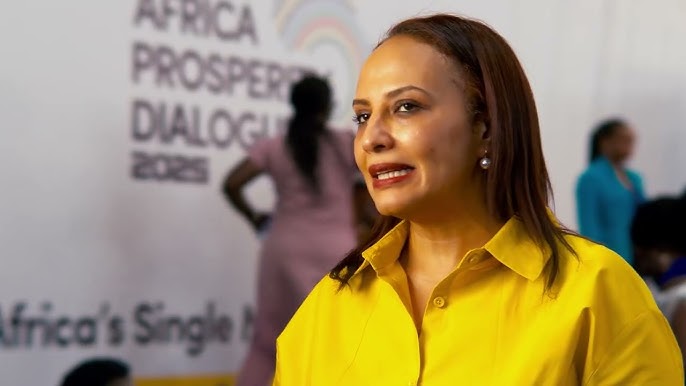
Dr. Fatima El Sheikh, Secretary General of the Arab Bank for Economic Development in Africa (BADEA), has urged African governments to introduce targeted tax incentives for women-led businesses, describing such measures as a “strategic economic shift” that could transform Africa’s development trajectory.
She made the call during the Presidential & Business Leaders’ Dialogue, held on Day Three of the 2026 Africa Prosperity Dialogues (APD). The dialogue, held under the theme “Empowering SMEs, Women & Youth in Africa’s Single Market: Innovate. Collaborate. Trade,” took place at the Accra International Conference Centre (AICC) on Friday, February 6, 2026.
Dr. El Sheikh highlighted the critical role of small and medium-sized enterprises (SMEs), women, and youth in driving the continent’s economic growth.
“Women and youth are not only the majority of Africa’s population, but they are also its greatest asset — a source of creativity, resilience, and ambition,” she said. Yet she cautioned that structural barriers, including limited access to finance, restricted markets, skill gaps, and weak integration into regional and continental value chains, continue to hinder their potential.
Dr. El Sheikh emphasized that the African Continental Free Trade Area (AfCFTA) presents an “unmatched opportunity” to unlock scale for African enterprises, allowing them to compete first within the continent and eventually globally. She noted that BADEA, with Ghana as its host, is committed to supporting this vision through financing, technical assistance, and capacity building initiatives.
“Our partnership in Ghana under the ‘24 Hours Our Economy’ initiative works to cascade finance to SMEs, with a particular focus on women and youth-led enterprises,” she said. “Innovation must be encouraged not only in technology but also in business models and financing instruments.”
Dr. El Sheikh called on African countries to take decisive leadership in implementing policies that reward women entrepreneurs. She proposed a tax incentive specifically for women-led businesses, stressing that this would go beyond promoting inclusion to reshaping Africa’s economic future.
“When women-led enterprises thrive, communities prosper. Supporting them is not a concession; it is an economic imperative,” she said. She highlighted that women-owned enterprises disproportionately reinvest in families and communities, enhancing productivity and long-term development.
Dr. El Sheikh appealed to policymakers, including representatives of the African Union and the Ghanaian government, to champion such initiatives. “Let’s make sure African women are at the front seat. Let’s give them the tools to lead trade, create jobs, and build wealth across the continent,” she urged.
Dr. El Sheikh further emphasized that recognition alone is insufficient. “I have spent 25 years championing African women. What I want is a legacy — a measurable impact that leaves lasting opportunities for the next generation,” she added.