

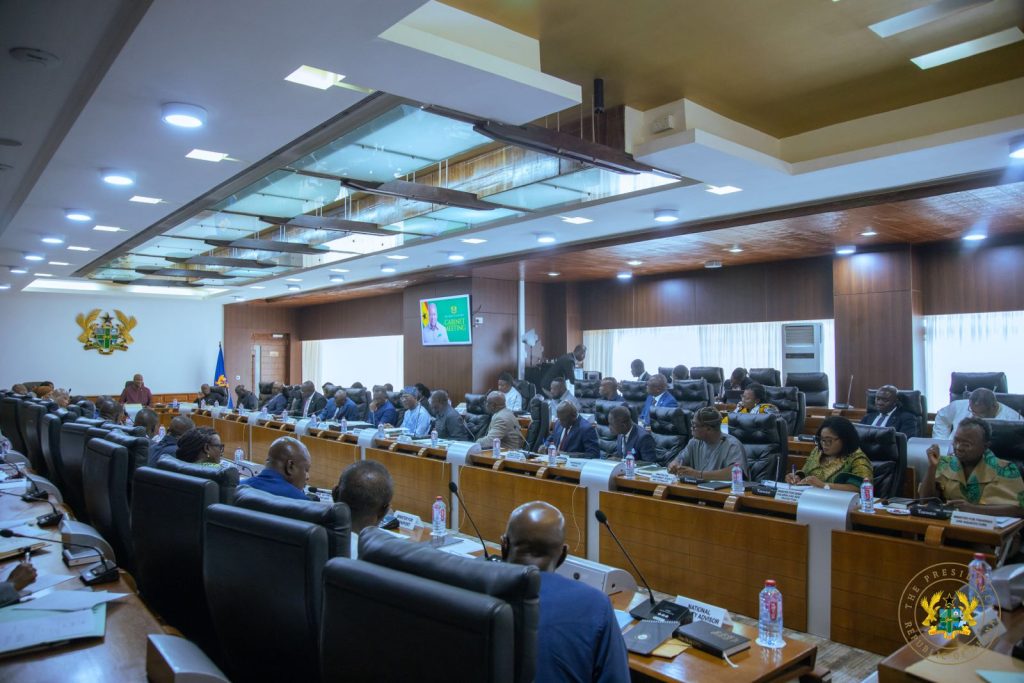
President Mahama’s Cabinet convened an emergency session on Wednesday to confront a deepening crisis in the cocoa sector, with Ghana’s beans now unsellable on the world market and the state marketing board effectively held hostage by a failed financing model, the Africa Confidential can reveal.
At the heart of the malaise: COCOBOD cannot afford to hold its own crop. With buyers walking away because Ghana’s producer price is no longer competitive, and liquidity so constrained that stock-holding for hedging is impossible, the industry now faces its most perilous season in decades.
The 2025/26 crop year began in August with a producer price of GH¢51,660 per tonne, set at 70% of gross FOB (US$7,200 at an exchange rate of 10.25). But by October, Abidjan had moved the goalposts. Côte d’Ivoire announced a farmgate price 20% above Ghana’s. Combined with cedi depreciation, the gap became a chasm.
The Producer Price Review Committee responded, hiking the price to GH¢58,000 to reflect a new exchange rate of 11.5. The move stemmed an immediate smuggling threat. But it came at a cost.
From October, the world market price began sliding. It has since fallen below US$6,400 per tonne—the breakeven point for Ghana’s delivered cost. COCOBOD, lacking the cash to warehouse and wait, kept selling. Buyers, meanwhile, are turning elsewhere. Other origins are now significantly cheaper.
The current distress is the harvest of decisions taken two years ago. In 2023, COCOBOD’s finances were already in intensive care. That year, for the first time, the annual syndicated loan suffered critical delays. Loss of confidence in Ghana’s economy pushed the first tranche to 22 December four months late.
Worse: COCOBOD had projected an 800,000-tonne crop and contracted 786,672 tonnes forward. Actual production was 432,145 tonnes. A forecasting error of 45% against a historical variance of 5-15% left the board with 333,767 tonnes of rolled-over contracts at an average price of just US$2,661 per tonne.
The loss: upwards of US$1 billion. Money that would have gone to farmers, the statement said, vanished.
By July 2024, COCOBOD could not pay the final syndicated loan tranche. The Ministry of Finance extended US$70 million in bridge financing to stave off default. That debt was never repaid. It has since been inherited by the current management.
The financing model hastily assembled after the 2023 syndication failure saw off-takers fund purchases directly. It kept the season moving but stripped COCOBOD of strategic flexibility. Without its own liquidity, the board cannot withhold supply when prices fall. It must sell into a declining market or cease buying from farmers.
That is the trap now sprung. With producer price fixed high to outcompete smugglers, and export prices below cost, COCOBOD is caught between the farmer and the buyer, between Abidjan and the cedi, between past debt and present illiquidity.
Cabinet has taken “key decisions”, according to the statement. What those are, it did not say. But with Ghana’s cocoa sector once the envy of West Africa now exporting at a loss and unable to finance its own crop, the question is no longer whether reform is coming. It is whether reform can arrive in time.