

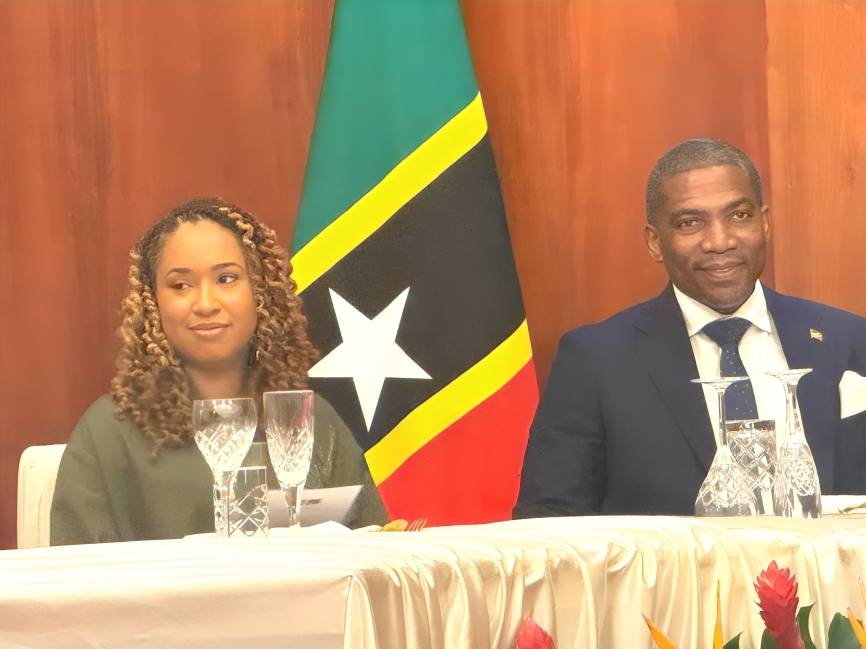
President John Mahama has secured a powerful ally in his campaign to have the transatlantic slave trade recognised as the gravest crime against humanity. Dr Terrance Michael Drew, Prime Minister of St Kitts and Nevis and current chair of CARICOM, has pledged to rally the entire Caribbean bloc behind Ghana’s African Union-backed resolution, scheduled for presentation to the UN General Assembly this month.
Speaking at Jubilee House on Wednesday, 4 March, during a state visit heavy with symbolism and substance, Dr Drew left no doubt about his commitment. “I am a leader of CARICOM, which are all of the countries in the Caribbean region, independent countries, and we have some associated members. And I, of course, consider this my responsibility to get CARICOM on board and the innovations have started. And so I wanted to place that on record.”
The Prime Minister’s visit, coinciding with Ghana’s 69th Independence Anniversary celebrations, was no routine diplomatic courtesy. Dr Drew revealed that Mahama’s address to the UN last year where he first signalled Ghana’s intention to pursue reparatory justice had moved him deeply. “There are a lot of speeches given at the UN General Assembly, but I particularly listened to your speech, and your speech inspired me. I told my team that I wanted to meet you.”
For Dr Drew, the journey to Accra carried personal and historical weight. “As I arrived in Ghana and I was driving along the street, I could not tell the difference whether I was at home or in a foreign country,” he said, pointing to the cultural and historical bonds that unite Africa and its diaspora.
“We come not only as partners in diplomacy, but as family reconnecting across the Atlantic. Saint Kitts and Nevis and Ghana share more than diplomatic ties; we share history.”
The Prime Minister reflected on the enduring legacy of the slave trade, which forcibly separated ancestors but failed to erase their identity. “In our music, in our spirituality, our cuisine and our communal traditions, the spirit of Africa lives on in St. Kitts and Nevis and the Caribbean.”
President Mahama seized the moment to articulate a vision that moves beyond symbolism. While acknowledging the emotional resonance of the transatlantic connection, he stressed the need for concrete economic integration.
“Political solidarity must now be matched by economic integration,” Mahama declared. He voiced strong support for expanding the African Export-Import Bank (AfriExim) into the Caribbean a move long discussed but yet to materialize describing it as “a bold and strategic step towards unlocking trade, investment, and financial cooperation across the Atlantic.”
The President also announced that Ghana will host a high-level special event on reparatory justice at the UN later this month. His language was calibrated for maximum impact. “We believe that the trafficking and racialized, structured enslavement of Africans constitutes one of the gravest crimes against humanity. Our call is not for charity. It is for justice.”
The visit produced more than declarations. Both countries signed a series of agreements designed to deepen bilateral cooperation, chief among them the extension of visa privileges to holders of ordinary passports—a significant bureaucratic easing previously reserved for diplomatic and service passport holders.
A bilateral labour agreement will facilitate the recruitment of Ghanaian medical professionals to address critical shortages in the Caribbean. Dr Drew confirmed that a contingent of Ghanaian nurses deployed in recent weeks had been “well-received, well-trained,” and that he had been asked to request more.
“I have heard that Ghana has a surplus of healthcare professionals, and the Caribbean has a dearth of healthcare professionals,” he said. “These are the type of collaborations that we can do among ourselves and make ourselves self-sufficient as the African continent, and as the Caribbean.”
A Memorandum of Understanding establishing a political consultation mechanism was also signed, alongside agreements to expand cooperation in tourism, climate resilience, renewable energy, the blue economy, and cultural industries.
Mahama acknowledged the structural constraints that continue to hamper Africa-Caribbean trade, including the absence of direct air connectivity. But he urged against using such obstacles as excuses for inaction.
“Improved air connectivity between Africa and the Caribbean is essential, but we cannot delay progress waiting for every structural constraint to be resolved,” he said. “Platforms such as the African Caribbean Trade and Investment Forum and the African Continental Free Trade Area offer immediate pathways to expand trade and investment partnerships.”
The President framed the relationship as a model for South-South cooperation. “Our ambition is clear: to position Ghana and St. Kitts and Nevis as model partners in South-South cooperation.”
As both leaders prepare for the UN event, the challenge will be translating political solidarity into measurable outcomes. Reparatory justice remains a contested concept in international law, and European powers have shown little appetite for formal compensation. But the Ghana-CARICOM axis, now reinforced by Dr Drew’s public commitment, represents a formidable voting bloc.
Mahama’s closing remarks captured the dual track of sentiment and strategy. “Our responsibility as leaders is to mobilise our people around a unifying vision, one that secures dignity, prosperity, and global respect for people of African descent everywhere.”
For Dr Drew, the visit to Ghana has already achieved its primary objective: a reconnection of family across the Atlantic. “There should be direct communication between Ghana and West Africa, and in particular, Ghana and Syria and the Middle East, so that our people don’t have to travel anywhere else to connect among ourselves,” he said.
With visa barriers falling, labour mobility increasing, and a coordinated diplomatic push now underway, the bridge between Africa and the Caribbean is strengthening. Later this month, at the United Nations, that bridge will be tested on the world stage.