

-But Who’s Watching the Watchers?
By Prince Ahenkorah
A regional taskforce set up to tackle the environmental fallout of illegal mining in Ghana’s Central Region says it has reclaimed over 10 hectares of degraded land but questions remain over the long-term sustainability of the effort, the role of foreign actors, and the state’s capacity to enforce its own mandates.
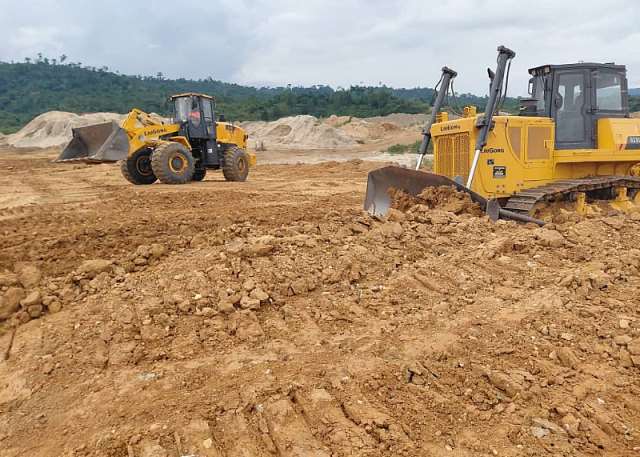
The Central Regional Land Reclamation Committee, a multi-agency body born out of a June 2025 Regional Security Council (REGSEC) resolution, has been quietly filling in abandoned mining pits and restoring scarred landscapes in Upper Denkyira East and surrounding districts.
The Committee’s December 15 statement, signed by NADMO’s regional director and Committee secretary CDCO E.K. Dawood Mensah, touts the initiative as a life-saving intervention.
The Committee’s formation followed a directive from the Ministry of Lands and Natural Resources and was greenlit by REGSEC after a proposal from the Upper Denkyira East MCE.
Chaired by Central North Police Commander DCOP Abraham Acquaye and coordinated technically by Engineer Abdulai Amo, the Committee includes representatives from NADMO, the Fire and Immigration Services, the EPA, Minerals Commission, Attorney-General’s Department, and several MMDCEs.
But this isn’t Ghana’s first anti-galamsey rodeo. Between 2006 and 2025, the country cycled through a carousel of operations—Flush-Out, Vanguard, Halt, NAIMOS—each promising to end illegal mining, each leaving behind a trail of abandoned pits and broken promises.
Those pits have proven deadly. In Upper Denkyira East alone, 27 people drowned in abandoned mine shafts between February and August 2025. Since the reclamation began, no new drowning cases have been reported—a rare and measurable success.
Yet the Committee’s own report reveals a troubling detail: many of the pits were left behind by foreign miners, particularly Chinese nationals, who operated in the area between 2017 and 2023 before relocating to the Western Region.
The report stops short of naming companies or individuals, and there is no indication that any prosecutions or reparations have followed.
The Committee has also had to fend off a wave of social media claims alleging that DRIP-provided machinery was torched by illegal miners. Officials deny this, stating that one low-bed truck was sabotaged in 2024 before the current administration took officeand another caught fire in a 2025 road accident. No attacks, they insist, have occurred during the current exercise.
To win hearts and minds, the Committee has taken to the airwaves, engaging local stations like Spark FM and Denkyiraman FM. The campaign, they say, has been met with “overwhelmingly positive” feedback. Small-scale miners, often scapegoated in national discourse, have reportedly cooperated with the effort.
Despite the gains, the Committee admits it is hamstrung by logistical bottlenecks. A lack of vehicles and heavy rains have slowed progress. More worryingly, the Committee warns of deliberate misinformation campaigns aimed at discrediting the project though it does not name the sources.
The Regional Coordinating Council has provided some support in the form of bulldozers, loaders, and trucks under the District Road Improvement Programme.
But the Committee is calling for more: a comprehensive RCC-led plan for the productive use of reclaimed lands, tighter REGSEC security to prevent re-mining, and sustained public education to keep communities engaged.