

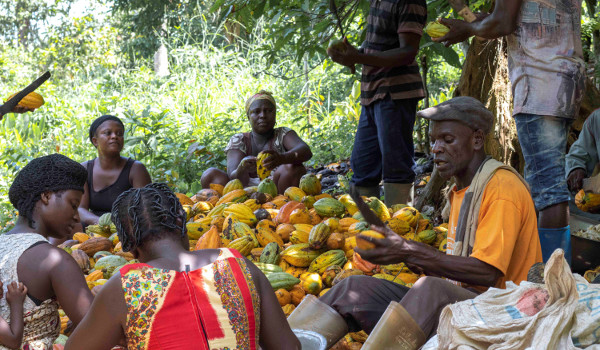
While Accra moves to stem its own sectoral bleeding, Côte d’Ivoire’s cocoa belt is seizing up.
A catastrophic slump in global prices has left the world’s largest producer with a paradoxical glut: warehouses are full, but farmers are penniless.
The much-vaunted regulatory machinery of the Conseil du Café-Cacao (CCC) is struggling to clear a logjam of unsold stocks from the main crop, pushing growers towards a precarious choice between ruinous price cuts and an unsustainable hoard.
The malaise began with last year’s bold but now-burdened pricing strategy. In a bid to outflank smugglers and boost rural incomes, the CCC set the farmgate price at a record high of 2,800 CFA francs (approx. US$5) per kilo.
This well-intentioned floor was immediately undermined by the subsequent and precipitous drop in global prices.
The result has been a commercial standstill. Licensed buyers, caught between the regulator’s high price and the tumbling world market, have stopped buying. Debts to farmers for last year’s beans remain unpaid, and new stock is piling up unsold.
“Everything is at a standstill,” conceded one licensed buyer, whose commercial viability is now in question. “We owe the farmers a lot of money, and we cannot tell when we will be able to pay.”
For growers like Fredrick Kwoasi Kwoasi, the CCC’s intervention has backfired.
With no official buyers at the legal price, he is confronted with a Faustian pact from informal traders: accept prices far below the government-set floor, or watch his new mid-crop harvest suffocate his homestead.
“They offer a choice that doesn’t suit us, but due to our lack of resources, we are forced to accept,” he said, facing the prospect of dumping his old stock for a pittance simply to clear space.
The CCC, under pressure from mounting inventories degrading in poor storage, accelerated a purchasing programme in early February.
But for the farmers and buyers now owed hundreds of millions of CFA francs, the regulator’s response is seen as too slow and too little. The authority, which sets the rules of the game, appears paralysed by the very floor price it created.
This gridlock in Abidjan stands in stark contrast to the swift, if painful, medicine being administered in Accra. Facing a similar liquidity crisis, Ghana’s government has mandated COCOBOD to pay arrears and clear accumulated beans. More strikingly, in a move that would have been unthinkable a year ago, COCOBOD’s hierarchy has taken a scalpel to its own salaries. Under its new CEO, Dr Randy Abbey, top executives have taken a 20% cut, and senior staff 10%, for the remainder of the season a direct admission of the severity of the industry’s distress and an attempt to share the burden.
For Ivorian farmers watching their Ghanaian counterparts receive state intervention and their buyers take pay cuts, the CCC’s inertia is damning. With the mid-crop looming and no clear signal from Abidjan on a revised pricing mechanism, the standoff is forcing farmers into a corner. They are left, like Kwoasi, to take solace only in the fact that the trees themselves remain alive, hoping for a policy rescue that has yet to materialise.