

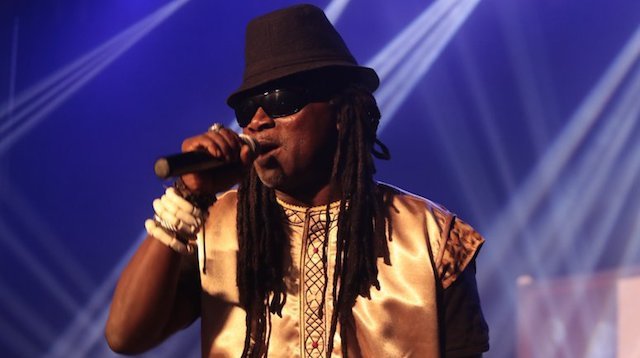
Highlife legend, Amandzeba Nat Brew, has registered his strongest displeasure during a performance at government’s ‘Diaspora Summit 2025’ programmes on Friday, December 19.
The artiste, was one of the creatives who performed at the opening of the 2-day event, underway at the Accra International Conference Centre (AICC). He performed his hit song ‘Wogbe’ released several years ago.
After what can be described as an amazing performance, Amandzeba dropped the bombshell.
Immediately after his performance, Nat Brew while thanking the gathering shockingly declared that he would have declined the invitation to perform but for the respect he has for President John Mahama, the Foreign Affairs Minister, Samuel Okudzeto Ablakwa and the audience.
Before handing the microphone over to the MC, Anita Erskine, the veteran musician retorted “But for this gathering, the president, the honourable minister, I would have declined this invitation”.
He however indicated that, his comment was for the ears of the President only. “But this is for the ears of the president”. Few minutes later, President Mahama delivered his keynote address and launched the two day event. He did not react to the comment by the musician.
It is not clear where Amandzeba’s concerns stem from but he has been out of the public eye for years now. It is not known if his concern has anything to do with political appointment.
Even though he is not known to be involved in active politics, he is said to be related to late President, Prof John Atta Mills.
Delivering his speech, President Mahama called for a deliberate unification of the African diaspora against long-standing and colonial mindsets.
According to him, this will be a strategic reversal of historical oppression to take back power. He addressing a gathering of diasporans and stakeholders, challenged attendees to actively deconstruct harmful narratives and adopt a new operational blueprint rooted in collective strength.
“Anything in this life, one strength of his power will no longer work. And that is true of slaves. It is true of stories, especially ones that are complete fabrications,” he stated, arguing against reliance on singular, outdated systems and false historical accounts.
The President issued a direct and provocative mandate for strategic reappropriation.
“Let’s take the narrative of those who oppressed us and work it. In fact, let’s take their entire modus operandi, flip it and reverse it.”
The core of his appeal was a charge to outperform the architects of division.
“So I urge you, my brothers and sisters, let’s be more intentional about our unity than they were about our division,” he concluded.
He called for a reexamination of Ghana’s national narrative to fully recognise the historical and cultural role of the African diaspora, arguing that the country’s story did not begin with colonial rule.
He challenged conventional accounts of Ghanaian history that often trace the nation’s origins to 1821, when the British established the Gold Coast colony.
The President said the exclusion of the diaspora from Ghana’s historical narrative had left the country with an incomplete understanding of its past.
“Have you ever wondered why the story of Ghana never included the story of the diaspora?” he asked, noting that the collective history of Ghana’s people predates colonial boundaries and administrations.
Foreign Affairs Minister, Samuel Okudzeto Ablakwa, on his part called for coordinated global action to advance the cause of reparative justice for Africans and people of African descent, describing it as a moral and historical imperative.
Ablakwa stressed that the summit should mark a turning point from rhetoric to concrete action in the demand for justice over the transatlantic slave trade and its lasting consequences.
He emphasized that reparative justice is not merely about the past, but about restoring dignity, recognizing historical wrongs, and forging a united global African front with a shared purpose.
According to Ablakwa, honouring the sacrifices and suffering of ancestors requires deliberate efforts to ensure their experiences are acknowledged and remembered, while empowering future generations to move beyond historical trauma.
The Minister noted that Ghana’s engagement with the diaspora remains central to the broader reparation agenda, positioning the country as a rallying point for justice, unity, and renewed global African identity.
“Let history record that this summit marked the moment when we move beyond rhetoric to coordinated action and when we unreservedly demanded justice for the greatest sin against humanity. In so doing, we honour our ancestors by insisting that their plight be recognized, that their pain and suffering be remembered and that their dignity be restored.
“We may be the answers to the prayers of our ancestors, but our children will be the beneficiaries of our refusal to be defined by the wounds of the past and our strength to join forces as one global African family with a collective purpose. Together, let us reaffirm that Africa’s rights is not only inevitable, it has already begun here in Accra,” he stated.
Several dignities including the President of Togo, Faure Gnassinggbe, Ghana’s diplomat Dr. Mohammed Ibn Chambers who is AU’s High Representative for Silencing the Guns, Ga Mantse King Tackie Teiko Tsuru II and many whom were Ghanaians living abroad and people of African descent.
The summit was held under the theme “Resetting Ghana: The Diaspora as the 17th Region.”
By Gifty Boateng