

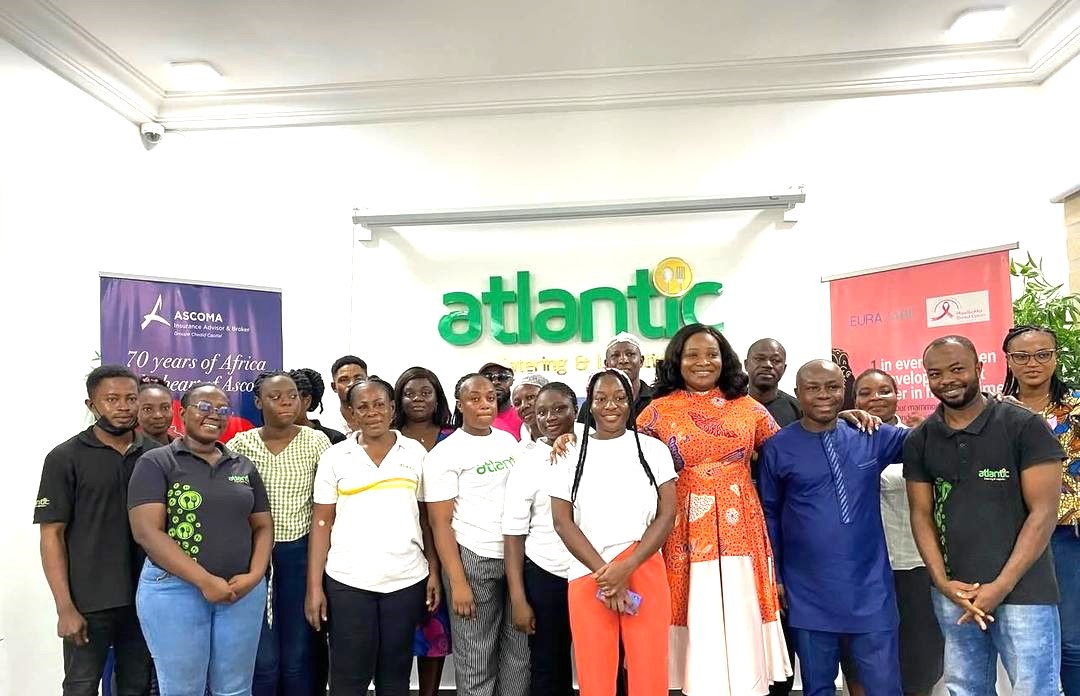
By Nana Appiah
When workers on Ghana’s offshore rigs and mining sites break for meals, the tomatoes, yams, and peppers on their plates tell a story that transcends hospitality. They are not imported. They are the harvest of Ghanaian smallholder farmers who now have a guaranteed buyer, thanks to a supply chain revolution engineered by Atlantic Catering & Logistics Ltd.
The woman behind it, Founder and CEO Maud Lindsay-Gamrat, operates on a simple but radical premise: successful business and economic development are not trade-offs. They are mutually reinforcing. A decade into building Atlantic Catering, she has the balance sheet to prove it.
“Every tomato, every yam, every pepper we buy from a Ghanaian farmer is money that stays in our economy,” Lindsay-Gamrat told The New Republic. “We are not just feeding our clients. We are contributing to the rural economy.”
The arithmetic is compelling. By sourcing directly from local farmers, Atlantic Catering creates a ready market that insulates growers from the volatility of spot markets and the scourge of post-harvest losses. The millions of cedis that flow through this supply chain circulate in rural communities rather than leaking overseas to pay for imported food.
It is a model that has propelled Atlantic Catering to 20th place on the prestigious Ghana Club 100 list, with 600 employees and a client roster that reads like a who’s who of Ghana’s extractive sector: oil and gas multinationals, mining operations, and airlines.
Lindsay-Gamrat’s trajectory is instructive. Before launching Atlantic Catering in 2014, she spent fifteen years in senior management at a multinational inflight catering company. The experience was formative. Feeding passengers at 35,000 feet leaves no margin for error. It instilled in her a discipline of systematic processes, uncompromising standards, and end-to-end supply chain vigilance.
When Ghana’s extractive industries began their expansion, she recognised an opportunity that went beyond filling bellies. The local content agenda the push to ensure Ghanaians benefit from resource extraction required proof that local suppliers could meet international standards.
Atlantic Catering became that proof. Lindsay-Gamrat invested heavily in ISO certifications for food safety, environmental management, and occupational health. The company became the first Ghanaian caterer to join the UN Global Compact Network. These credentials opened doors to multinational clients, but they also raised the bar for her suppliers.
The impact cascades down the chain. Farmers supplying Atlantic Catering must meet quality and safety requirements that professionalise their operations. What began as a catering company has become an engine of agricultural modernisation.
The philosophy extends beyond corporate clients. Through the ‘Clean Bites’ initiative, run by the Atlantic Cares Foundation, the company has trained over 1,300 street food vendors in safe food handling and sanitation. “Excellence shouldn’t be reserved for multinationals,” Lindsay-Gamrat insists. “Every Ghanaian deserves safe food.”
A graduate of UPSA with a Global Executive MBA from China Europe International Business School, Lindsay-Gamrat runs dedicated training programmes for her workforce, with particular focus on women. Emotional intelligence and leadership courses are standard. “I believe in lifting as I climb,” she says.
The next climb is continental. Lindsay-Gamrat plans to take Atlantic Catering’s model across Africa, maintaining the local sourcing ethos that has defined its success. “Wherever we go, we will source locally,” she affirms. “That is how you build economies and ensure local communities benefit.”
For Ghana’s smallholder farmers, the message is tangible: there is a buyer waiting for their harvest, and the market stretches all the way to the oil rigs. For policymakers watching the local content debate, Atlantic Catering offers evidence that the agenda is viable when driven by private sector discipline rather than government diktat.
Maud Lindsay-Gamrat has built more than a catering company. She has demonstrated that Ghana’s resources can feed Ghanaians twice once through extraction, and again through the supply chains that support it.