

Mahama’s Refinery Revival Seeks To Tame ‘Galamsey’ And Capture Value
By Philip Antoh
In a strategic move to formalise the chaotic artisanal gold sector and capture greater value from its mineral wealth, the government has initiated the first-ever local refining of gold sourced from small-scale miners.
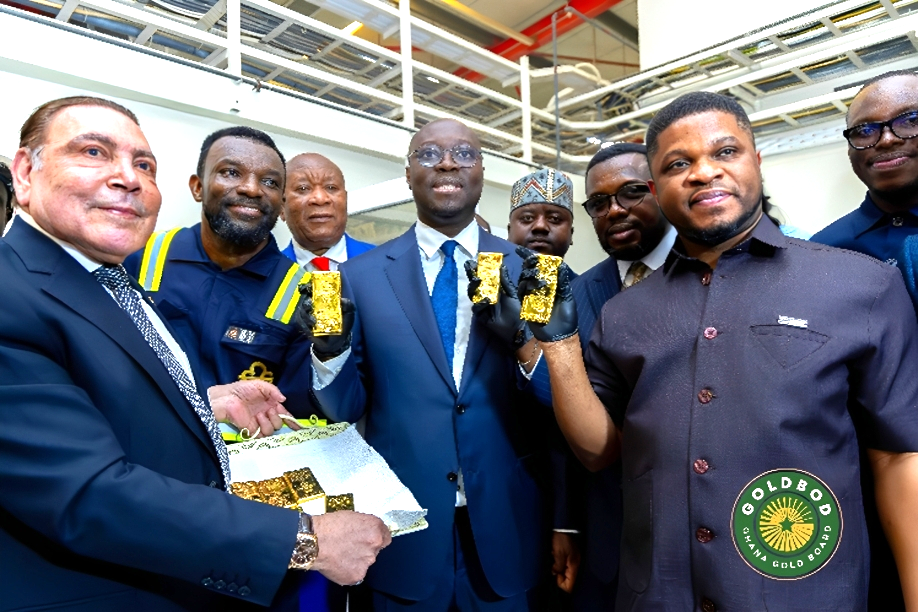
The Ghana Gold Board (GoldBod), in partnership with the privately-owned Gold Coast Refinery (GCR), has begun processing gold into bullion bars, marking the operational revival of a facility originally commissioned by President John Mahama in 2016 but left largely dormant thereafter.
The initiative, showcased during a high-level tour led by Finance Minister Dr. Cassiel Ato Forson and GoldBod CEO Sammy Gyamfi, represents a core plank of the administration’s economic policy.
It aims to redirect a significant portion of the estimated $6 billion in annual informal gold exports into official channels, boosting foreign reserves and tightening control over the illicit ‘galamsey’ trade that has caused severe environmental damage.
GCR’s Executive Chairman, Dr. Said Deraz, revealed the refinery is operating with technical support from South Africa’s Rand Refinery, the only London Bullion Market Association (LBMA)-accredited refinery in Africa.
This partnership is crucial for ensuring the final product meets international trading standards.
The current agreement with GoldBod covers one tonne of gold per week, though GCR’s stated capacity is two tonnes. “These gold bars you see are for the Ghana Gold Board. We are just service providers,” Deraz stated, underscoring the state’s intended control over the commodity.
Minister Forson framed the move as the fulfillment of President Mahama’s long-held vision, directly linking the refinery’s operation to the government’s flagship ’24-hour economy’ policy, citing the creation of 162 jobs and round-the-clock shifts.
The bullion bars now bear the stamps of GoldBod, the Bank of Ghana, and the Ghana Standards Authority a first for a state entity.
However, analysts note significant hurdles. The success of the scheme hinges on GoldBod’s ability to consistently attract and purchase gold from artisanal miners at competitive prices, outbidding well-established and often illicit foreign buyer networks.
Furthermore, while the Rand Refinery technical partnership provides interim credibility, Ghana’s long-term ambition to become a regional hub depends on GCR obtaining its own LBMA accreditation a costly and rigorous process that remains a future goal.
Minister Forson’s call for GoldBod to establish a national assay laboratory by year’s end points to the infrastructure gaps still being addressed.
The venture is a high-stakes test of state capacity. If successful, it could enhance fiscal stability, reduce environmental degradation, and add value to a primary export. If it fails to lure miners from the informal sector, it risks becoming a costly white elephant.
The government is betting that formalisation, through a guaranteed market and now local refinement, will prove more attractive than the shadowy, albeit familiar, galamsey economy.
The durability of this model will be tested by the international gold price, the efficiency of GoldBod’s operations, and the sustained political will to enforce mineral sector regulations.