

By Philip Antoh
Vice President Jane Naana Opoku-Agyemang has offered unusually strong public endorsement for Lands and Natural Resources Minister Emmanuel Armah-Kofi Buah, framing his leadership as a decisive turn in Ghana’s protracted and largely unsuccessful fight against illegal mining (galamsey).
The high-profile commendation during a working visit on 27 January signals a strategic attempt to reinvigorate a politically toxic anti-galamsey agenda that has undermined previous administrations.
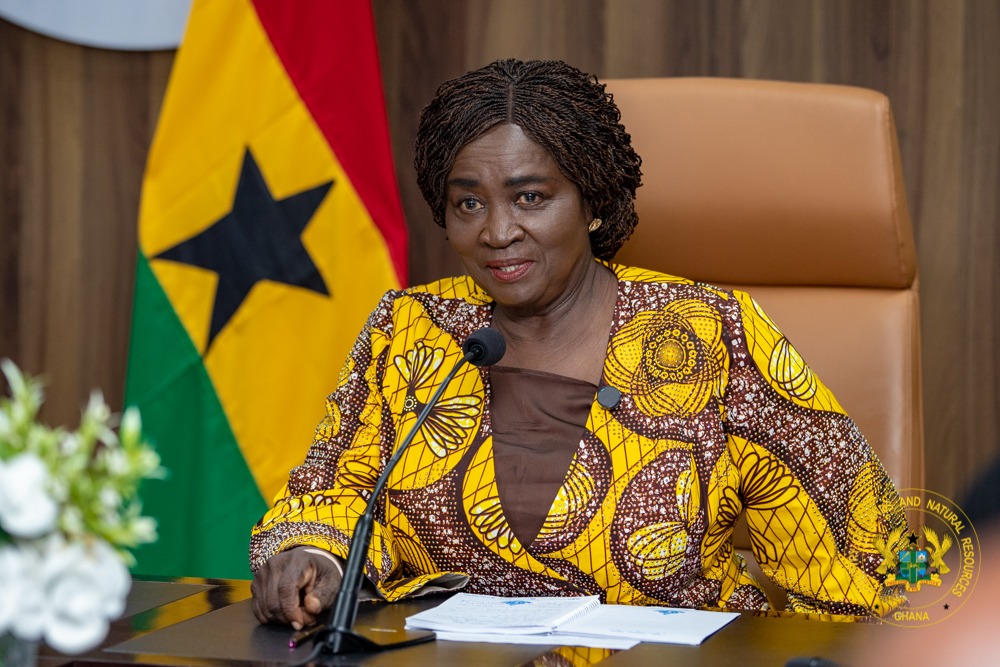
Speaking to the Ministry’s senior staff, the Vice President characterized the Ministry under Buah as moving from “mere words to real actions,” specifically citing land reclamation and improved inter-agency coordination.
She described the institution as critical to “national survival,” acknowledging the “significant” historical damage while insisting on a current “determination to restore.” This language serves a dual purpose: validating Buah’s approach while carefully distancing the current government from the policy failures of the immediate past.
The Vice President’s focus on “tackling vested interests” is a pointed, if indirect, acknowledgment of the powerful syndicates often with political and security connections that have rendered previous crackdowns ineffective.
Her pledge of “full support from the highest levels of government” is a necessary political guarantee for a minister whose enforcement actions are likely to provoke fierce resistance.
Opoku-Agyemang explicitly linked land administration reform and digitization to the anti-galamsey fight, identifying transparent land systems as a tool to “reduce misuse and enhance accountability.”
This aligns with the Ministry’s ongoing efforts to formalize and digitize land records, a technical process aimed at weakening the opaque customary and informal agreements that often facilitate illegal mining operations.
Minister Buah, in his presentation, reiterated the goal of balancing economic development with environmental protection, a standard formulation that belies the extreme difficulty of the task. His reference to “gradually rebuilding trust” admits the deep scepticism surrounding government action in this sector.
The Vice President’s visit is less a routine morale booster and more a calculated political intervention. It aims to confer high-level legitimacy on Buah’s mandate, arm him with visible presidential backing for difficult enforcement decisions, and reset public expectations after years of policy whiplash and enforcement theatre.
The true test will be whether this top-cover support translates into sustained, politically costly actions against well-connected operators in hotspot regions like the Ashanti, Eastern, and Western territories.
The endorsement raises Buah’s profile but also his accountability; failure to demonstrate tangible progress will now reflect directly on the Vice President’s office.
This move suggests the administration is preparing for a more confrontational phase in the galamsey war, likely anticipating significant political blowback.