

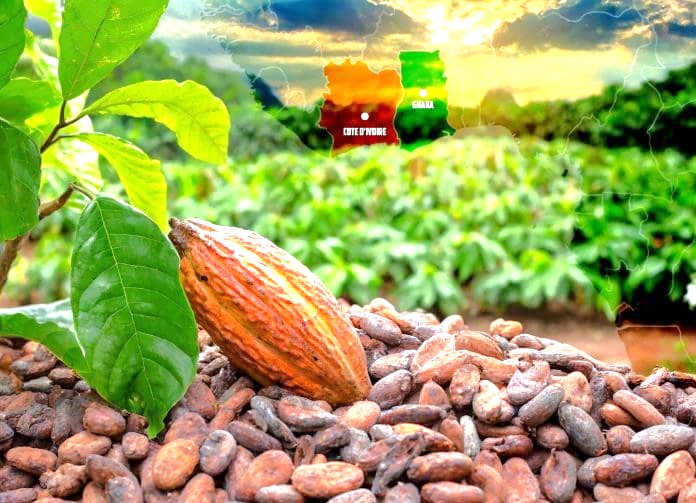
The world’s two largest cocoa producers are navigating the sharpest market downturn in a generation, but their trajectories have sharply diverged. Ivory Coast’s dramatic 60 per cent cut to its farmgate price on 4 March stands in stark contrast to Ghana’s more modest 30 per cent reduction three weeks earlier.
The divergence exposes the fragile foundations of a decade-old alliance and lays bare the structural vulnerabilities of economies built on a single commodity.
Agriculture Minister Bruno Kone delivered the news Ivorian farmers had dreaded: from March, the price would fall to 1,200 CFA francs per kilogramme, down from the record 2,800 CFA francs set by President Alassane Ouattara in October ahead of his re-election campaign .
The announcement came a month ahead of the normal pricing cycle—a measure of the desperation gripping Abidjan as unsold stocks pile up across the country.
“The price of cocoa on the international market is forcing us to make an adjustment,” Kone told reporters, acknowledging that world prices had plunged from $12,000 per tonne in late 2024 to around $2,900 today .
Across the border, Finance Minister Cassiel Ato Forson had on 12 February announced a new producer price of GH¢2,587 per bag a cut of roughly 30 per cent from previous levels .
The reduction was accompanied by a sweeping reform agenda: a new COCOBOD Bill allowing automatic price adjustments linked to world markets, a forensic audit of the past eight years, and a mandate for 50 per cent local processing .
The arithmetic of survival differs markedly between the two neighbours. Franklin Cudjoe, president of IMANI Africa, calculated that Ivorian farmers will receive the equivalent of 980 to 1,225 Ghana cedis per 64kg bag for the mid-crop starting March. Ghanaian farmers, by contrast, will take home GH¢2,587 per bag almost double .
Yet the comparison offers cold comfort to farmers on both sides of the border. In Ivory Coast, the sector accounts for 14 per cent of GDP and supports some five million livelihoods . In Ghana, nearly two million people depend on cocoa, and the country is still recovering from its deepest economic crisis in a generation .
The roots of the crisis lie in the vertiginous swing of global commodity markets. After cocoa prices soared to record levels in late 2024, chocolate manufacturers responded by reducing bar sizes, increasing non-cocoa additives, and pivoting to alternative products—the so-called “Year of the Gummy Bear” trend that has fundamentally altered consumer habits .
At the same time, favourable weather produced bumper harvests, leaving the global market headed for a surplus of 300,000–400,000 tonnes this season . For Ghana and Ivory Coast, which together supply some 60 per cent of world output, the arithmetic turned lethal.
Both countries operate state-managed marketing systems that sell forward 80 per cent of their crop and set fixed farmer prices based on those forward sales . When world prices plummeted, traders simply stopped buying Ivorian and Ghanaian beans, leaving stockpiles rotting in warehouses.
In Abidjan, the government launched a programme in late January to buy 100,000 tonnes of unsold cocoa directly from farmers at a cost of half a billion dollars . Kone told RFI last week that 64,000 tonnes had been purchased, though unionist Yao Yao complained that some growers “still haven’t received any money”
In Ghana, COCOBOD’s liquidity crisis proved even more acute. The corporation defaulted on a $70 million bridge facility and accumulated legacy debts of GH¢5.8 billion, including GH¢3.7 billion owed to the Ministry of Finance.
Production shortfalls worsened the situation: COCOBOD had projected 800,000 tonnes for 2023/2024 but produced only 432,145 tonnes, creating rollover contracts and losses exceeding $1 billion .
The crisis represents the sternest test yet of the Ghana-Ivory Coast cocoa alliance, formalised in 2017 to coordinate pricing and improve farmers’ livelihoods. The partnership secured the $400 per tonne Living Income Differential in 2020, a landmark achievement that forced global traders to pay a premium for West African beans .
But national economic pressures are now overriding regional solidarity. Ghana’s aggressive price cut and reform agenda reflect the exigencies of a country in debt distress. Ivory Coast’s more dramatic reduction, by contrast, comes from a position of relative financial strength—though the optics of a 60 per cent cut so soon after a record high are politically damaging for Ouattara.
Alex Assanvo, executive secretary of the Initiative cacao Côte d’Ivoire – Ghana, acknowledged that the two countries would need to coordinate their responses. “The organisation remains mobilised to coordinate policies in both countries,” he told Reuters .
The pricing gap has created an irresistible arbitrage opportunity. With Ghanaian beans now significantly cheaper than Ivorian cocoa, smugglers are moving product across the border to capture the premium . The phenomenon threatens to distort supply data and undermine the credibility of both countries’ regulatory systems.
Ivory Coast has responded by moving its mid-crop harvest start date forward to 1 March, hoping to stay ahead of the smuggling curve . But the structural incentives remain: as long as the price differential persists, beans will flow across the border.
Ghana’s reform agenda represents a fundamental shift in philosophy. The proposed COCOBOD Bill would institutionalise flexibility, allowing automatic producer price adjustments linked to world prices and exchange rates while guaranteeing farmers at least 70 per cent of gross FOB . The 50 per cent local processing mandate aims to capture value that currently flows overseas, creating jobs and reducing exposure to raw commodity volatility.
Ivory Coast, by contrast, has doubled down on state intervention. The CCC’s decision to purchase unsold stocks directly—a half-billion-dollar gamble—reflects a belief that the state must absorb short-term pain to maintain farmer loyalty and long-term production capacity.
Which strategy will prove more resilient remains an open question. Ghana’s approach risks alienating farmers who voted for the Mahama administration on promises of higher prices . Ivory Coast’s interventionism strains the public finances and may prove unsustainable if low prices persist.
For the millions who depend on cocoa, the statistics translate into empty pockets and anxious households. Yao Yao, the unionist based in Duekoue, spoke for farmers on both sides of the border when he voiced disappointment that the state was not doing more to offset “such a dizzying drop” .
In Ghana, farmers who marched on COCOBOD headquarters in February carried placards reading “Cocoa is sweet, but our lives are bitter.” President Mahama, himself a 50-acre cocoa farmer, offered empathy but no reversal. “I am a cocoa farmer, so when the prices were reduced by government it affected me too,” he said .
The medium-term outlook offers little comfort. Global cocoa inventories have surged to a six-month high of 2.15 million bags . Demand destruction from the 2024 price spike appears persistent, with consumers developing “sticky” habits for non-chocolate alternatives.
Major manufacturers like Hershey and Mondelez are processing high-cost cocoa hedged during the 2025 highs, compressing margins and delaying any benefit from lower spot prices . Mondelez reported gross margins collapsing from 38.6 per cent to 28.2 per cent in its most recent filings, warning of a $500 million hit in Q1 2026 due to inventory revaluations .
For Ghana and Ivory Coast, the coming months will determine whether their alliance can survive the current turmoil—and whether either country’s strategy can deliver a sustainable future for the millions who depend on cocoa. In villages across the cocoa belt, farmers are watching and waiting. The sweet taste of chocolate has turned bitter.