

By Nelson Ayivor
President John Dramani Mahama has announced a decisive shift in Ghana’s mineral development strategy, declaring that by 2030 no raw mineral ores will be exported from the country.
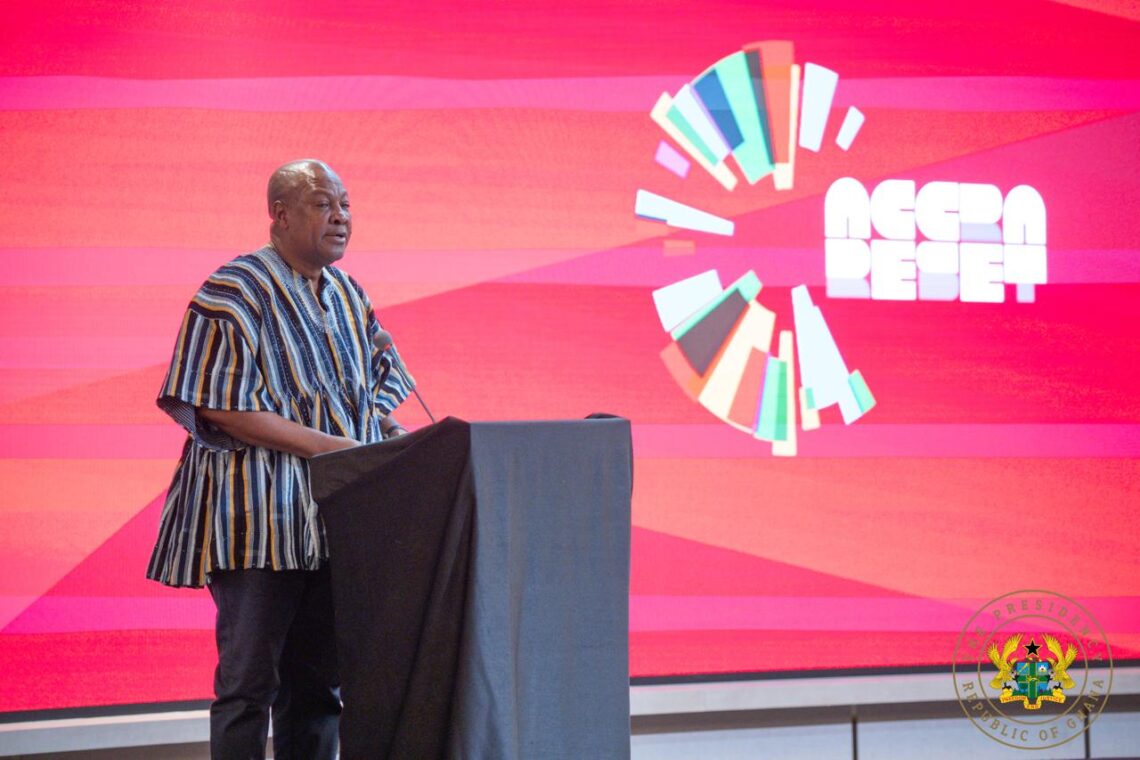
Speaking at the Accra Reset side event dubbed Addis Reckoning on the margins of the African Union Summit in Addis Ababa, the President said the policy marks a turning point in Ghana’s pursuit of industrialisation, job creation, and economic sovereignty.
Addressing African leaders, development partners, and private sector stakeholders, President Mahama stated that Ghana would no longer ship raw manganese, bauxite, or iron ore abroad.
Instead, all such minerals would be processed locally to ensure value addition and broader participation of Ghanaians in the mineral value chain. According to him, exporting unprocessed resources has denied the country jobs, technology transfer, and long term economic benefits.
President Mahama framed the 2030 deadline as both an economic and social imperative. He argued that Ghana’s young population demands visible progress and tangible opportunities, and that continued reliance on raw exports has failed to meet these expectations.
Local processing, he said, is the most direct pathway to building industries that can absorb skilled and semi skilled labour while expanding the country’s manufacturing base.
The President stressed that industrialisation anchored in mineral processing would stimulate related sectors such as logistics, energy, engineering, and services.
He noted that Ghana possesses sufficient mineral endowments to support domestic industries if deliberate policies are pursued to attract investment, build infrastructure, and strengthen technical capacity.
Youth Employment and Migration Pressures
A central theme of President Mahama’s remarks was the link between economic opportunity and migration. He warned that limited job prospects at home have pushed many young Africans to take dangerous migration routes across the Sahara and the Mediterranean in search of livelihoods in Europe.
President Mahama said the Accra Reset initiative was designed to respond to this urgency by accelerating structural transformation rather than relying on slow incremental change.
He emphasised that young people are less willing to wait for distant promises of prosperity and instead expect immediate pathways to employment and economic inclusion.
By retaining and processing minerals locally, Mahama argued, Ghana could create sustainable jobs that reduce the incentives for irregular migration while strengthening social stability.
The President linked the mineral export ban to the broader objectives of the Accra Reset, a framework aimed at repositioning Africa within global value chains. He described the initiative as action oriented, insisting that Africa must move beyond declarations to implementation.
According to President Mahama, the Addis Reckoning marked a moment of accountability where ideas discussed in previous forums must translate into concrete decisions. He said the commitment to end raw mineral exports was an example of the kind of decisive action required to reset Africa’s development trajectory.
President Mahama called on policymakers, investors, and development partners to align financing, skills development, and technology transfer with Africa’s industrial ambitions.
Implications for Industry and Investment
The announcement is expected to have significant implications for Ghana’s mining sector and its investment climate. Local processing of minerals will require substantial investment in refineries, smelters, and supporting infrastructure, including reliable power and transport networks.
President Mahama acknowledged these challenges but argued that they also present opportunities for domestic and foreign investors. He said Ghana is prepared to work with credible partners who are willing to invest in value addition rather than extractive export models.
He added that policy certainty, regulatory clarity, and regional market integration would be critical to making local processing commercially viable.
President Mahama placed Ghana’s decision within a broader African context, noting that many countries on the continent are reassessing their roles in global supply chains. He argued that Africa’s continued export of raw materials perpetuates dependency and limits bargaining power in international trade.
By prioritising local processing, Ghana aims to position itself as part of a new African industrial wave that leverages the African Continental Free Trade Area to access regional markets.
President Mahama said coordinated approaches among African countries could help avoid destructive competition while building complementary industrial hubs.
In his closing remarks, Mahama emphasised that the success of the 2030 target will depend on disciplined implementation. He urged stakeholders to treat the declaration not as a political slogan but as a binding national objective.
He stressed that timelines, accountability mechanisms, and measurable milestones must guide the transition from raw exports to value added production. The Accra Reset, he said, provides the urgency and coordination needed to drive this transformation.
President Mahama concluded by thanking participants for their engagement and reiterating that the Addis Reckoning was a call to action. From Addis Ababa, he said, Africa must stop talking and start implementing policies that deliver prosperity for its people.