President John Dramani Mahama has announced the establishment of a robust framework to strengthen the Cash Waterfall Mechanism, marking a significant step in stabilising Ghana’s power sector finances.
Speaking during his 2026 State of the Nation Address in Parliament, the President said the new framework goes beyond merely clearing inherited arrears and is designed to ensure strict monitoring and effective implementation of the mechanism.
“A robust framework has been established to strengthen monitoring and implementation of the Cash Waterfall Mechanism, beyond clearing inherited arrears.”
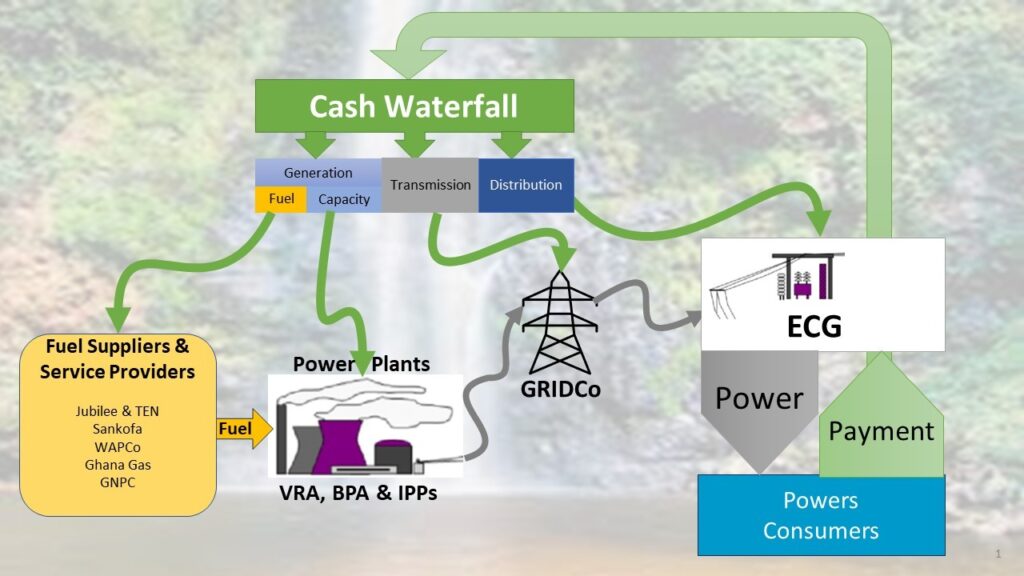
The Cash Waterfall Mechanism, introduced to allocate revenues collected in the power sector among stakeholders in a structured and transparent manner, has faced persistent challenges in recent years due to revenue shortfalls and inefficiencies in distribution.
ECG Losses and Liquidity Crisis in 2024
President Mahama attributed part of the sector’s recent financial instability to weaknesses at the distribution level under the previous administration led by Nana Akufo-Addo.
According to him, the Electricity Company of Ghana struggled with high commercial and technical losses, significantly undermining revenue flows into the mechanism.
“At the distribution level, the Electricity Company of Ghana (ECG) was plagued by high commercial and technical losses, collecting only 62% of the energy it purchased and declaring less than 50% of its collections into the Cash Waterfall Mechanism (CWM).”
He explained that the situation resulted in severe liquidity shortfalls across the power value chain, with cascading effects on electricity generation and supply reliability throughout 2024.
The shortfall meant that independent power producers and other sector players were not paid in full and on time, increasing debt levels and straining relationships within the industry.
ECG Single Holding Account.
To plug revenue leakages and restore discipline, the government operationalised the ECG Single Holding Account, a key financial control measure.
“Another major milestone was the operationalisation of the ECG Single Holding Account, overseen jointly by the Ministry and the Public Utilities Regulatory Commission (PURC).
“This intervention has significantly reduced revenue leakage and enhanced ECG’s capacity to meet its payment obligations.”
The involvement of the Public Utilities Regulatory Commission in overseeing the account is intended to promote transparency and ensure that collections are properly accounted for before distribution through the Cash Waterfall Mechanism.
Energy sector analysts view the Single Holding Account as a critical reform tool capable of addressing long-standing inefficiencies that have undermined financial sustainability in the sector.
Renegotiation of Power Purchase Agreements
In addition to tightening revenue management, the government has taken steps to address the high cost of power generation, which has placed pressure on tariffs and public finances.
President Mahama revealed that negotiations with nine Independent Power Producers have yielded significant savings and debt restructuring.
“The Engagements with the Independent Power Producers (IPPs) have resulted in $250 million in immediate savings and $1.1 billion of debt restructured for payment in the period 2026–2028.”
The revised agreements, he noted, will be submitted to Cabinet and Parliament for approval and ratification, ensuring that due process is followed.
Renegotiating power purchase agreements has long been considered a delicate task, as many of the contracts contain capacity charges and take-or-pay clauses that have contributed to rising sector debt.
The government’s ability to secure both immediate savings and medium-term restructuring signals a major breakthrough in cost management.
Toward Financial Stability and Reliable Power
The combined impact of strengthening the Cash Waterfall Mechanism, operationalising the ECG Single Holding Account and renegotiating IPP contracts is expected to improve liquidity across the electricity value chain.
By ensuring that revenues are fully captured and transparently distributed, the government aims to rebuild confidence among investors and power producers while safeguarding consistent electricity supply for households and businesses.
President Mahama framed the reforms as part of a broader strategy to place the energy sector on a sustainable footing.
With revenue leakages curtailed and payment systems reinforced, the administration believes the power sector can move beyond the recurring cycles of debt accumulation and supply disruptions that have characterised recent years.
As the revised agreements await legislative approval, stakeholders will be watching closely to assess how effectively the new framework consolidates gains and maintains discipline within the system.
For now, the announcement signals a renewed commitment to restoring financial health in Ghana’s power sector, with the strengthened Cash Waterfall Mechanism at the centre of the reform agenda.