

Says Days of Political Cover For Illicit Gold Are Over’
By Leo Nelson
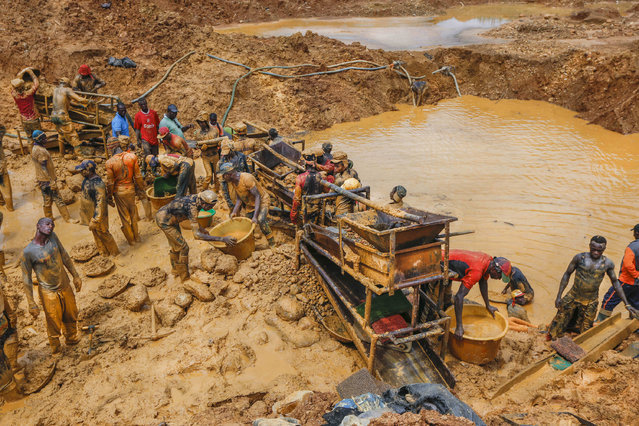
In a moment of startling candour that cut through the usual political platitudes, President John Dramani Mahama has admitted that the fight against illegal mining, the environmental scourge, known as galamsey is complicated by the fact that actors within his own political network are complicit.
Addressing a delegation from Organised Labour at the Jubilee House on Tuesday, the President laid bare the uncomfortable reality of a clandestine economy that adapts and survives by purchasing protection from whichever party holds power.
“And so I don’t kid myself that we don’t have our own people involved,” Mahama stated, offering a rare glimpse into the realpolitik of resource governance.
He described a well-worn pattern of political capture, where mining operators, facing a change of regime, swiftly pivot to seek new patrons.
“Even when one party changes, those who were running some operation will go to the next party and say, now that you have come, come and take over this operation and let’s share. We too will be getting small, this is what we are doing,” he explained.
The President’s admission underscores the deep entanglement of galamsey within the country’s political and traditional fabric. His comments were not merely an observation but a warning to his own appointees and allies that the old rules of engagement have changed.
The message from the Flagstaff House is clear: the days of operators shifting allegiance and continuing business as usual under a new political umbrella are numbered.
This political entanglement is just one layer of a multi-faceted crisis. Mahama detailed the fierce resistance encountered by the National Anti-Illegal Mining Operations Secretariat (NAIMOS) on the ground.
Enforcement teams are often met not as saviours, but as adversaries. “They go to a community and the chiefs, the youth and everybody come out and resist them,” he lamented. This community solidarity, born of economic desperation, turns river basins and forest reserves into fortified zones of illicit activity.
A key driver of this desperation, Mahama pointed out, is the crisis in the cocoa sector. Chronically low producer prices have pushed many farmers to a stark economic calculation: cocoa farming is no longer viable.
“The low price that was paid to cocoa farmers made some of them give up their farms for gold mining,” he said, linking the fate of the country’s green gold to the allure of the yellow one. To counter this, his administration is pushing a new pricing mechanism aimed at guaranteeing farmers up to 70% of the global cocoa price a move designed to make cocoa competitive with clandestine digging.
Beyond the politics and economics, the state’s capacity to police its own territory is threadbare. The President highlighted critical logistical deficits, from a lack of patrol boats to police inland waters to insufficient monitoring equipment for vast forest reserves.
He indicated that his government is now in discussions with the Finance, Defence, and Interior ministries to resource NAIMOS adequately.
The subtext of Mahama’s address was a recognition that the fight against galamsey is not a sprint but a generational struggle.
By openly acknowledging that his own house must be put in order, he has signalled a shift from performative crackdowns to a more complex, and politically risky, strategy of enforcement.
Whether his administration can succeed where others have failed will depend on its willingness to confront the very networks he has now admitted are part of his own political ecosystem. The alternative is to watch the country’s water bodies turn brown and its political class remain compromised.