

By Leo Nelson
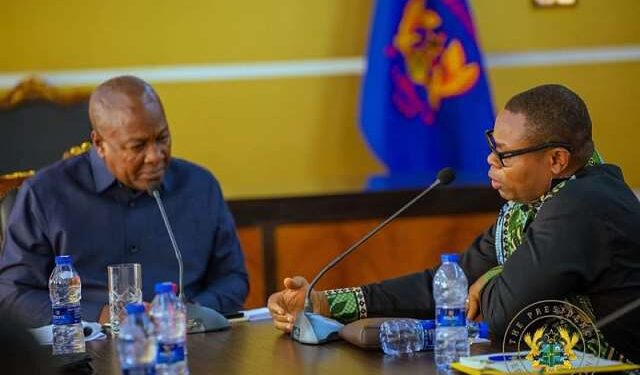
The Founding President and Chief Executive Officer of IMANI Center for Policy and Education, Franklin Cudjoe, has commended President John Dramani Mahama for what he describes as a strong commitment to engaging civil society organisations in national policy decisions.
Speaking in a media interview, Cudjoe said recent interactions between government and policy institutions reflect a growing recognition of the value of independent expertise.
According to him, such engagement represents a meaningful shift in how governance can incorporate diverse perspectives to improve decision-making.
“I am glad to say that some politicians still find us very worthy and important to ask our views,” he noted, adding that this recognition validates years of work by policy think tanks and advocacy groups in Ghana.
Cudjoe pointed to a recent instance involving discussions on a lithium agreement as a clear example of this engagement. He explained that amid public debate over royalties and the broader structure of the deal, IMANI was invited to provide its independent assessment.
According to him, the request came directly from President Mahama, who sought the organisation’s input on the matter. “He said there has been a lot of discussion, but he values our institution’s insight and wants to hear from us,” Cudjoe recounted.
He said IMANI provided its analysis, and within days, the bill associated with the agreement was withdrawn from Parliament. Although the proposal was later reintroduced, Cudjoe indicated that revisions reflected some improvements influenced by stakeholder input.
For him, the process demonstrated a willingness by government to listen, reconsider, and refine policy decisions in response to expert advice. “You feel respected and fulfilled when your work leads to real changes,” he said.
Recognition of Long Standing Policy Advocacy
Franklin Cudjoe emphasised that the current level of engagement is the result of years of consistent work by civil society organisations. He explained that institutions like IMANI have spent considerable time researching, analysing, and publicly debating policy issues, often without immediate acknowledgment from decision makers.
He noted that being consulted at critical moments signals that such efforts are now being recognised. “All the work we have done over the years is beginning to make sense when you are called upon to contribute,” he stated.
This, he said, represents a broader maturation of Ghana’s policy environment, where independent institutions are increasingly seen as partners in governance rather than external critics.
While praising the current administration, Cudjoe also reflected on past experiences with political leadership, particularly during the presidency of Nana Addo Dankwa Akufo-Addo. He noted that although there were periods of engagement, the level of responsiveness to policy advice differed.
He recalled that prior to Akufo-Addo’s election, IMANI had engaged extensively with him on policy proposals, including the Free Senior High School initiative.
According to Cudjoe, those discussions involved detailed debates and analysis, reflecting a willingness to consider different viewpoints at the time.
However, he suggested that maintaining that level of engagement proved challenging once the administration assumed office. In contrast, he described the current approach as more open and consultative.
“What makes the difference is being called when it matters most,” he explained, highlighting the importance of timely consultation in shaping effective policies.
Civil Society’s Role in Policy Development
Franklin Cudjoe’s remarks underscore the evolving role of civil society organisations in Ghana’s governance framework. By contributing research and analysis, these institutions provide alternative perspectives that can complement official policy processes.
He argued that involving such groups in decision making enhances transparency and accountability, while also improving the quality of outcomes. In his view, policies developed through inclusive processes are more likely to address public concerns and withstand scrutiny.
The example of the lithium agreement, he noted, illustrates how collaboration between government and independent institutions can lead to better informed decisions. Even where final outcomes differ, the process itself strengthens democratic governance.
The recognition of civil society input also has broader implications for public trust in government. When citizens see that policies are shaped through consultation and evidence based analysis, it can increase confidence in public institutions.
Cudjoe suggested that this approach may help bridge gaps between policymakers and the public, particularly in areas where decisions carry significant economic or social impact. By engaging credible institutions, governments can demonstrate a commitment to transparency and accountability.
He also emphasised that constructive criticism remains an essential part of this relationship. While consultation is important, he said, civil society must continue to hold government accountable and provide independent assessments of policy decisions.
A Model for Future Engagement
As Ghana continues to navigate complex policy challenges, the interaction between government and civil society is likely to play an increasingly important role. Cudjoe expressed optimism that the current approach could serve as a model for future administrations.
He noted that sustained engagement requires mutual respect, openness to differing viewpoints, and a shared commitment to national development. When these elements are present, he said, the policy process becomes more inclusive and effective.
For Cudjoe and IMANI, the recent developments mark a significant milestone in their work. Being invited to contribute at critical stages of decision making, he said, reinforces the relevance of independent policy research in shaping Ghana’s future.