

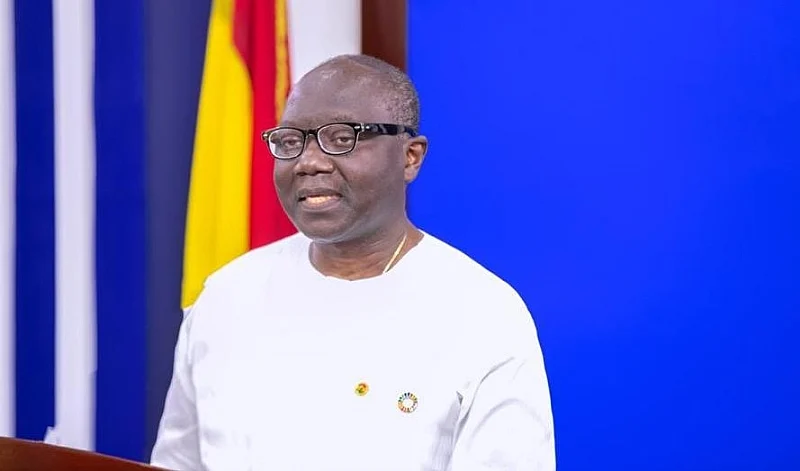
Former Minister for Finance Ken Ofori-Atta is not allowing request for his extradition from the United States (US) to Ghana to face prosecution unchallenged.
According to the Minister for Justice and Attorney General, Ofori-Atta who has been domiciled in the US since the beginning of this year, has hired top legal services to challenge the extradition order being sought by Government of Ghana and the Office of the Special Prosecutor (OSP).
Dr Dominic Ayine who revealed this when he addressed the media under the Government Accountability series platform at the presidency on Thursday, December 18, said the former Minister has contracted accomplished lawyers at the bar in the US to challenge the order.
“And I just want to know that he has hired some of the top lawyers in the United States of America, very experienced lawyers, to, I mean, defend him”, he said.
The Minister, who said he is unperturbed about the action of the cousin of former President Akufo-Addo said this means that the order is going to be fought in the US through the institutions available to him all the way to the Supreme Court which means it going to take time. He however maintained that, he is not afraid of what is waiting to happen.
“Now, I’m not afraid at all, all right? I am not afraid at all. But it means that there’s going to be a fight in the federal courts in the U.S. If the district court says no, you go to the circuit court, all right? If the circuit court says no, he’s entitled to go to the U.S. Supreme Court to fight his case. So I cannot tell you that he will come tomorrow, or he will come the next day, okay? And I’m just being honest. Accounting to the people means being explicit and truthful. So this is what, I mean, we are not afraid”.
He said as a government, they have completed their part of the legal process by putting in the request for the extradition of the former Minister and one Ernest Darko Akore to face corruption-related charges brought by the Office of the Special Prosecutor (OSP).
“It is now in the hands of the U.S. judicial authorities to ascertain whether the threshold for extradition has been met. This step was taken after my office received the necessary documentation and clarifications from the Office of the Special Prosecutor”.
The two are expected to answer to a total of 78 alleged corruption and corruption-related offences. Dr Ayine urged the former minister to come home and face the law indicating that, there is nothing for him to fear promising he will ensure he is treated fairly.
“I mean, on behalf of the government of His Excellency John Dramani Mahama, we have taken the requisite steps to bring him to Ghana to face trial. And if I were him, this is his home. He should just join the next flight and come here. I mean, under my watch, he will not be treated unfairly, you know? He will go through due process and be prosecuted, just like any other person, just like Kwabena Adu-Boahen or, you know, Hanan or any of the persons that I have, you know, filed charges, you know, against”.
The Attorney General said this following a question posed to him on why Ghana is not exploring the principle of reciprocity at a time Ghana has handed some of it citizens to the Americans over allegations of romance scam.
Responding to that concern in the wake of the arrest of Ghanaian socialite Fredrick Kumi alias Abu Trica over alleged romance scam, the AG said that even though Ghana still has that treaty in place, it is depends on certain factors.
“Now, the principle of reciprocity underlines extradition procedures. And usually, without a bilateral treaty or a multilateral treaty arrangement that obligates a state to extradite persons accused of crime that are found within its territory to another country, usually extradition cannot take place. In the case of Ghana and the United States of America, there is a 1931 extradition treaty that was signed between the United States of America and Great Britain, when Ghana was a colony of the United Kingdom, by Great Britain and Northern Ireland. Now, that treaty expired as far as the United Kingdom is concerned. So it’s no longer applicable between the United States and the United Kingdom. It has not expired. It was renewed when we became independent in 1957. And so it is still in existence between Ghana and the United States”.
He added “Now, if you look at Article 3 of that extradition treaty, it lists the extraditable offenses. And then it also provides the principles of extradition, of which reciprocity is one. Extradition is based upon certain legal principles. Now, if the offense, for instance, does not fall within the ambit of the extraditable offenses provided under the treaty, it will be very difficult for a person to be extradited. Okay? If, for instance, there is a sense that persecution will take place rather than prosecution, that a person will not be treated fairly if extradited. It’s most likely, I mean, extradition will not take place. If you cannot show by your extradition package, that is the request that you have sent to the U.S., the one that I have sent to the U.S., that there is sufficient evidence, okay, to come to a conclusion, I mean, a reasonable conclusion that a crime has been committed, even though you still have the ability to prove that crime beyond reasonable doubt, right, extradition may not be granted. So the basic point I want to make is that, yes, the principle of reciprocity applies, okay, and I would have been very happy to hand over Abu Trica as I have done, okay, and then get Ofori-Atta quickly in retain, all right? But usually, the extradition proceedings take place in a court of competent jurisdiction. In our case, that is the district court, all right? In the U.S., it will also be the federal district court.”
By Gifty Boateng