

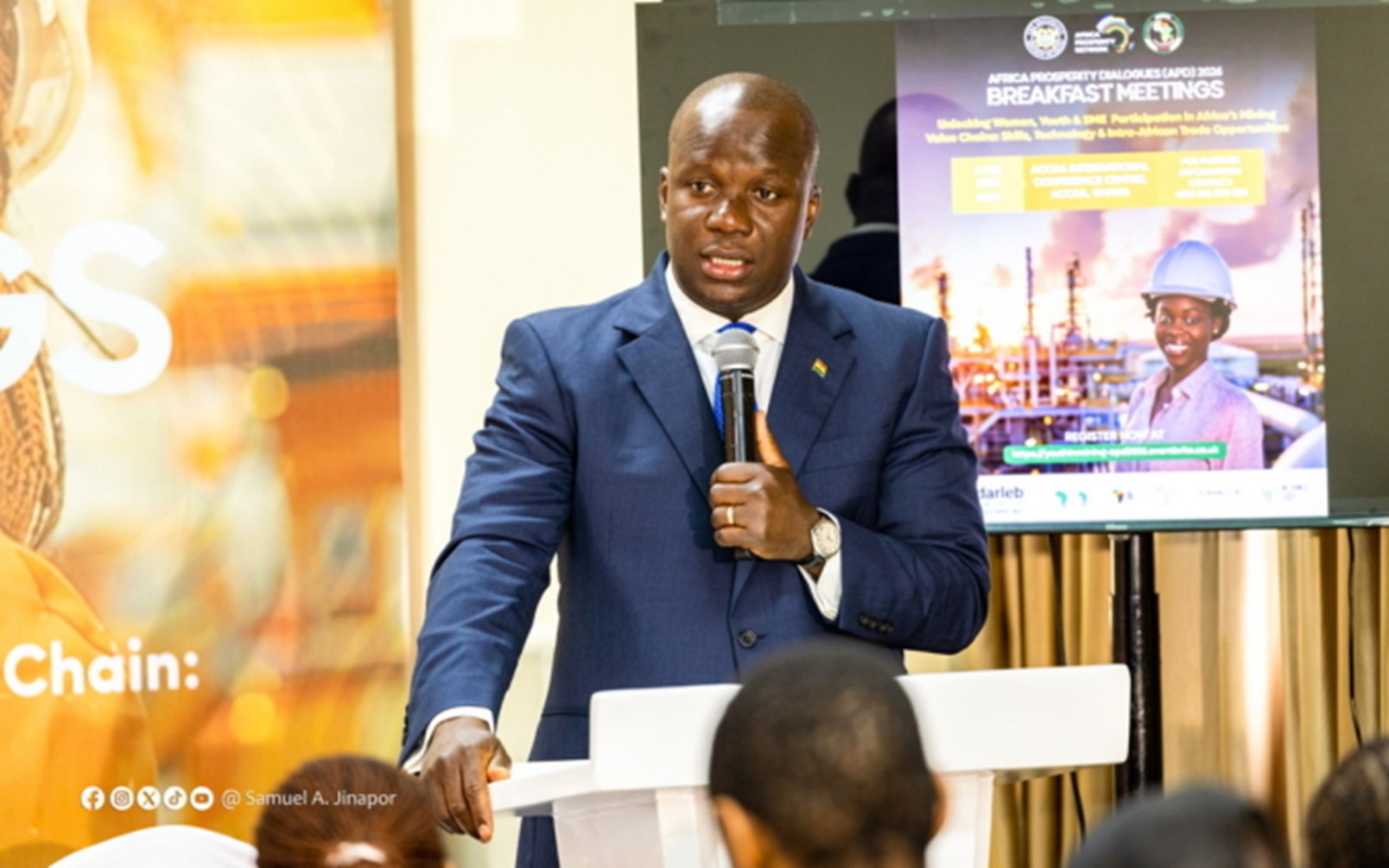
Former Minister for Lands and Natural Resources and MP for Damongo, Samuel A. Jinapor, has urged African governments, mining firms, and financial institutions to actively include women, youth, and small to medium-sized enterprises (SMEs) in all aspects of Africa’s mining value chains.
Speaking at the Africa Prosperity Dialogues (APD) 2026 Mining Breakfast Meeting and Workshop at the Accra International Conference Centre on Wednesday,
Mr. Jinapor pointed out that while Africa is one of the richest regions in minerals globally, the current structure of its mining industry restricts its ability to contribute to inclusive growth and sustainable development.
He highlighted that Africa produced over 1,000 tonnes of gold in 2023, making up more than 27 percent of the world’s total output, with Ghana and South Africa being among the leading producers.
Mr. Jinapor noted that Ghana stood out as Africa’s top gold producer, contributing around four million ounces in 2023, with projections to rise to about 4.8 million ounces in 2024 due to increased production from both large and small-scale mining activities.
Despite this progress, he contended that Africa’s mining sector is still primarily extractive, with weak connections to local economies and limited value addition.
“For many years, Africa’s mining sector has been narrowly focused on extraction,” he stated, emphasizing that mining should be viewed as a complete value chain that goes far beyond the mine itself.
He pointed out that Africa’s issue is not a lack of mineral resources but rather the inability to convert these mineral assets into widespread economic involvement.
Mr. Jinapor highlighted that true participation should extend beyond just jobs at mining sites. It should also encompass access to skills, technology, finance, and markets throughout the mining value chain.
“Participation should involve access to skills, technology, finance, and markets,” he stated, emphasizing the need to empower women, youth, and SMEs to engage in areas like exploration, engineering services, equipment manufacturing, mineral processing, logistics, and downstream manufacturing.
From a policy standpoint, he pointed out the necessity for clear and enforceable frameworks that encourage local participation, supplier development, and value addition.
He emphasized that skills development should align with the needs of a modern, technology-driven mining economy, cautioning that without targeted investment in relevant skills, efforts for inclusion would remain merely theoretical.
Mr. Jinapor also stressed the significance of supporting SMEs through simplified regulations and better access to finance.
He remarked that development finance institutions, commercial banks, and public-private partnerships play a vital role in reducing risks associated with investments in mining-related businesses, especially those led by women and young individuals.
He further urged mining companies to go beyond compliance-focused strategies and actively foster local enterprise development.
According to him, mining companies can act as anchors for building robust domestic value chains through supplier development, mentoring, and integrating local businesses into procurement systems.
Regarding intra-African trade, Mr. Jinapor pointed out the African Continental Free Trade Area (AfCFTA) as a significant opportunity for Africa to retain more value from its mineral resources.
“Rather than exporting raw materials, countries can process minerals locally, create semi-finished or finished products, and trade them across borders within the continent,” he remarked.
He added that such an approach would create jobs, deepen skills and technological capabilities and ensure that a greater share of mineral wealth remains within Africa.
As host of the AfCFTA Secretariat, he said Ghana has a strong responsibility to lead efforts to promote harmonised standards and predictable cross-border trade in mineral-based products.
Mr. Jinapor called for stronger partnerships among governments, industry players, financiers and entrepreneurs to ensure that Africa’s mineral wealth delivers inclusive and sustainable development outcomes, expressing confidence that the APD platform would help translate policy ideas into practical action.