

By Nelson Ayivor
President John Dramani Mahama has urged African leaders and global partners to move decisively from reflection to delivery, calling for the interlocking of Africa’s sovereign prosperity spheres as the continent confronts a rapidly changing global order.
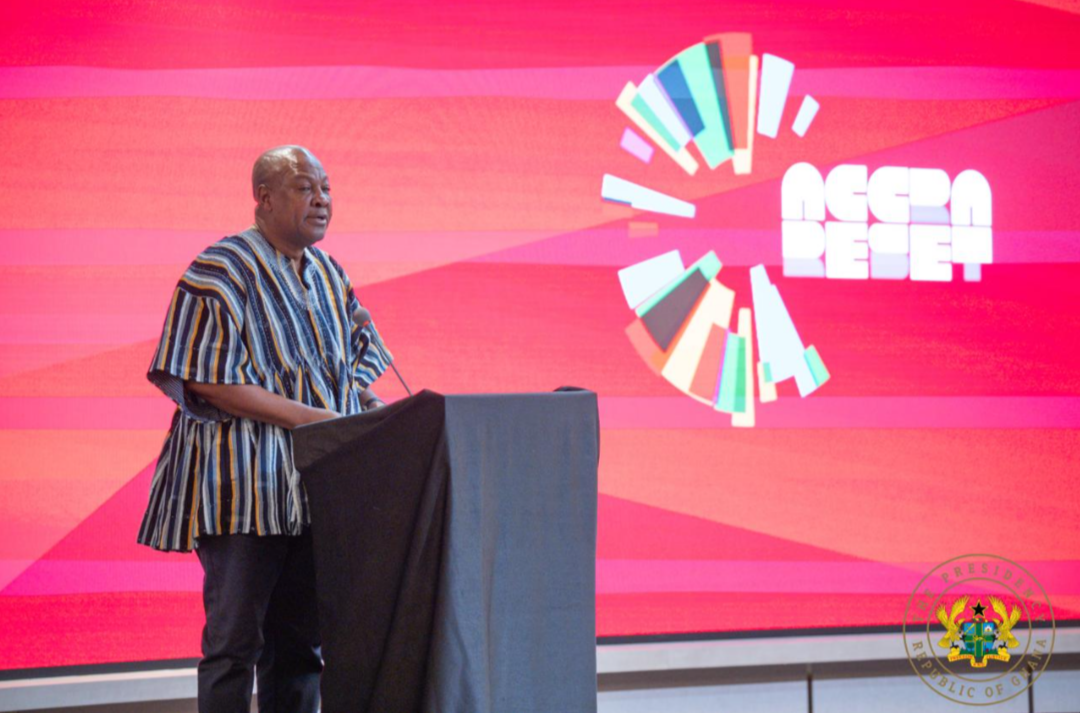
Speaking at the “Accra Reset” side event dubbed “Addis Reckoning” on the margins of the African Union Summit in Addis Ababa, the President framed the moment as a necessary reckoning rather than another routine summit discussion.
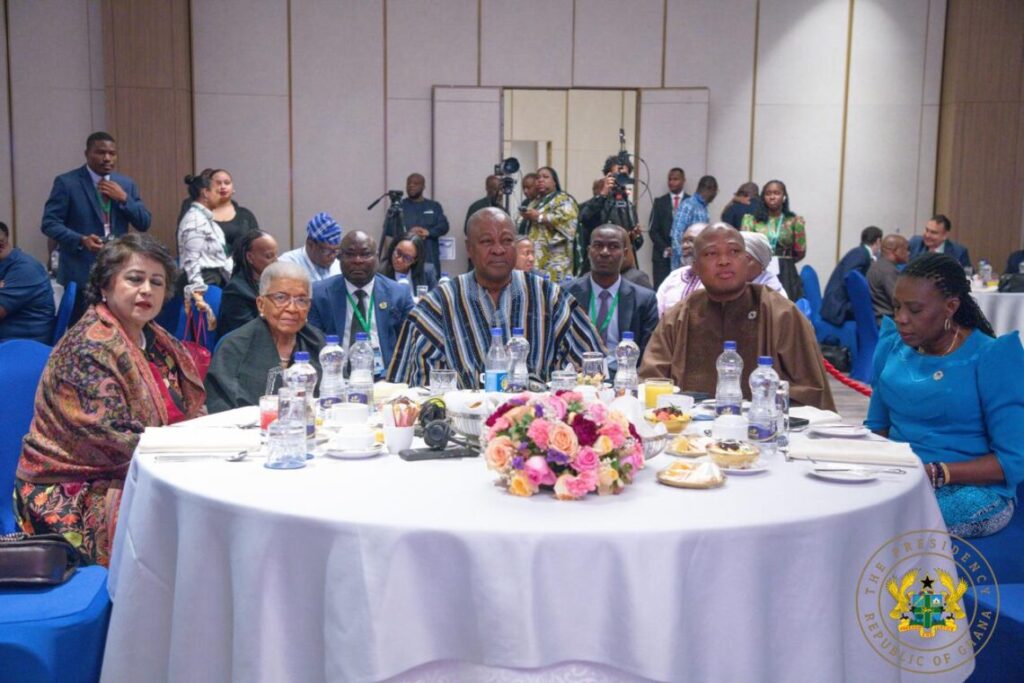
Addressing a high-level gathering of heads of state, policymakers, business leaders, and representatives of multilateral institutions, President Mahama said Africa had reached a point where long-standing assumptions about development, cooperation, and global integration no longer held.
He pointed to fractured supply chains, cautious global finance, fast-moving technology outpacing regulation, and shifting geopolitical rules as forces demanding a new response from the continent.
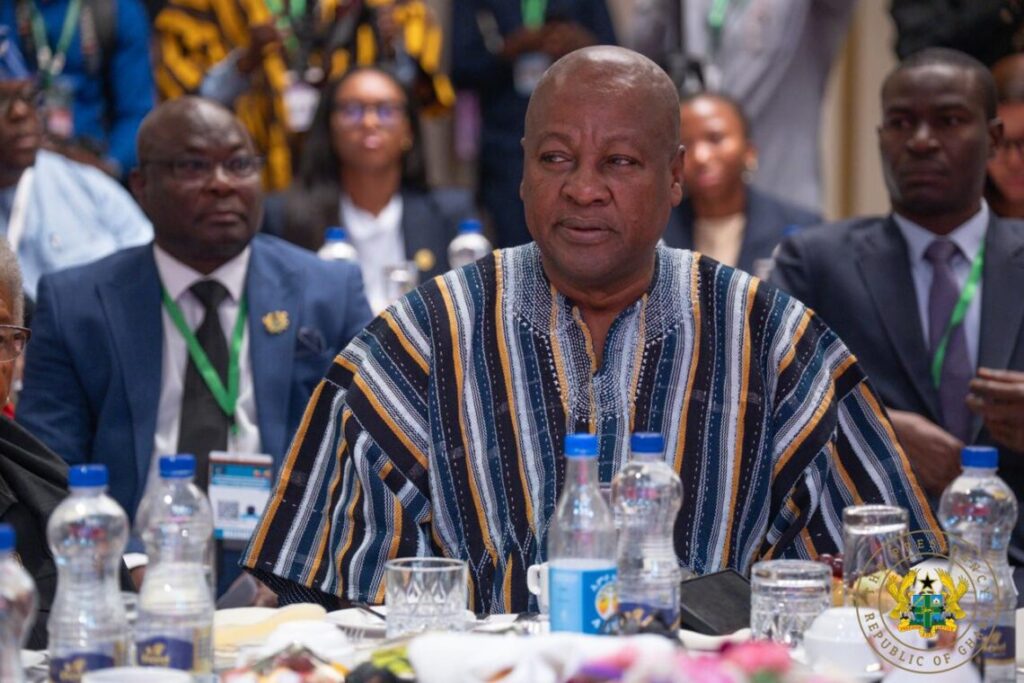
President Mahama explained that the Accra Reset was not conceived as a declaration or rhetorical exercise, but as a practical architecture designed to align finance, health, trade, skills, and technology into a single direction of travel.
“We earned this dialogue at the Health Sovereignty Summit in Accra. I gave a political voice at the United Nations General Assembly. We tested it in Davos, and today we’re in Addis Ababa to move it into action.”
He acknowledged the political leadership invested in the initiative by members of the Interim Presidential Council of the Accra Reset, noting that leadership often requires commitment before certainty emerges.
The council includes President Ruto, President Al-Sisi, President Tinabu, President Hitchinema, President Chisekedi, President Faure Nyasinde, and President Lula da Silva, and not least, Prime Minister Mian Mutley.
According to the President, Africa’s frustration with existing development models has matured into determination, opening space for ideas capable of reshaping international cooperation.
Health as the Foundation of Prosperity
A central pillar of the Accra Reset, President Mahama said, is a rethinking of global health governance. For decades, health systems across Africa have been treated primarily as fiscal burdens.
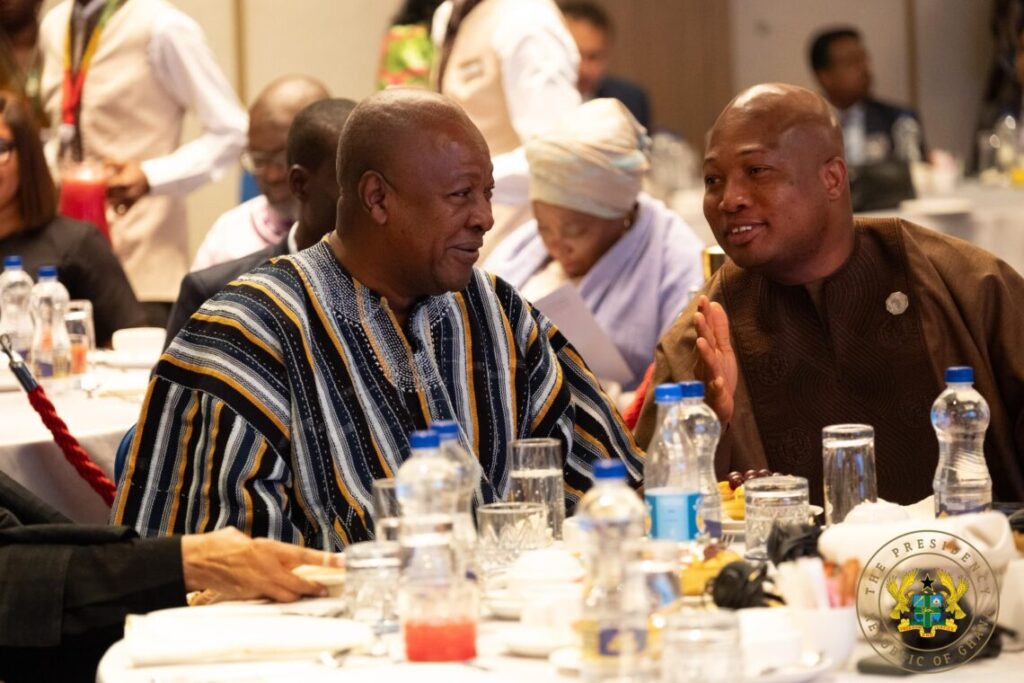
Under the Accra Reset framework, he argued, health must be understood as a foundation of productivity, stability, and economic resilience. In this context, he announced the establishment of a high level panel to drive reform of the global health architecture.
“I am pleased to announce our high-level panel on reform of global health architecture, which is co-chaired by Professor Peter Piot, Honourable Budi Gunadi-Sadikin, Chancellor Elhaj Asai, and Honourable Nisia Trinidadi-Lehman. Reform will be grounded in knowledge of past failures while animated by future promise.”
The panel, he said, would draw lessons from past failures while focusing on practical solutions that strengthen health sovereignty and reduce dependence on external supply chains. The approach positions health not as a social afterthought but as a multiplier of wealth and national capacity.
President Mahama also highlighted the importance of strengthening Africa’s negotiating power in an increasingly complex global economy. He revealed that technical work had begun on a sovereign negotiators certification programme aimed at cultivating a new generation of African dealmakers.
These professionals, he said, would be equipped to manage technology agreements, mineral contracts, and sophisticated financing arrangements with confidence and competence.
On trade and mobility, the President pointed to evolving initiatives under the African Continental Free Trade framework and emerging digital platforms. He said these efforts were giving new meaning to free movement by linking trade integration with skills mobility and labour market access.
Digital Passports and Global Partnerships
One of the most concrete proposals outlined at Addis Reckoning was the introduction of a global digital skills passport. President Mahama said such a system would ensure that the qualifications of young Africans are recognised across borders and platforms, opening pathways to employment, innovation, and collaboration worldwide.
He also spoke of a renewed spirit of global partnership inspired by the Bandung era, noting growing exchanges with countries such as South Korea, Singapore, India, and Indonesia.
These partnerships, he said, were focused on technological learning, digital trade, and industrial planning, including the integration of artificial intelligence into governance and production systems.
Throughout his address, President Mahama returned to the theme of disciplined execution. He challenged the notion that African leaders must choose between ambition and realism, arguing that ambition becomes realistic when institutions align, partners listen, and execution is treated as a shared responsibility.
He outlined a set of priority commitments that require definitive decisions, including dealmaking capacity, health as an economic multiplier, intelligence on critical mineral supply chains, the repatriation of African sovereign foreign exchange reserves, and the rollout of digital skills passports.
According to the President, Africa has reflected long enough and must now commit to delivery. President Mahama concluded by describing the Addis gathering as the beginning of a more disciplined phase for the Accra Reset.
It was not, he said, a conclusion but a point of resolve where ideas must prove themselves through measurable outcomes. By interlocking sovereign prosperity spheres, African countries can coordinate more effectively, negotiate from positions of strength, and shape development pathways that reflect their own priorities.
As the African Union Summit continues under the auspices of the African Union, the Addis Reckoning has positioned the Accra Reset as a bold attempt to redefine Africa’s engagement with the global system.
Whether its ambitions translate into lasting transformation will depend on the discipline and cooperation that President Mahama urged leaders to embrace.