

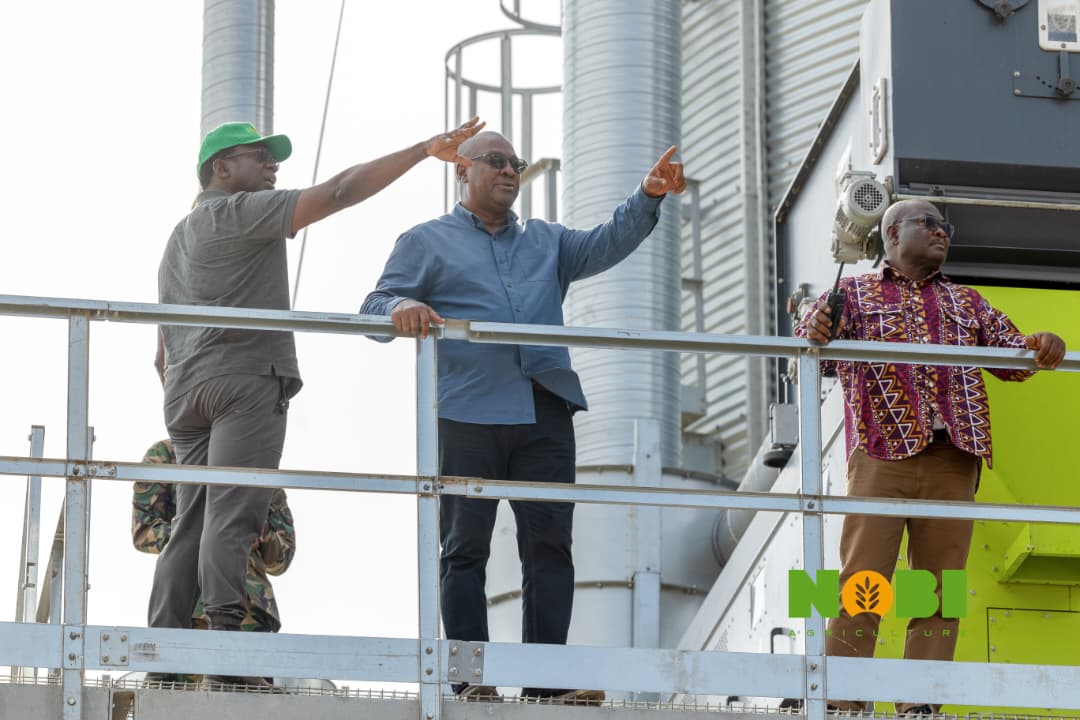
President John Dramani Mahama on Saturday, March 21, 2026, visited Nobi Farms in the Afram Plains as part of his Resetting Ghana Thank You Tour, drawing national attention to one of the country’s most ambitious private agricultural investments.
The visit formed part of a broader effort by the President to engage key sectors of the economy and acknowledge initiatives contributing to Ghana’s development, particularly in agriculture.
He was accompanied by the Minister for Food and Agriculture, Eric Opoku, underscoring government’s continued interest in large-scale farming and food security.
Nobi Farms, owned by Ghanaian entrepreneur Kwame Awuah-Darko, is situated on a vast 21,000-acre tract of land in the Afram Plains, although development is currently focused on 7,000 acres in its first phase.
During the tour, the President and his delegation were taken through various sections of the farm, including its rice fields, irrigation systems, warehouses and processing facilities.
A key highlight of the visit was the farm’s irrigation infrastructure, anchored by a large reservoir designed to ensure year-round farming and reduce dependence on erratic rainfall patterns in the region.
The irrigation system supports consistent cultivation cycles and forms a critical component of the farm’s strategy to scale rice production sustainably.
The delegation also observed the farm’s adoption of modern agricultural technology, including improved seed varieties, mechanized farming techniques and integrated processing systems.
These innovations have contributed to increasing productivity and demonstrate how technology can transform rice farming into a viable and profitable venture in Ghana.
At the processing level, the farm is equipped with facilities that enable drying, milling and storage of rice, ensuring value addition and minimizing post-harvest losses.
Management of Nobi Farms indicated that the project is not only focused on production but also on building a complete agricultural value chain that supports efficiency and long-term sustainability.
The project is already making a socio-economic impact in the Afram Plains, providing over 150 direct jobs to local youth and creating opportunities for skills development in modern farming practices.