

By Leo Nelson
President John Dramani Mahama says Ghana’s business environment has improved over the past year, pointing to declining interest rates, stabilising inflation and reduced government borrowing as key factors supporting a recovery in private sector activity.
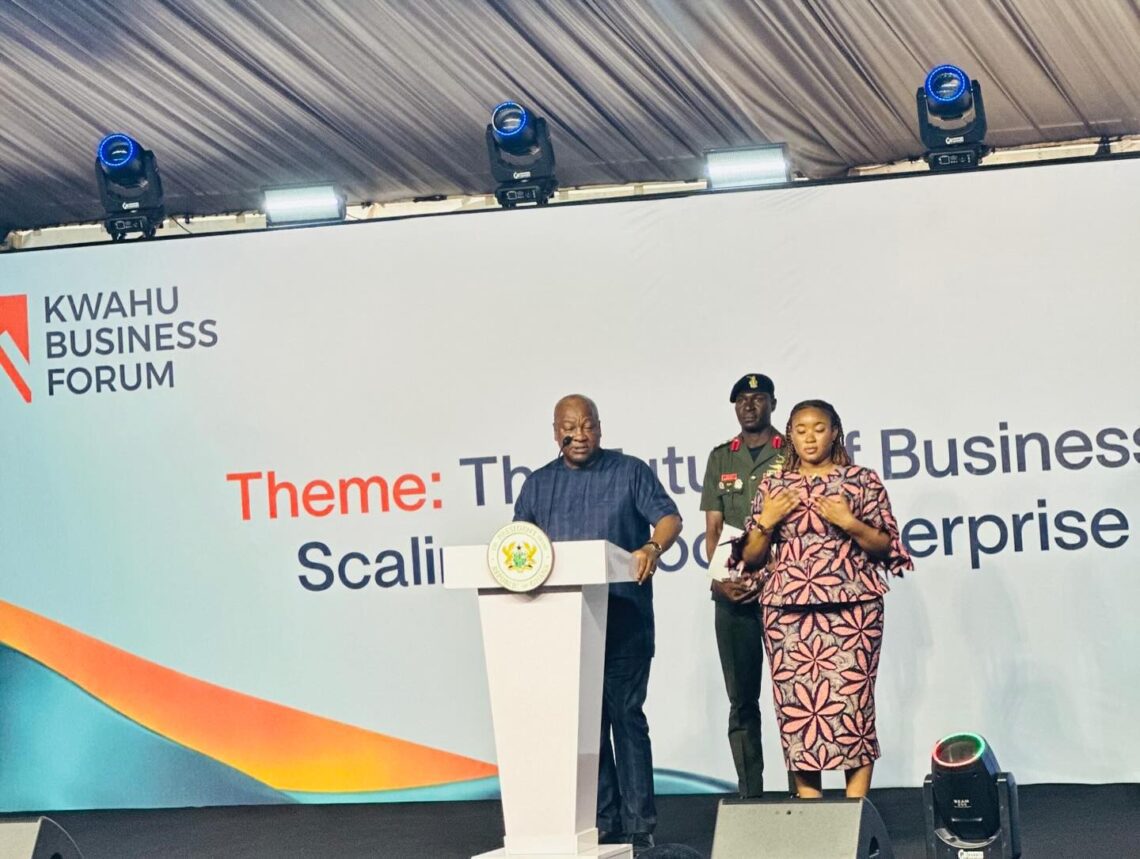
Speaking at the Kwahu Business Forum, Mahama said the government’s reduced reliance on domestic debt markets has eased pressure on bank liquidity, allowing lenders to redirect credit toward businesses. He noted that borrowing costs, which stood above 30% in 2024, have fallen sharply, with some firms now accessing financing at single-digit rates.
The president also cited currency stability as a critical development, saying a more predictable exchange rate has improved planning for businesses and reduced the local currency cost of imports. He said this has lowered effective duties at ports, while urging importers to comply fully with customs regulations.
According to him, his administration’s priority has been restoring macroeconomic stability to support long-term growth, adding that foreign direct investment and domestic investment are both showing signs of recovery.
On policy, he highlighted the rollout of the 24-hour economy programme, with legislation passed to establish an authority that will oversee participating firms. Incentives are expected to include duty-free imports of plant and machinery for expanding companies and expedited port clearance processes.
He also pointed to tax reforms, including the removal of selected levies and adjustments to value-added tax thresholds, aimed at lowering the burden on smaller firms and improving compliance.
Beyond macroeconomic policy, Mahama addressed structural challenges in the private sector, including weak succession planning, limited scale among small firms and reliance on government contracts. He encouraged mergers, acquisitions and stronger corporate governance to build more resilient enterprises.
The president also reiterated a commitment to reducing political interference in business, saying contract awards and public investment programmes would be based on capacity rather than political affiliation.
On infrastructure, he mentioned ongoing large-scale road construction under the government’s “big push” programme, describing it as a key driver of economic activity across supply chains, from manufacturing inputs to employment generation.
Mahama said reforms in the energy sector are also progressing, with the government renegotiating legacy debts with independent power producers to stabilise electricity supply and reduce financial pressures on the sector.
He added that the broader objective is to create a predictable and competitive environment that encourages private investment, supports industrial expansion and strengthens Ghana’s economic resilience.