

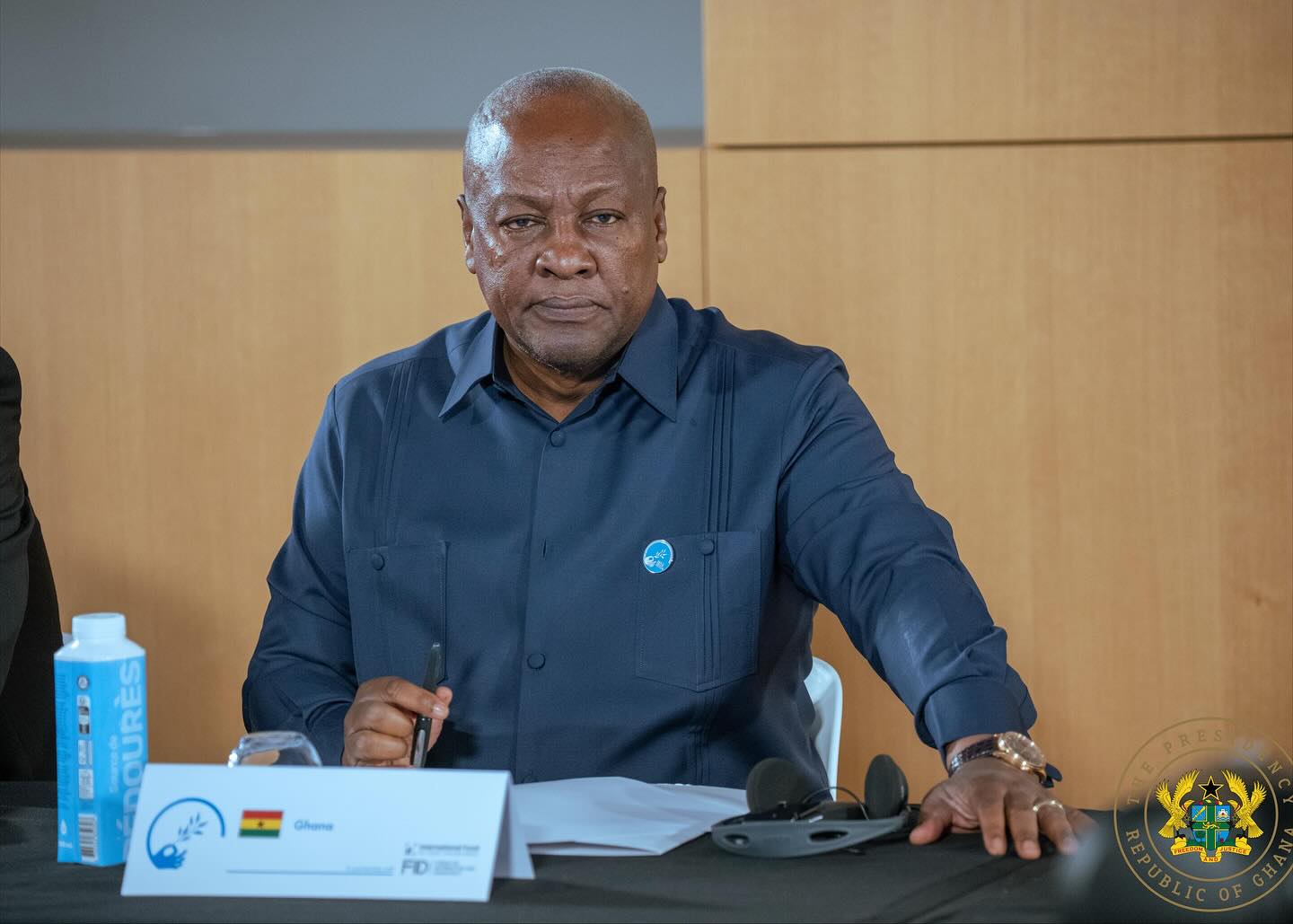
Pollster predicts 60% approval for President Mahama amid opposition disarray and shifting public expectations
By Gifty Boateng
President John Mahama’s post-election honeymoon appears to be extending well into his second year in office, with new polling data suggesting a significant surge in public approval.
According to Mussa Dankwah, Executive Director of Global InfoAnalytics, Mahama would secure over 60% of the vote if elections were held today an increase from the 56% he garnered in the December 2024 general election.
Dankwah, a seasoned pollster with growing influence in Ghana’s political forecasting space, attributes the President’s rising popularity to a combination of residual goodwill and the opposition New Patriotic Party’s (NPP) ongoing identity crisis.
Speaking on Atinka TV’s Agenda programme, he noted that real-time polling conducted through online and telephone surveys indicates a widening gap between the ruling National Democratic Congress (NDC) and the NPP.
The NPP, still reeling from its 2024 defeat, has yet to mount a coherent opposition strategy. Dankwah argues that the party remains out of sync with public sentiment, focusing on issues that resonate more within its internal echo chambers than with the broader electorate.
“They are chasing what nobody is interested in except themselves,” he said, pointing to a lack of coordinated messaging and strategic focus.
The party’s parliamentary presence has also weakened. Having secured just 88 seats in 2024, the NPP has since lost two more Ablekuma North and Akwatia while Kpandai hangs in the balance following a court-ordered rerun.
The erosion of its legislative base further complicates its efforts to present itself as a credible alternative.
Dankwah’s analysis suggests that the public’s tolerance for controversial policy decisions has shifted. He cited the government’s imposition of a GHC1 Energy Sector Levy and its plan to procure new military aircraft both of which, he argued, would have sparked public outrage under previous administrations.
“Now, there is barely a murmur,” he observed, attributing the muted response to residual anger over the NPP’s perceived misgovernance during its last term.
This recalibration of public expectations, he contends, has created a buffer for the Mahama administration, allowing it to pursue difficult fiscal and security policies without triggering widespread backlash.
The polling bump comes amid renewed speculation over Mahama’s political future. Although constitutionally barred from seeking a third term, pressure is mounting within sections of the NDC for him to reconsider or at least to play a kingmaker role in the 2028 succession. Dankwah’s findings are likely to fuel such speculation, even as Mahama maintains that he will not seek re-election.
Meanwhile, Vice-President Mahamudu Bawumia remains the frontrunner in the NPP’s flagbearer race, but Dankwah suggests that even a Bawumia candidacy would struggle to close the gap. “Mahama would beat him by an even wider margin,” he said, hinting at further details to be released in an upcoming survey.
The NPP’s challenge, then, is not merely one of leadership selection but of strategic reinvention. With Mahama’s approval ratings buoyed by a combination of public fatigue with the past and a recalibrated political landscape, the opposition faces a steep climb to regain relevance.