

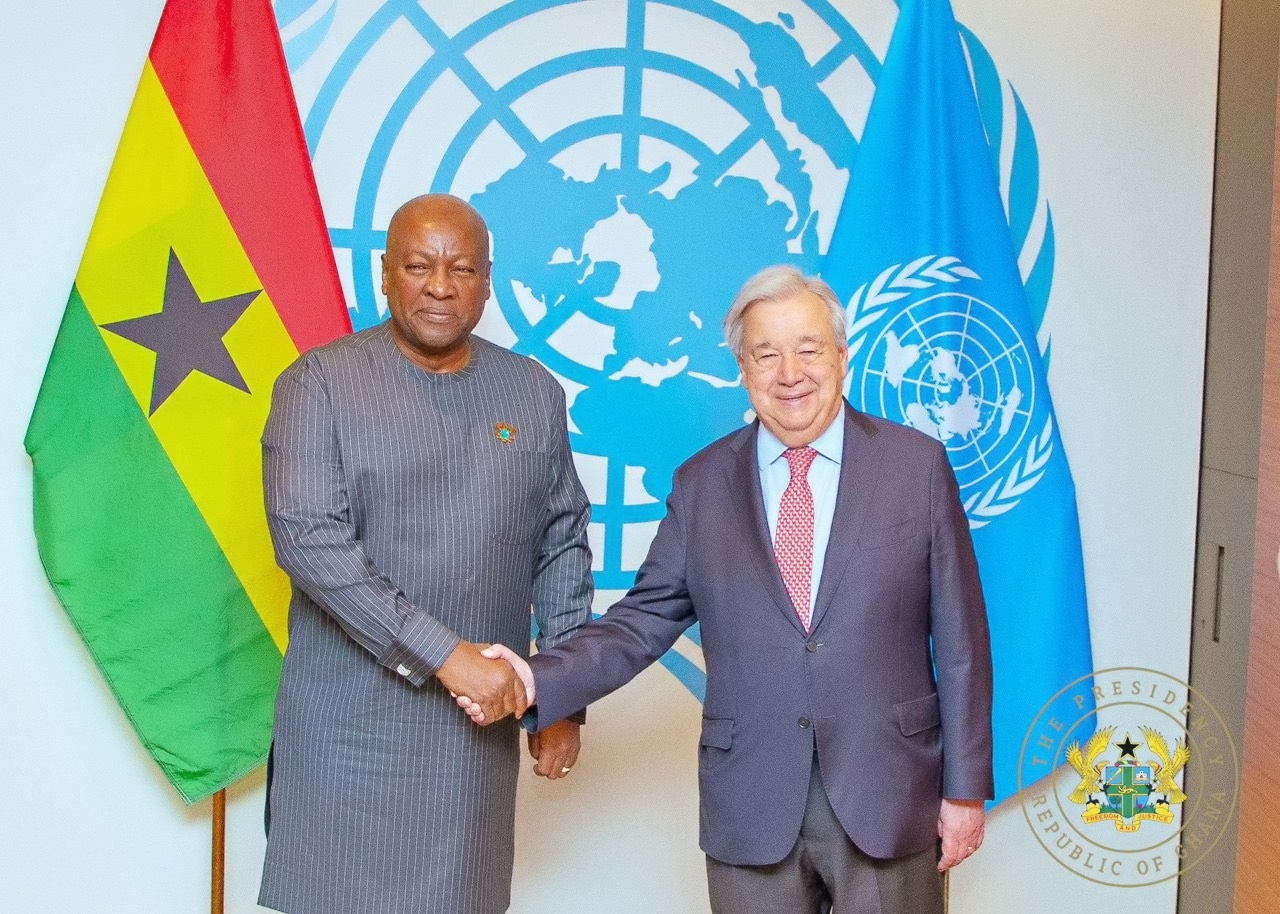
123 nations back historic demand for justice over slave trade.
By Perince Ahenkorah
In a moment that will echo through the halls of history, the United Nations General Assembly has adopted a landmark resolution on reparations for the transatlantic slave trade championed by President John Dramani Mahama with 123 member states voting in favour, sending a thunderous message that the world can no longer look away from the darkest chapter of human history.
Only three nations voted against. Fifty-two abstained. But the overwhelming support, on March 25 the International Day of Remembrance of the Victims of Slavery and the Transatlantic Slave Trade marks a watershed in the decades-long struggle for reparative justice.
And it was Ghana’s President who stood at the podium of the UN Headquarters in New York to deliver a speech that left delegates spellbound, challenging the global community to confront the full horror of a system that tore 13 million Africans from their homes.
“There is no such thing as a slave,” Mahama declared, his voice cutting through the chamber. He paused to let the weight of those words settle.
Those referred to as slaves, he explained, were human beings trafficked and forcibly enslaved by others who believed they could own them as property. “Not if you acknowledge an individual’s humanity; not if you respect an individual’s basic right to dignity,” he stressed.
The resolution, which emerged from months of consultations involving African institutions, UN member states, scholars and legal experts, formally declares the trafficking and enslavement of Africans as the gravest crime against humanity.
It calls for global recognition of the transatlantic slave trade’s true scale and for collective action toward reparative justice.
Speaking on behalf of the African Group, Mahama said the proposal was grounded in “truth, compassion, and moral conscience.”
“Let it be recorded that when history beckoned, we did what was right for the memory of the millions who suffered the indignity of slavery,” he told the Assembly.
The President recalled that the international observance was established in 2007, following a UN resolution in 2006 to commemorate victims every March 25. But he insisted that remembrance must go beyond symbolism to education, documentation, and global reflection.
“Through these activities, we do more than remember. We document and educate; we gain a greater perspective,” he said.
In a passionate address on reparatory justice, Mahama challenged the world to begin all discussions on slavery by reaffirming racial equality and human dignity.
“When discussing slavery, we must start by reclaiming the dignity of Africans and the humanity of our ancestors,” he said.
He described the transatlantic slave trade as a system deliberately designed to strip Africans of their humanity, built on a false racial hierarchy with no scientific or moral basis.
“The adoption of this resolution serves as a safeguard against forgetting,” he noted.
With 123 nations now on record supporting the call for reparative justice, the resolution adds unprecedented momentum to a global movement. Advocacy groups and nations across Africa, the Caribbean and the Americas have hailed the outcome as a turning point not just in acknowledging historical wrongs, but in charting a route to healing.
“Today, we come together in solemn solidarity to affirm truth and pursue a route to healing and reparative justice,” Mahama said.
As the cheers subsided in the General Assembly hall, one thing became clear: the man from Ghana had not only secured a diplomatic victory. He had placed the question of reparations squarely at the centre of the world’s conscience and dared it to look away.