

Opts for Equity and Partnership, as CEO Sells Mahama’s Vision at Indaba
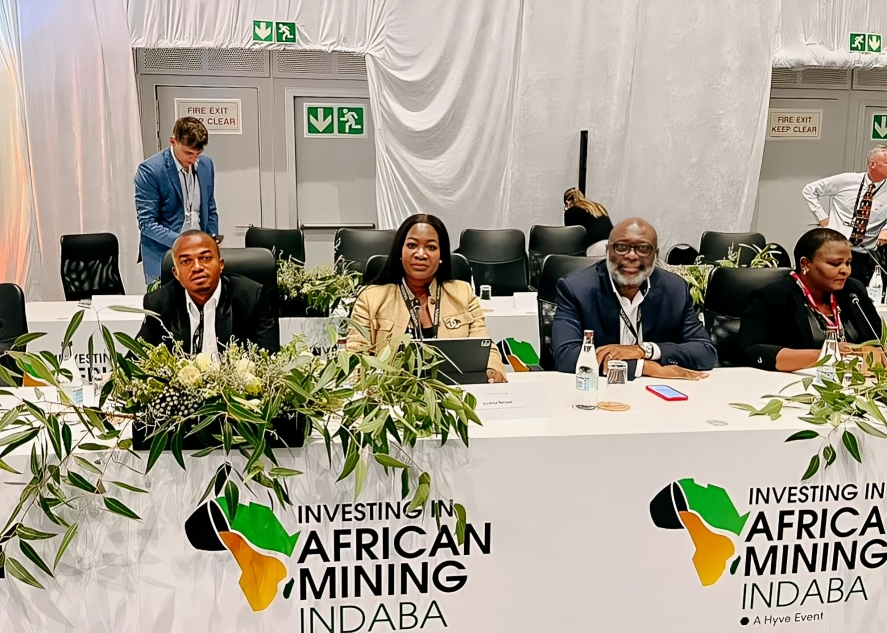
The Minerals Income Investment Fund has completed its most assertive Indaba campaign to date, deploying its chief executive, board members and sector minister in a coordinated offensive to reposition the Fund from passive royalty collector to active co-investor.
Across three days of high-level engagements, MIIF delivered a consistent and deliberately provocative message: the old extractive compact is dead. What remains contested is who assumes the risk of building what comes next.
DAY ONE: STREAMING TALKS AND SOCIAL LICENCE
The Fund opened Monday with chief executive Justina Nelson leading term sheet discussions with three of Ghana’s largest gold producers. Meetings with Asanko Gold, AngloGold Ashanti and Gold Fields centred on streaming arrangements, foreign exchange volatility and post-extraction land restoration — technical subjects that nonetheless signalled Accra’s intent to secure downstream value rather than await quarterly royalty cheques.
Nelson’s delegation, including board members Hon. Yakubu Mohammed and Ama Mawusi Mawuenyefia, pressed the gold majors on cedi exposure, a persistent margin-squeezer for foreign operators. But the Fund leaned conspicuously on environmental, social and governance credentials. Chief Technical Officer Kwabena Barning and Head of Investment Ernest Attiso secured company commitments to collaborate on reforestation of mined-out areas and MIIF’s Women from Mining Communities Scholarship scheme, which targets female participation in technical roles.
“The one who joins the hand has the right to the meat,” Cape Town Executive Mayor Geordin Hill-Lewis had told delegates at the opening ceremony, deploying a West African proverb to frame the conference theme, Stronger Together: Progress Through Partnerships. By close of play Monday, MIIF had converted rhetoric into working-level talks.
DAY TWO: MINISTER ARTICULATES THE PIVOT
If Monday was about deal traction, Tuesday belonged to doctrine. Lands Minister Emmanuel Armah Kofi Buah used a continental integration panel to formally announce Ghana’s departure from West Africa’s historical extractive playbook.
The Minerals Income Investment Fund, he said, is no treasury buffer. It is a developmental investment vehicle designed to take direct equity stakes in mining assets, infrastructure and downstream ventures — crowding in private capital while weaning the state off over-reliance on taxes and royalties.
“Investors want predictability and seriousness of purpose,” Buah told delegates. “An institution like MIIF demonstrates that Ghana is not only regulating the sector, but also investing alongside partners for mutual benefit.”
He pointed to potential cross-border applications under ECOWAS, where MIIF-style vehicles could anchor regional infrastructure projects too capital-intensive for single markets. The sub-region has long talked of shared mineral value chains; Buah’s remarks suggest Accra now views investment funds as the mechanism to move from communiqué to concrete.
But the Minister acknowledged the pivot carries its own disciplines. Patient capital requires regulatory predictability, reliable geological data and enforceable environmental standards all areas where Ghana has faced investor scrutiny. His emphasis on governance was calibrated to reassure an audience scarred by past resource nationalism cycles.
On galamsey, Buah struck a familiar balancing act: enforcement without economic exclusion, formalisation without amnesty. Illegal mining remains a political headache for Accra, but he framed the challenge as community integration rather than outright confrontation.
DAY THREE: NELSON’S BANKABILITY BROADSIDE
By Wednesday’s Ministerial Symposium, MIIF’s messaging sharpened into diagnosis. Speaking on a CEO roundtable examining financing for a new project wave, Nelson delivered a blunt assessment of African mining’s perennial ailment: plenty of global capital, precious few investable projects.
“There is no shortage of capital globally. What Africa needs are de-risked, feasibility-ready projects that investors can confidently support,” she said.
Nelson reserved sharpest criticism not for geopolitical noise, regulatory flip-flops or pit-to-port infrastructure deficits — the familiar litany — but for the project pipeline itself. Too many prospects remain stuck at JORC resource stage, she argued, lacking the feasibility work and governance scaffolding required to trigger institutional chequebooks.
Her remedy: African sovereign wealth and pension funds must shed passive postures and assume early-stage risk. Not dominant equity, she stressed, but strategic co-investment that signals credibility to skittish international partners.
“We are not here to crowd out private capital. We are here to crowd it in,” Nelson said.
MIIF’s own evolution from royalty collector to streaming negotiator served as implicit case study. Nelson cited Ghana’s removal of VAT on exploration inputs and ongoing digitalisation of cadastral systems as proof that regulatory clarity can shift risk calculations. On the AfCFTA front, she urged harmonised standards and shared processing infrastructure, noting that individual national markets remain too small to support integrated mineral value chains. Regional hubs, not national champions.
The subtext was unmistakable. What Nelson termed a “pragmatic risk-sharing framework” would see governments absorb infrastructure and regulatory uncertainty while private operators focus on geology and metallurgy.
VERDICT PENDING
MIIF’s presence at Indaba has grown conspicuously since 2023. What began as a royalty manager is now pitching term sheets alongside private equity desks, articulating investment doctrine at ministerial level and publicly challenging sister funds to assume greater risk.
Whether streaming deals with the gold majors materialise before Thursday’s gala dinner will determine if this year’s handshakes become next year’s term sheets. Whether African institutional investors possess the risk appetite for early-stage positioning remains unproven.
But Nelson’s diagnosis shifts the burden of proof back towards project sponsors and their government hosts. Bankability, she reminded delegates, is not discovered; It is constructed.
MIIF Drops Royalty Model
0Related Posts
Add A Comment
© 2026 THE NEW REPUBLIC GH.
About | Contact | Privacy Policy