By Nelson Ayivor
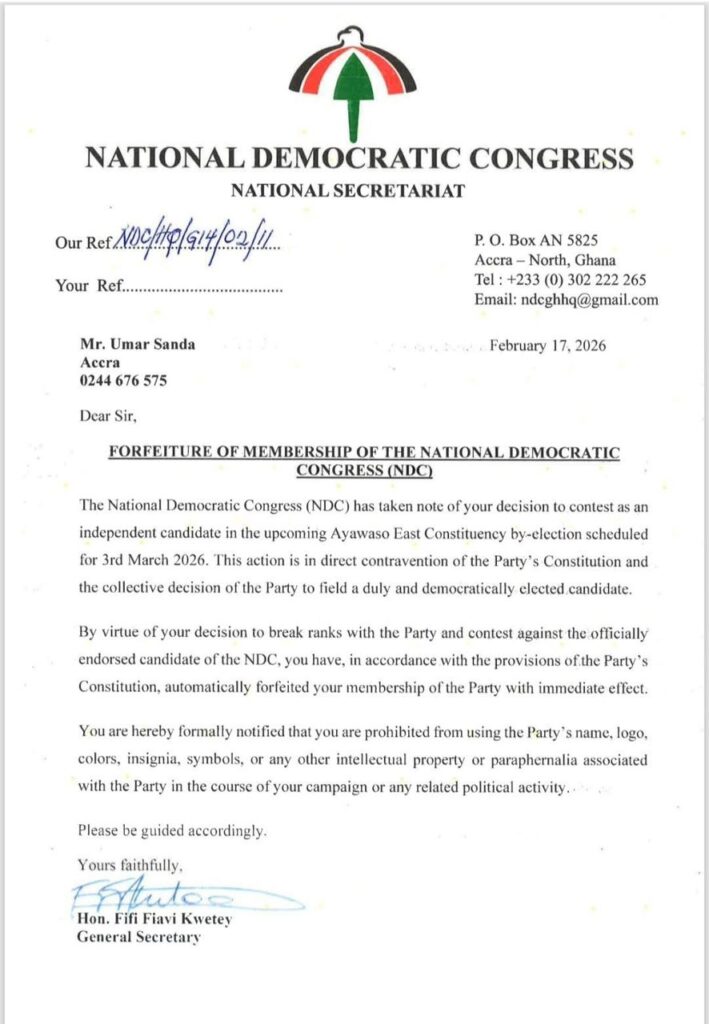
The National Democratic Congress has formally terminated the membership of Umar Sanda after he declared his intention to contest as an independent candidate in the upcoming Ayawaso East Constituency by-election scheduled for March 3, 2026.
The decision, communicated in an official letter dated February 17, 2026, underscores the party’s resolve to enforce internal discipline and uphold the authority of its constitution and collective decisions.
“By virtue of your decision to break ranks with the Party and contest against the officially endorsed candidate of the NDC, you have, in accordance with the provisions of the Party’s Constitution, automatically forfeited your membership of the Party with immediate effect.”

The letter formally notifies Sanda that he is no longer recognized as a member of the NDC and is therefore barred from associating himself with the party in any political activity related to the by-election or beyond.
The party further emphasized that following the loss of membership, Sanda is prohibited from using the NDC’s name, logo, colors, insignia, symbols, or any intellectual property associated with the party.
This restriction applies to campaign materials, public appearances, and any form of political communication that could suggest affiliation with the National Democratic Congress.
The action against Umar Sanda comes amid heightened political activity in the Ayawaso East Constituency, where the forthcoming by-election has attracted significant public interest. The constituency has historically been competitive, making party unity and message discipline especially critical in the run-up to the polls.
Within the NDC, the decision reflects a broader effort to reinforce internal cohesion ahead of key electoral contests. Party insiders argue that allowing members to defy official decisions without consequences would weaken the authority of party structures and undermine confidence in internal democratic processes.
From this perspective, the enforcement of constitutional provisions is seen as essential to maintaining organizational credibility. The letter itself adopts a firm but procedural tone, framing the forfeiture not as a discretionary punishment but as an automatic consequence triggered by Sanda’s actions.
By invoking the party constitution, the NDC positions its response as rule-based rather than politically motivated, signaling that similar breaches would attract the same outcome regardless of the individual involved. This development highlights the tension that can arise between individual political ambition and collective party discipline.
While Ghana’s democratic system allows candidates to contest elections as independents, political parties retain the right to regulate the conduct of their members in accordance with their constitutions. In this case, the NDC has opted to prioritize institutional order over accommodation
The timing of the expulsion is also significant. With the by election date approaching, the party appears keen to eliminate ambiguity about who represents it on the ballot. By decisively cutting ties with Sanda, the NDC aims to present a unified front to voters and avoid confusion that could dilute support for its officially endorsed candidate.

Reactions among party supporters have been mixed. While the majority of party supporters view the decision as necessary to protect party unity and discourage indiscipline, others argue that internal disagreements should be managed through dialogue rather than public sanctions.
Nevertheless, the party leadership has given no indication that it intends to revisit the decision. For Umar Sanda, the forfeiture of membership alters the political landscape of his candidacy.
As an independent candidate, he will now campaign without the institutional backing, branding, and grassroots structures typically provided by a major political party. His prospects will depend largely on personal appeal, local networks, and the ability to mobilize resources independently.
The NDC’s stance may also serve as a signal to other members contemplating similar moves. By acting swiftly and decisively, the party reinforces the message that contesting against an official candidate is incompatible with continued membership.
This approach aligns with practices across Ghana’s major political parties, which generally treat such actions as grounds for expulsion. As the Ayawaso East by election draws closer, attention will shift to how this development influences voter perceptions and campaign dynamics.
While the immediate issue centers on party discipline, the broader implications touch on the balance between individual political agency and collective party responsibility in Ghana’s multiparty democracy.
The National Democratic Congress concluded its letter by advising Sanda to be guided accordingly, signaling that the matter is considered closed from the party’s perspective.
Whether the episode will have lasting effects on internal party relations or electoral outcomes remains to be seen, but it has already become a notable moment in the evolving political narrative surrounding the by-election.