

Mahama’s Jet and the Gaps in the State
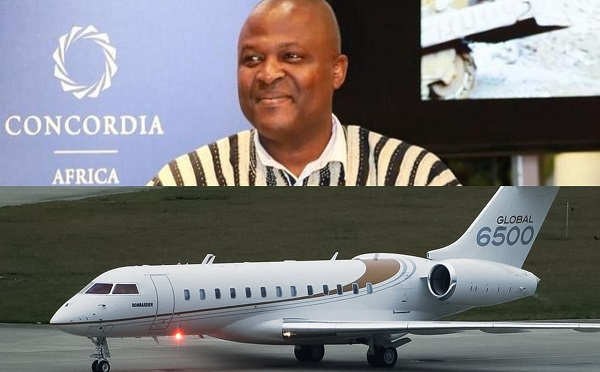
When Ibrahim Mahama’s newly acquired Bombardier Global 6500 touched down at Accra International Airport, it was not merely the arrival of another luxury asset for Ghana’s wealthy elite.
The founder of Engineers & Planners immediately sought to redefine the jet’s purpose, announcing that the aircraft and its predecessor would be placed at the service of the nation as an emergency air ambulance.
Standing on the tarmac, Mahama framed the move as a civic intervention. “My old plane is now an air ambulance. It is an emergency aircraft for every Ghanaian, not just for myself.”
The declaration is classic Mahama: a blend of personal modesty and grand gesture, underscoring his long-standing role as a private financier of last resort for a public health system struggling to meet demand.
For the uninitiated, an air ambulance is far more than a chartered flight. It is a mobile intensive care unit, equipped with ventilators, cardiac monitors, and emergency medication, staffed by medical personnel capable of stabilizing a patient en route to advanced facilities.
In a country where tertiary care is often concentrated in Accra and Kumasi, and where international medical evacuations are frequently necessary, such capability can mean the difference between life and death.
Mahama is no novice to this terrain. His quiet philanthropy has long targeted the gaps left by the state. In late 2024, he wired $100,000 for a ten-year-old girl with stage 4 leukaemia being treated in South Africa, and $25,000 for a 13-year-old’s kidney transplant.
He has funded eye surgery in Dubai for a prominent journalist. Through the Joyce Tamakloe Cancer Foundation, established in memory of his late mother, he has donated mammogram machines to under-resourced health centres.
Yet the air ambulance announcement raises a question that extends beyond Mahama’s generosity: Why is such capacity not a given? The initiative, while life-saving, shines a light on the chronic underinvestment in emergency medical infrastructure. In many jurisdictions, air ambulance services are integrated into the public health system or provided by state-backed emergency services. In Ghana, they remain the preserve of the wealthy or, in this case, the benevolence of one man.
Mahama’s gesture will undoubtedly save lives. It also serves as a reminder that in the absence of robust state institutions, citizens are left to depend on the conscience of the connected.
For now, Ghanaians in urgent need have a new option. But the sustainability of a system reliant on the goodwill of a single businessman remains an open question one that Ghana’s policymakers would do well to answer.