

By Leo Nelson Ayivor
In the muddy waters of Ghana’s once‑pristine rivers lies a silent tragedy—one that does not make headlines. It is not just about polluted streams, dying forests, or lost farmland. It is about unborn children whose first contact with the world is already tainted by poison.
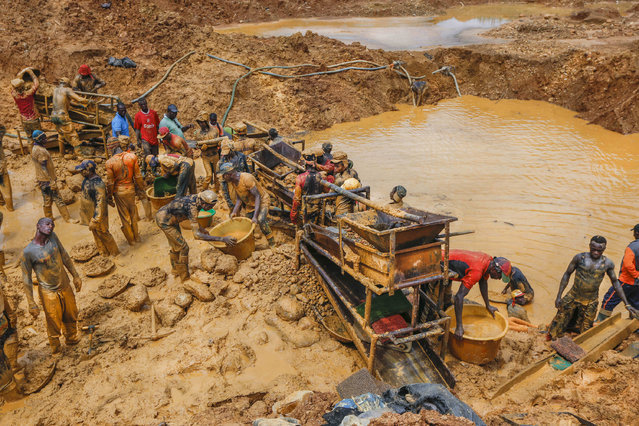
Illegal small‑scale mining, locally known as galamsey, has long been framed as an environmental or economic crisis. Yet emerging medical evidence reveals a deeper and more disturbing reality: the effects of this destructive practice may begin before a child is even born.
Across Ghana’s mining regions from the Western and Ashanti Regions to parts of the Eastern and Central Regions rivers that once sustained communities have been turned into chemical reservoirs. Mercury, arsenic, lead and cyanide used in gold extraction seep into soil and water and eventually enter the human body through drinking water, food and air.
For pregnant women living in these communities, exposure to these toxins carries devastating consequences. Medical researchers have discovered that heavy metals from mining pollution easily cross the placenta the organ responsible for delivering nutrients and oxygen to unborn babies . The toxins also enter breast milk, affecting children during their most critical developmental stages .
Dr Philip Ohemeng Anokye, Clinical Coordinator at the Chiraa Government Hospital in the Sunyani West Municipality, warned that the nation will experience more babies with body deformities and abnormalities if illegal mining activities are not brought under control.
“Whenever a pregnant woman consumes mercury‑contaminated food or water, the chemical enters into her bloodstream and subsequently finds its way into the placenta and causes irreparable damage,” he explained. “Mercury damages the baby’s brain system and thinking faculty”
The Paediatric Society of Ghana (PSG) has issued an urgent warning that galamsey poses a severe threat to children’s health and brain development, with irreversible consequences for Ghana’s future. In an open letter to the President signed jointly by Dr Hilda Mantebea Boye, President, and Dr Gabrielle Obeng‑Koranteng, General Secretary, the Society called on government leaders to treat the situation as a national emergency requiring immediate action .
Scientific evidence shows that toxic exposure causes permanent brain damage with no safe exposure level, reduced IQ and learning capacity, speech delays and behavioural disorders . The consequences also include anaemia, stunted growth, weakened immune systems, kidney and liver damage, and increased risk of chronic disease later in life.
Even unborn babies are not spared from heavy metal poisoning . Dr Sara Johnson Atunah‑Jay, Co‑Chair of the Society’s Climate Change and Environmental Health Committee, revealed the extent of the crisis: “We have children who are born with congenital malformations. Doctors are being forced to provide medical abortions because of severe deformities. This is an existential crisis destroying life in perpetuity.”
Prof. Paul Osei Sampene, Professor of Chemical Pathology at the Kwame Nkrumah University of Science and Technology (KNUST), told a gathering of paediatricians that his research into maternal autopsies in 2024 had revealed troubling patterns of congenital malformations linked to environmental exposure
His investigations began after a woman died in a ward and was buried without the removal of her unborn child—a violation of traditional practice. “Traditionally, the mother cannot be buried with the baby in the uterus. When I removed the baby, I saw very interesting details. As a doctor, I said, let’s try to understand this,” he explained.
The findings pointed to environmental stressors and pollution as contributing factors to rising congenital abnormalities. Prof Sampene continued, “Later, I realised there should be something wrong somewhere. I started looking into the literature and saw that even in Congo, similar things were happening. That is what brought me to this fact” .
The Paediatric Society estimates that illegal small‑scale gold mining has left 65 per cent of Ghana’s water bodies polluted by heavy metals. Mercury is particularly dangerous because it attacks the brain and nervous system, while arsenic and lead are associated with cancers, organ damage, and impaired intellectual development.
The World Health Organization estimates that lead exposure alone costs low‑ and middle‑income countries hundreds of billions of dollars annually in lost economic productivity. Ghana faces mounting healthcare costs for dialysis, cancer treatment and disability support, placing additional strain on the health system and national finances.
Behind the scientific data are stories of families grappling with unimaginable grief. Midwives in mining areas have spoken of babies born with deformities and of mothers who lose pregnancies without understanding why.
Clinics in these communities increasingly report unusual health patterns chronic illnesses in children, unexplained birth defects, and rising kidney disease linked to environmental toxins.
Yet for many families, the link between these tragedies and the polluted environment around them is not immediately obvious. Galamsey’s effects are often invisible, slow and cumulative. A mother may drink contaminated water throughout her pregnancy without realising the risk. Months later, the consequences emerge in the delivery room.
The tragedy is not confined to isolated communities. Pollution from illegal mining has spread across multiple regions, contaminating soil, rivers, crops and fish consumed by millions of Ghanaians .
The Paediatric Society warned that the damage extends far beyond individual health: children exposed to mining toxins experience poor academic performance and higher dropout rates, leading to reduced adult productivity and earnings.
“Galamsey creates a destructive cycle,” the Society stated. “It damages the environment, undermines health and productivity, and weakens Ghana’s capacity to manage resources responsibly.”
Ironically, many of the people most exposed to the dangers of galamsey are also those who depend on it for survival. In rural communities where agriculture has declined and employment opportunities are scarce, illegal mining offers quick income. Entire families move closer to mining camps, unknowingly placing themselves in the path of toxic exposure.
Women cook and sell food near mining sites. Children play beside contaminated streams. Young men handle mercury with bare hands while processing gold. The same activity that puts food on the table is also poisoning the environment that sustains life.
The human cost of galamsey forces Ghana to confront a painful moral question: How much gold is worth the life of an unborn child?
The environmental devastation is visible rivers turned brown, forests reduced to craters. But the invisible damage unfolding inside the womb may be far more devastating. A poisoned river can be restored. A destroyed forest can regrow. But a child born with irreversible neurological damage or a mother who loses a pregnancy cannot be restored by environmental rehabilitation.
The Paediatric Society of Ghana has urged the government to declare galamsey a child health emergency, protect and monitor all water sources serving pregnant women, children and schools, and conduct nationwide screening for heavy metals in high‑risk districts . It also called for the establishment of long‑term child development monitoring programmes and the inclusion of child health impact assessments in all mining and environmental policies.
The fight against galamsey is often framed as an environmental battle. In reality, it is a public health emergency. Stopping illegal mining is not just about saving rivers like the Pra, Ankobra or Offin. It is about protecting the most vulnerable members of society those who have no voice yet, those whose lives begin long before they are seen.
Every contaminated river is a threat not only to ecosystems but to the next generation of Ghanaians. And every day the crisis continues, more children may begin life already carrying the burden of a poisoned environment.
As Prof Sampene warned: “We are seeing children malformed, mothers suffering, and doctors forced into difficult decisions. This is not random; it is pollution, it is stress, it is wrong”
The tragedy of galamsey is not only in the rivers it destroys, but in the lives it alters before they even begin.